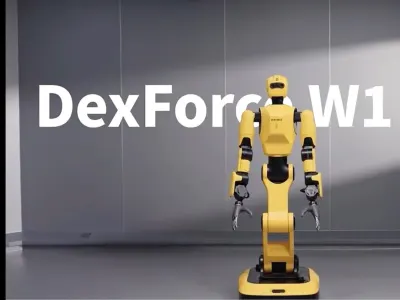
Dex Force
DexForce (深圳市跨维智能科技有限公司) is a pioneer in 3D spatial vision, Sim2Real digital twin simulation, and dual-arm mobile manipulation humanoids. Founded by IEEE Fellow Prof. Kui Jia, DexForce engineered the W1 Pro, a 34-powered-joint humanoid platform combining an omnidirectional wheeled chassis with dual 7-DoF robotic arms capable of lifting 10 kg per arm. Supported by its DexVerse physical simulation engine and DexSense 3D vision foundation model, DexForce deploys systems across automotive factories, electronics assembly, and logistics.
💡Notable Achievement: DexForce developed DexVerse, an end-to-end physics-based Sim2Real simulation engine that generates millions of synthetic data iterations to train vision and dual-arm manipulation models without requiring manual real-world teleoperation.
What Does Dex Force Do?
DexForce (跨维智能) is revolutionizing industrial manipulation through the convergence of 3D spatial vision, physical digital twins, and dexterous humanoid robotics. Led by renowned computer vision authority Prof. Kui Jia, DexForce addresses the core bottleneck of physical AI: the scarcity of high-quality real-world training data. Through its DexVerse simulation platform, DexForce generates infinite photorealistic synthetic data, allowing its W1 Pro dual-arm mobile humanoid to master complex factory assembly tasks entirely in simulation before executing them zero-shot in the physical world. This breakthrough delivers unbeatable deployment speed, high precision, and extreme resilience across electronics and automotive manufacturing plants.
“DexForce powers dual-arm mobile humanoid robots with Sim2Real 3D spatial intelligence, enabling zero-shot factory automation without real-world training bottlenecks.”
DexVerse Sim2Real Engine
Synthesizes physics-grounded 3D training datasets that bridge the simulation-to-reality gap for complex grasping and assembly.
Industrial-Grade Dual 7-DoF Arms
Delivers 10 kg continuous payload per arm with sub-millimeter repeatability for machine tending and heavy component handling.
Full-Shift 8-Hour Endurance
Combines energy-efficient wheeled mobile bases with high-capacity LiFePO4 batteries to support continuous 8-hour factory shifts.
What Can Dex Force Robots Actually Do?
Cross-portfolio operational capabilities, manipulation tasks, and environmental competencies
DexForce develops wheeled mobile humanoids, industrial dual-arm manipulation cells, and enterprise digital twin simulation software.
Heavy-Duty Dual-Arm Handling
Dual 7-DoF arms lifting up to 10 kg per arm for heavy metal casting transfer, battery pack assembly, and pallet loading.
Reflective & Cluttered Bin Picking
Proprietary 3D vision algorithms that accurately reconstruct reflective metallic parts and clear plastics in dense industrial bins.
Sim2Real Zero-Shot Deployment
Training new workpiece handling workflows entirely within DexVerse simulation, cutting deployment ramp-up from weeks to hours.
Dex Force Robots
Showing 1 Humanoid Robots of 1 total model
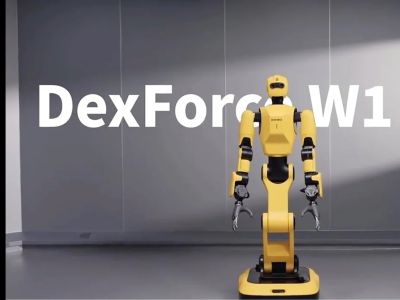
W1 Pro
Manufactured by Dex Force
The W1 Pro is a wheeled humanoid robot from Dex Force, featuring a highly humanoid upper body with advanced arms and hands mounted on a stable mobile chassis for efficient navigation and manipulation. It excels in high-precision tasks with sub-millimeter accuracy, powered by Sim2Real technology and Visual Language Action (VLA) models that enable rapid skill transfer from simulation to real-world applications. Equipped with 34-40 degrees of freedom, binocular vision sensors, and automatic hand-eye calibration, it handles complex operations like parts assembly, factory inspections, and delicate interactions such as operating a coffee machine. Designed for multi-scenario versatility in industrial and service environments, the W1 Pro prioritizes endurance with up to 8 hours of runtime, low power consumption, and modular end effectors for adaptability. Its hybrid architecture trades bipedal complexity for reliability, focusing on sustained commercial utility in unstructured settings.
Dex ForceSoftware & AI Ecosystem
Developer platforms, fleet management portals, autonomy intelligence, and enterprise integrations
Software Feature
What Makes Dex Force Different?
Editorial AnalysisOrigin of Bots objective strategic assessment, engineering moats, and commercial hurdles
Key Strengths & Moats
- ✓Pioneering Sim2Real synthetic data pipeline eliminates manual robot training in factory environments
- ✓High 10 kg per arm payload capacity outperforms most humanoid service robots
- ✓Full 8-hour continuous battery shift provides true drop-in compatibility with factory workflows
- ✓Stable wheeled base avoids bipedal falling risks while maximizing shop-floor payload
Core Strategic Focus
Expanding global partner distribution through its Seattle US entity and deploying multi-robot fleet orchestration in automotive plants.
Road Ahead & Challenges
- •Wheeled locomotion cannot climb standard architectural stairs, limiting multi-floor access without elevators
- •High computational overhead of continuous high-resolution 3D point-cloud processing
- •Navigating crowded factory floors with moving forklifts and overhead cranes
Dex Force vs Key Competitors
Strategic capability matrix across platform categories, commercial readiness, and target markets
| Strategic Dimension | W1 Pro (DexForce) | AgiBot A2-W | Moxi 2.0 (Diligent) | Robot Era Q5 |
|---|---|---|---|---|
| Form Factor & Mobility | Wheeled Dual-Arm Torso | Wheeled Dual-Arm Humanoid | Wheeled Single-Arm Torso | Wheeled Dual-Arm Humanoid |
| Arm Payload (Per Arm) | 10.0 kg | 5.0 kg | 3.0 kg | 5.0 kg |
| Battery Shift Runtime | Up to 8 Hours | 4–6 Hours | 8–10 Hours | 4–5 Hours |
| Primary AI Advantage | DexVerse Sim2Real Synthetic 3D | AgiOS Embody-Brain | Social HRI & Tele-Assist | ERA-42 Multimodal VLA |
| Target Application | Heavy 3C & Automotive Cells | Automotive Assembly | Hospital Logistics | Factory & Service Handling |
Corporate Ecosystem & Ownership Structure
Parent company relationships, historical acquisitions, and global operating facilities
Articles & Industry News
Showing 1 recent article and news updates about Dex Force
Frequently Asked Questions
10 AnswersVerified answers, company specifications, and deployment details about Dex Force
What is the unit purchase price or RaaS lease model for DexForce W1 Pro?
DexForce commercializes W1 Pro starting around $65,000 to $85,000 USD depending on whether dual 5-finger dexterous hands or industrial 2-finger parallel grippers are selected. Turnkey RaaS subscription leasing models start around $2,800 to $3,600 USD per month, which includes DexVerse cloud simulation digital twins, hardware support, and over-the-air perception updates.
What is the commercial timeline and current availability status of W1 Pro?
Founded in 2021, DexForce spent initial years perfecting its 3D vision foundation model and DexVerse engine. In early 2024, the company unveiled the W1 Pro, initiating enterprise pilots across Guangdong electronics factories. Full commercial mass availability commenced in 2025, with hundreds of manipulation cells deployed across China and international pilot sites.
Where are DexForce humanoids deployed in customer manufacturing facilities?
W1 Pro units are deployed in production lines operated by consumer electronics OEMs in Shenzhen and Dongguan, automotive Tier-1 supplier warehouses in Shanghai and Guangzhou, and academic embodied AI testing labs in Hong Kong and Beijing.
What target factory workflows does W1 Pro automate?
W1 Pro automates dual-arm pick-and-place, machine tending (loading and unloading CNC and injection molding machines), bin picking of unsorted reflective metal parts, PCB tray transfer, and precision packaging verification.
What mechanical drivetrain and actuator architecture powers W1 Pro?
W1 Pro incorporates 34 powered joints. Its mobile base uses an omnidirectional Mecanum/steered-wheel drive with brushless DC motors, while its upper body features dual 7-DoF robotic arms with integrated harmonic reducers, absolute encoders, and torque sensors capable of lifting 10 kg per arm (20 kg dual-arm total).
What end-effector dexterity and tactile sensing does W1 Pro feature?
The platform supports either modular industrial parallel-jaw grippers with quick-release interfaces or 5-finger anthropomorphic hands with 12 DoF. The end-effectors feature silicone fingertips with high-frequency tactile arrays for detecting slip and grip force regulation down to 0.1 N.
What is W1 Pro's continuous battery runtime and charging system?
W1 Pro is equipped with a high-capacity 48V, 30Ah (1.44 kWh) industrial lithium iron phosphate (LiFePO4) battery system delivering up to 8 hours of continuous mobile manipulation. It features autonomous inductive docking for automated floor charging between operational shifts.
What is the operational autonomy level versus teleoperation dependency?
W1 Pro operates at Level 4 task autonomy. By leveraging its DexSense 3D model, the robot autonomously detects random parts in cluttered bins, calculates collision-free grasping paths, and places parts with sub-millimeter precision. Teleoperation is primarily used for offline imitation data gathering.
What sensory perception suite and foundation AI models govern W1 Pro?
The perception system is powered by dual high-resolution 3D industrial stereo cameras, eye-in-hand RGB-D sensors, and 360-degree LiDAR for base navigation. The software runs on an onboard edge AI server running DexSense, a proprietary 3D spatial vision model pre-trained on billions of synthetic frames from DexVerse.
What worker safety mechanisms and compliance protect nearby technicians?
W1 Pro conforms to ISO 3691-4 and ISO 10218 collaborative robot safety standards. Dual-safety LiDAR creates dynamic protective slowdown and emergency-stop zones around the wheeled base. Arm joint torque limiters instantly halt movement upon detecting unexpected physical resistance >15 N.
Verified Data & Editorial Assurance
Compiled from verified corporate filings, official Dex Force datasheets, and robotics engineering registries. Information has been verified against official manufacturer documentation. For commercial procurement or proprietary integrations, contact the manufacturer directly.