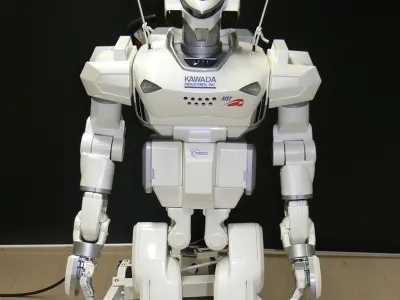
Kawada Robotics
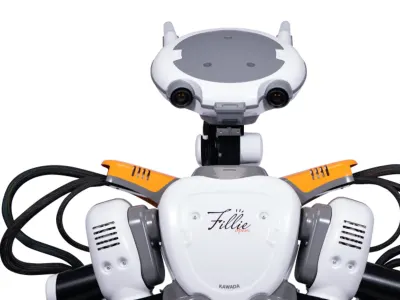
Kawada Robotics develops dual-arm collaborative industrial humanoid robots. Its flagship industrial humanoid, NEXTAGE Fillie (alongside historical research platforms HRP-2, HRP-3, and HRP-4), features a compact dual-arm upper-body humanoid torso with 15 active degrees of freedom, stereoscopic head cameras, and hand cameras. Engineered for electronics manufacturing, pharmaceutical packaging, and laboratory research, NEXTAGE Fillie works alongside human line operators without safety cages.
💡Notable Achievement: Kawada Robotics pioneered industrial humanoid deployment with NEXTAGE, having placed over 1,500 dual-arm humanoid workstations in commercial Japanese factories since 2011, while co-developing the landmark bipedal HRP research series with Japan's AIST.
What Does Kawada Robotics Do?
Kawada Robotics' NEXTAGE Fillie is one of the most commercially successful industrial humanoid robots in history. Designed to share human workspaces without safety cages, NEXTAGE's dual arms and integrated vision system allow manufacturers to automate high-mix, low-volume assembly without changing existing factory layouts.
“Kawada Robotics' NEXTAGE Fillie is the battle-tested dual-arm collaborative humanoid powering electronics and pharmaceutical assembly lines.”
Cageless Collaborative Safety
80W low-power motors meet strict international safety standards for cage-free human coexistence.
Dual-Arm Stereoscopic Hand-Eye Coordination
Head and wrist cameras work together for sub-millimeter part recognition and alignment.
Compact Human-Sized Footprint
Fits directly into existing human worker assembly benches without modifying factory floor space.
What Can Kawada Robotics Robots Actually Do?
Cross-portfolio operational capabilities, manipulation tasks, and environmental competencies
Industrial dual-arm collaborative humanoids and historical bipedal research platforms.
Precision Dual-Arm Assembly
High-mix electronics, cosmetics, and optical component packaging.
Advanced Humanoid Research
Full-body bipedal research platforms developed with AIST.
Kawada Robotics Robots
Showing 3 Humanoid Robots of 3 total models
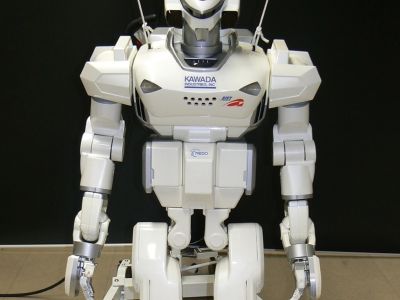
HRP-3
By: Kawada Robotics
Launched: 2006
The HRP-3 humanoid robot, developed by Kawada Industries in collaboration with AIST and Kawasaki Heavy Industries, represents a significant advancement in bipedal robotics for harsh environments. Standing at 160 cm tall and weighing 68 kg, it features 36-42 degrees of freedom, enabling complex manipulations and stable locomotion on slippery or uneven surfaces. Designed for disaster relief, construction, and industrial tasks, HRP-3 boasts dustproof and water-resistant construction, allowing operation under heavy rain or dust. Enhanced leg-arm coordination supports carrying heavy loads, while autonomous/remote hybrid control improves task efficiency. Equipped with stereo cameras, gyroscopes, accelerometers, and force sensors, it navigates challenging terrains, recovers from falls, and performs collaborative work with humans. Its robust hardware and advanced software make it a pioneer in practical humanoid applications beyond laboratories.
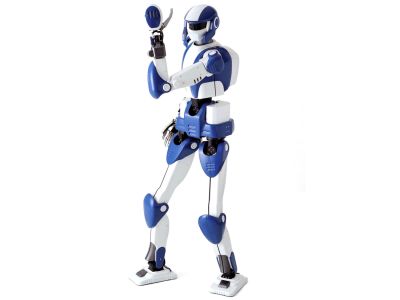
HRP-4
By: Kawada Robotics
Launched: 2010
The HRP-4 is a lightweight, slim humanoid robotics platform developed for advanced research in human-robot collaboration and bipedal locomotion. Standing at 151 cm tall and weighing just 39 kg, it features 34 degrees of freedom, including 7 DOF per arm for precise object manipulation and 6 DOF per leg for stable walking. Equipped with low-power motors under 80W for enhanced safety around humans, it performs natural movements like waist twisting, one-footed balance, and dexterous five-fingered hand grasping. Cameras and microphones enable face recognition, object tracking, and voice command response. Designed as a successor to HRP-2 and HRP-3, HRP-4 supports indoor navigation in human environments, with flexible joints for athletic poses and tasks. Its compact, human-proportioned body facilitates safer interaction, object handling up to 0.5 kg per arm, and motion control software from AIST, accelerating humanoid R&D for practical applications like assistive work.
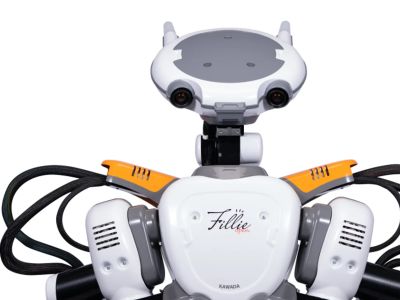
NEXTAGE Fillie
By: Kawada Robotics
Launched: 2022
The NEXTAGE Fillie is a compact collaborative humanoid robot designed for safe human-robot interaction in industrial and research settings. Featuring a humanoid form with dual arms, it excels in assembly tasks, object manipulation, and environment recognition using integrated stereo cameras on the head and optional hand cameras. With 15 degrees of freedom across arms, neck, and waist, it offers precise movements with 1.5kg payload per arm and 0.03mm repeatability. Its smaller, lighter design compared to predecessors enables quicker motions while maintaining curved arm shapes to prevent pinching. Equipped with LED status indicators on "feelers" for visibility, Fillie supports image-based navigation and versatile end-effectors for tasks like reception, inspection, and logistics. Ideal for manufacturing side-by-side with humans, it emphasizes likeable aesthetics, cost-performance, and expandability for R&D or production automation.
Kawada RoboticsSoftware & AI Ecosystem
Developer platforms, fleet management portals, autonomy intelligence, and enterprise integrations
Software Feature
What Makes Kawada Robotics Different?
Editorial AnalysisOrigin of Bots objective strategic assessment, engineering moats, and commercial hurdles
Key Strengths & Moats
- ✓Over 1,500 active commercial installations across premier Japanese electronics and cosmetic factories
- ✓Immense track record in collaborative safety compliance and hand-eye stereo vision
Core Strategic Focus
Expanding open-source research editions (NEXTAGE Fillie Open) and international exports.
Road Ahead & Challenges
- •Upper-body only; stationary pedestal requires mobile AMR base integration for transit
Kawada Robotics vs Key Competitors
Strategic capability matrix across platform categories, commercial readiness, and target markets
| Strategic Dimension | NEXTAGE Fillie (Kawada) | YuMi (ABB) | MICO Plus (Flexiv) | ARMAR-7 (KIT) |
|---|---|---|---|---|
| Degrees of Freedom | 15 DoF (Dual 6-DoF + Head/Waist) | 14 DoF (Dual 7-DoF) | 14 DoF (Dual 7-DoF) | 16+ DoF (Dual 8-DoF) |
| Vision System | Head Stereo + Dual Wrist Cameras | Optional Wrist Camera | 3D Head + Wrist Cameras | Head Stereo Cameras |
| Payload per Arm | 2 kg | 0.5 kg | 5 kg | 3 kg |
Corporate Ecosystem & Ownership Structure
Parent company relationships, historical acquisitions, and global operating facilities
Articles & Industry News
Showing 1 recent article and news updates about Kawada Robotics
Frequently Asked Questions
10 AnswersVerified answers, company specifications, and deployment details about Kawada Robotics
What is the unit purchase price or RaaS lease pricing for NEXTAGE Fillie?
NEXTAGE Fillie base systems retail for approximately $55,000 to $70,000 USD (around 7.5M to 9.5M JPY) including dual arms, vision cameras, and pedestal mount, with leasing options starting at ~$1,800 USD/month.
What is the commercial timeline and current availability status of NEXTAGE Fillie?
Kawada introduced NEXTAGE in 2011, followed by NEXTAGE Fillie in 2021 and 'NEXTAGE Fillie Open' in 2023 for open-source ROS/ROS2 research. Systems are actively manufactured and commercially available worldwide.
Where are NEXTAGE robots actively deployed in real-world facilities?
Over 1,500 units are installed in Japan across Canon optics assembly lines, Shiseido cosmetics packaging cells, automotive wire harness facilities, and pharmaceutical packaging cleanrooms.
What target industrial workflows does NEXTAGE Fillie automate?
Specializes in pick-and-place kitting, PCB inspection, precision screw fastening, cosmetic bottle labeling, and chemical pipetting.
What mechanical drivetrain and actuator architecture powers NEXTAGE Fillie?
Features a 15-DoF upper body (6 DoF per arm, 2 DoF neck, 1 DoF waist) driven by low-power 80W brushless DC motors with precision harmonic drive reducers.
What end-effector dexterity and tactile sensing does NEXTAGE Fillie feature?
Features modular tool flanges supporting pneumatic vacuum suction cups, two-finger electric grippers, and micro force-torque sensors delivering ±0.05 mm repeatability.
What is NEXTAGE Fillie's continuous power and runtime architecture?
Operates continuously on standard single-phase 100–240V AC factory power with ultra-low power consumption (~500W for full dual-arm operation).
What is the operational autonomy level of NEXTAGE Fillie?
Functions autonomously at Level 4 for structured factory tasks, executing automated visual part identification, coordinate calibration, and grasp execution without teleoperation.
What sensory perception suite and software govern NEXTAGE Fillie?
Features twin stereo color cameras in the head for 3D workspace mapping, high-resolution cameras in both wrists for sub-millimeter visual servoing, and QNX/ROS 2 software.
What worker safety mechanisms protect human operators?
Motor outputs are restricted to 80W per joint, meeting ISO 10218-1 collaborative safety standards and eliminating the legal requirement for physical safety cages in factory lines.
Verified Data & Editorial Assurance
Compiled from verified corporate filings, official Kawada Robotics datasheets, and robotics engineering registries. Information has been verified against official manufacturer documentation. For commercial procurement or proprietary integrations, contact the manufacturer directly.