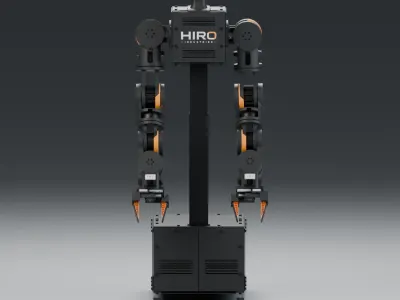
HIRO Industries
HIRO Industries is a robotics startup in Corvallis, Oregon, building practical robots for useful physical work. It was co-founded by CEO Lex Roller, who previously worked on industrial automation at Hampton Lumber and on robot platforms at Nori Robotics, and CTO Ethan Marreel, who comes from Oregon State University's Dynamic Robotics and AI Lab (DRAIL), known for the Cassie and Digit legged robots. Its first product, Origin, is a stationary two-armed robot that sits at a human workstation instead of walking around. Origin stands about 160 cm tall, uses two-finger grippers rather than humanlike hands and sees with three RGB-D cameras on its head and wrists. HIRO is starting with packing, kitting and light assembly through early design partnerships with manufacturers, so customers can automate a station without redesigning the whole facility. Origin is listed as a prototype available by inquiry, with a published price of about $55,000. The company says its long-term aim is to make useful physical labor more abundant, starting with teams around Oregon.
💡Notable Achievement: Co-founder Ethan Marreel comes from Oregon State University's Dynamic Robotics and AI Lab, home of the Cassie biped.
What Does HIRO Industries Do?
HIRO Industries builds Origin, a stationary dual-arm robot that slots into a human workstation for packing, kitting and light assembly.
“A two-armed robot for one workstation.”
Workstation Fit
Fixed base, no facility redesign.
Practical Grippers
Two-finger grippers for goods handling.
Local Focus
Starting with Oregon manufacturers.
What Can HIRO Industries Robots Actually Do?
Cross-portfolio operational capabilities, manipulation tasks, and environmental competencies
Workstation automation.
Packing and Kitting
Dual-arm station work with RGB-D vision.
HIRO Industries Robots
Showing 1 Humanoid Robots of 1 total model
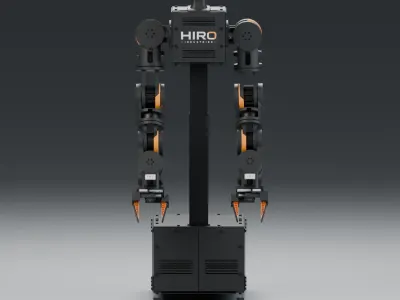
Origin
Manufactured by HIRO Industries
Origin is the first robot from HIRO Industries of Corvallis, Oregon: a stationary, human-scale dual-arm robot designed for human workstations. Two seven-joint arms with compliant parallel grippers, a lifting column and three RGB-D cameras (one in the head, one on each wrist) bring two hands and a view of the work to a shared workspace, giving it 17 degrees of freedom in total. HIRO is developing it around packing, kitting and light assembly, and invites manufacturers to start with a single task through an early design partnership. It is not yet a finished product, and HIRO has not published a price, size, weight or payload.
HIRO Industries Timeline & Milestones
Evolutionary history, landmark prototypes, major acquisitions, and commercial roadmap
Origin workstation robot listed
HIRO Industries presents Origin, a stationary dual-arm robot for packing, kitting and light assembly, as a prototype available by inquiry.
Source: humanoid.guide
HIRO Industries Competitors by Category
Direct industry rivals grouped by specific robotics domain
What Makes HIRO Industries Different?
Editorial AnalysisOrigin of Bots objective strategic assessment, engineering moats, and commercial hurdles
Key Strengths & Moats
- ✓Simple, practical design.
- ✓Founders with industrial and OSU robotics experience.
Core Strategic Focus
Dual-arm workstation robot.
Road Ahead & Challenges
- •Prototype stage.
- •No disclosed funding.
- •Competes with established dual-arm cobots.
HIRO Industries vs Key Competitors
Strategic capability matrix across platform categories, commercial readiness, and target markets
Category / Focus
- Origin
- Stationary dual-arm robot
- Feather
- Wheeled bimanual platform
- RB-Y1
- Wheeled bimanual robot
- ROBO T1
- Low-cost bimanual robot
Primary Use
- Origin
- Packing, kitting and light assembly
- Feather
- Developer platform, food service
- RB-Y1
- Industrial automation, manufacturing
- ROBO T1
- Pick and place, machine tending
Weight
- Origin
- Approx. 60–120 kg including the base
- Feather
- 105 kg fully configured (published)
- RB-Y1
- 131 kg (Config A); 170 kg (Config M)
- ROBO T1
- Approx. 45–60 kg
Release Year
- Origin
- 2026
- Feather
- 2026
- RB-Y1
- 2025
- ROBO T1
- 2026
| Strategic Dimension | Origin | Feather | RB-Y1 | ROBO T1 |
|---|---|---|---|---|
| Category / Focus | Stationary dual-arm robot | Wheeled bimanual platform | Wheeled bimanual robot | Low-cost bimanual robot |
| Primary Use | Packing, kitting and light assembly | Developer platform, food service | Industrial automation, manufacturing | Pick and place, machine tending |
| Weight | Approx. 60–120 kg including the base | 105 kg fully configured (published) | 131 kg (Config A); 170 kg (Config M) | Approx. 45–60 kg |
| Release Year | 2026 | 2026 | 2025 | 2026 |
Corporate Ecosystem & Ownership Structure
Parent company relationships, historical acquisitions, and global operating facilities
Global Facilities & Operating Hubs
HIRO Industries Headquarters
HQCorvallis, Oregon, United States
Frequently Asked Questions
8 AnswersVerified answers, company specifications, and deployment details about HIRO Industries
What is HIRO Industries?
HIRO Industries is a Corvallis, Oregon, robotics startup building practical robots for physical work. Its first product is Origin, a stationary two-armed robot for human workstations.
What is the HIRO Origin robot?
Origin is a dual-arm robot on a fixed base that works at an ordinary workstation. It is about 160 cm tall, uses two-finger grippers and sees with three RGB-D cameras on its head and wrists.
What tasks is Origin designed for?
HIRO is starting with packing, kitting and light assembly, and more generally repetitive goods handling in light industrial and warehouse settings, through early design partnerships.
Who founded HIRO Industries?
CEO Lex Roller previously worked on industrial automation at Hampton Lumber and robot platforms at Nori Robotics. CTO Ethan Marreel comes from Oregon State University's Dynamic Robotics and AI Lab.
How much does Origin cost?
Origin has been listed with a price of about $55,000 and is offered as a prototype through an inquiry process rather than as an off-the-shelf product.
Why does Origin not walk?
HIRO chose a fixed base so the robot can slot into existing workstations. That avoids the cost and complexity of legs and lets customers automate one station without redesigning their facility.
What grippers does Origin use?
Origin uses compliant two-finger parallel grippers instead of humanlike hands, prioritising reliable picking and placing of goods over human-style dexterity.
Who are HIRO Industries' customers?
HIRO is working first with manufacturers and teams around Oregon, especially small and mid-sized businesses looking for a practical entry point into workstation automation.
Verified Data & Editorial Assurance
Compiled from verified corporate filings, official HIRO Industries datasheets, and robotics engineering registries. Data is monitored and audited on an ongoing basis for accuracy. For commercial procurement or proprietary integrations, contact the manufacturer directly.