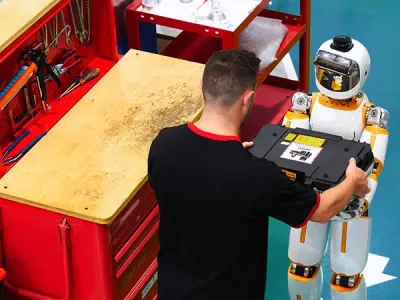
Italian Institute of Technology (IIT)
The Istituto Italiano di Tecnologia (IIT) is Italy's national research institute for science and technology, established in 2003 and headquartered in Genoa, with a network of research centres across Italy. Its scientific director is Giorgio Metta. IIT is one of Europe's leading centres for humanoid robotics. It coordinated the development of iCub, a child-sized open-source humanoid robot launched through the European RobotCub project and used by dozens of research labs worldwide to study learning, perception and cognition. IIT's Artificial and Mechanical Intelligence lab, led by Daniele Pucci, developed iRonCub, a jet-powered flying humanoid based on iCub. On 18 June 2025 iRonCub3 made its first flight, lifting about 50 cm off the ground using four jet engines. IIT research has produced spin-off companies, including Generative Bionics, founded in 2024 to commercialise humanoid robots. IIT's robots are research platforms rather than commercial products.
💡Notable Achievement: IIT's jet-powered iRonCub3 humanoid made its first flight on 18 June 2025, lifting about 50 cm off the ground with four jet engines.
What Does Italian Institute of Technology (IIT) Do?
The Istituto Italiano di Tecnologia is Italy's national technology research institute in Genoa and a leading humanoid research centre, home of the iCub and the jet-powered iRonCub.
“Europe's leading humanoid research institute and the origin of iCub.”
iCub
A child-sized open-source humanoid coordinated by IIT and used by labs worldwide.
iRonCub
A flying humanoid that made its first flight on 18 June 2025.
Spin-offs
Research feeds companies such as Generative Bionics, founded in 2024.
What Can Italian Institute of Technology (IIT) Robots Actually Do?
Cross-portfolio operational capabilities, manipulation tasks, and environmental competencies
Humanoid research platforms for learning, control and flight.
Cognitive Research
iCub is used to study learning, perception and cognition.
Jet-Powered Flight
iRonCub3 lifts off using four jet engines.
Italian Institute of Technology (IIT) Robots, Robot Hands & Robot Dogs
Showing 2 Humanoid Robots of 4 total models
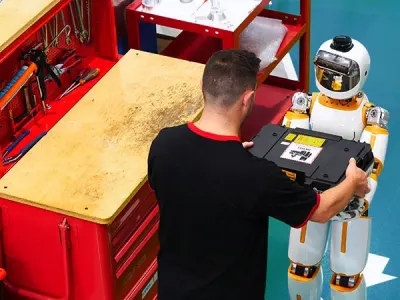
ErgoCub Humanoid Robot
By: Italian Institute of Technology (IIT)
Launched: 2023
ergoCub is a 1.5 m, 55.7 kg humanoid robot developed by the Italian Institute of Technology (IIT) with INAIL, Italy's workers' compensation authority, as an evolution of the iCub robot. It was designed for physical collaboration with people: its geometry minimizes the joint effort of shared lifting tasks, so it can help reduce the musculoskeletal injuries that heavy lifting causes. It carries up to about 10 kg, walks at roughly human walking speed, works with the iFeel wearable sensors that track a worker's motion, and was presented on September 21, 2023 at IIT's 20th-anniversary celebrations in Genoa.
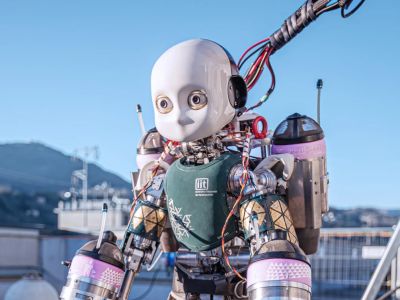
iRonCub
By: Italian Institute of Technology (IIT)
Launched: 2025
iRonCub is a groundbreaking jet-powered flying humanoid robot developed by IIT's AMI lab, transforming the iCub3 platform into the world's first humanoid capable of controlled flight. Equipped with four micro-jet engines—two on the arms and two on a backpack jetpack—it generates over 1000 Newtons of thrust to achieve stable hover up to 50 cm, managing extreme heat over 800°C via a titanium spine and heat-resistant covers. Advanced AI control systems, including neural networks and UKF pose estimation, enable human-like balance amid turbulent airflows, shifting center of mass, and limb movements. Onboard sensors like IMU and depth cameras support real-time flight dynamics, multibody aerodynamics, and non-stationary maneuvers. Designed for research in aerial humanoid robotics, it pioneers applications in search-and-rescue, hazardous inspections, and disaster response, blending bipedal morphology with unprecedented aerial agility.
Italian Institute of Technology (IIT)Timeline & Milestones
Evolutionary history, landmark prototypes, major acquisitions, and commercial roadmap
IIT established
The Istituto Italiano di Tecnologia is established as a private foundation to strengthen Italy's technology research.
Source: iit.it
Headquarters established in Genoa
IIT sets up its headquarters and main laboratories in Genoa.
Source: iit.it
iCub humanoid project launched
IIT launches the iCub humanoid robot through the European RobotCub project as an open research platform.
Source: iit.it
Giorgio Metta becomes scientific director
Giorgio Metta, a co-creator of iCub, is appointed scientific director of IIT.
Source: iit.it
Generative Bionics spin-off founded
IIT researchers found Generative Bionics to commercialise humanoid robots based on IIT research.
Source: opentalk.iit.it
iRonCub3 flying humanoid takes off
IIT's jet-powered iRonCub3 humanoid makes its first flight, lifting about 50 cm off the ground.
Source: opentalk.iit.it
Italian Institute of Technology (IIT) Competitors by Category
Direct industry rivals grouped by specific robotics domain
Boston Dynamics
→Model: Atlas
Focus: Dynamic acrobatic terrestrial humanoid
Gravity Industries
Industry PeerModel: Daedalus Jet Suit
Focus: Human-worn jet turbine flight suits
What Makes Italian Institute of Technology (IIT) Different?
Editorial AnalysisOrigin of Bots objective strategic assessment, engineering moats, and commercial hurdles
Key Strengths & Moats
- ✓Decades of humanoid research and the open-source iCub.
- ✓Successful spin-off pipeline into companies.
Core Strategic Focus
Advancing humanoid and flying-humanoid research.
Road Ahead & Challenges
- •Research platforms are not commercial products.
- •Flight remains at an early experimental stage.
Italian Institute of Technology (IIT) vs Key Competitors
Strategic capability matrix across platform categories, commercial readiness, and target markets
| Strategic Dimension | iRonCub 3 (IIT) | Atlas (Boston Dynamics) | iCub 3 (IIT) | Ameca (Engineered Arts) |
|---|---|---|---|---|
| Propulsion | 4 Jet Turbines (1000 N Thrust) | All-Electric Joint Actuators | All-Electric Joint Actuators | Pneumatic & Electric |
| Flight Capability | Yes (Hover and Liftoff) | No (Terrestrial Only) | No | No |
| Degrees of Freedom | 53 DoF | 28 DoF | 53 DoF | 52 DoF |
Corporate Ecosystem & Ownership Structure
Parent company relationships, historical acquisitions, and global operating facilities
Robot Comparisons
Showing 1 in-depth comparison featuring Italian Institute of Technology (IIT) — Explore all comparisons →
Frequently Asked Questions
8 AnswersVerified answers, company specifications, and deployment details about Italian Institute of Technology (IIT)
What is the Italian Institute of Technology (IIT)?
IIT is Italy's national research institute for science and technology, established in 2003 and headquartered in Genoa. It is a leading centre for humanoid robotics research.
What is the iCub robot?
iCub is a child-sized, open-source humanoid robot developed under IIT's coordination through the European RobotCub project. Dozens of labs worldwide use it to study learning, perception and cognition.
What is iRonCub?
iRonCub is IIT's jet-powered flying humanoid, based on iCub. On 18 June 2025 iRonCub3 made its first flight, lifting about 50 cm using four jet engines.
Who leads IIT?
IIT's scientific director is Giorgio Metta, appointed in 2019. The iRonCub project is led by Daniele Pucci of the Artificial and Mechanical Intelligence lab.
Can you buy an iCub robot?
iCub is a research platform rather than a consumer product. Research institutions can obtain iCub robots through IIT, and its designs and software are open source.
Has IIT created robotics companies?
Yes. IIT research has produced several spin-offs, including Generative Bionics, founded in 2024 by IIT researchers to build commercial humanoid robots.
Why build a flying humanoid robot?
IIT designed iRonCub to explore robots that can fly and walk, for tasks such as reaching disaster areas quickly and then working on the ground like a humanoid.
Where is IIT based?
IIT is headquartered in Genoa, Italy, with a network of research centres across Italy and joint labs abroad, including the centre where its humanoid robots are developed.
Verified Data & Editorial Assurance
Compiled from verified corporate filings, official Italian Institute of Technology (IIT) datasheets, and robotics engineering registries. Information has been verified against official manufacturer documentation. For commercial procurement or proprietary integrations, contact the manufacturer directly.