Lightberry
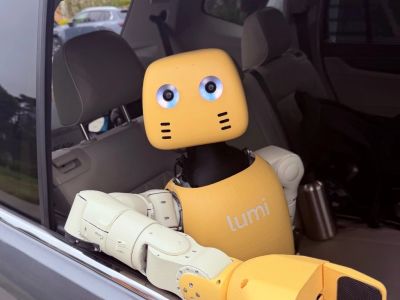
Lightberry is a San Francisco robotics-software company, part of Y Combinator's Fall 2025 batch, that builds what it calls the social brain for robots. Its software lets robots listen, speak, see and move around people, so they can hold conversations, show personality and be programmed in natural language instead of code. Founded in 2025 by Ali Attar, who previously founded the SigmaOS browser, and Stephan Koenigstorfer, who has a physics background from CERN and worked at robotics startups, it partners with manufacturers such as Unitree and supports humanoids from Unitree, Fourier, Booster and High Torque. It has also rented robots for people-facing roles at conferences, sales events and receptions. In August 2026 Lightberry introduced Lumi, a yellow 1.3-metre humanoid built on Unitree's G1 with its own cameras, microphones, hands, Nvidia Jetson Thor compute and Lightberry OS. The first 100 Founder Edition units cost $39,990, with hardware pricing expected to fall to about $20,000 later.
💡Notable Achievement: A Y Combinator Fall 2025 company whose Lumi humanoid is built on Unitree's G1, with 100 Founder Edition units at $39,990.
What Does Lightberry Do?
Lightberry makes the social brain for robots, software that lets humanoids talk, show personality and act, and sells Lumi, a G1-based interactive humanoid.
“Robots with personality.”
Social Brain
Conversation, expression and autonomy.
No-Code
Program behaviour in natural language.
Lumi
Interactive humanoid on Unitree G1.
What Can Lightberry Robots Actually Do?
Cross-portfolio operational capabilities, manipulation tasks, and environmental competencies
Interactive humanoids and robot software.
Social Interaction
Conversation, storytelling, photos and guiding people.
Lightberry Robots
Showing 1 Humanoid Robots of 1 total model
Lumi
Manufactured by Lightberry
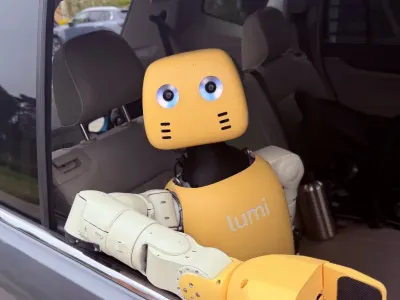
Lumi is a yellow, rounded interactive humanoid from San Francisco software company Lightberry, introduced on August 27, 2026. It combines Lightberry's custom sensors and software with a Unitree G1 base to create a robot that entertains crowds, holds long conversations, tells stories, takes photos, looks up information and guides people. It has 34 degrees of freedom, stands 1.3 m tall, runs Lightberry OS on an NVIDIA Jetson Thor, and the first 100 Founder Edition units ship in 2026 at $39,990.
Lightberry Software & AI Ecosystem
Developer platforms, fleet management portals, autonomy intelligence, and enterprise integrations
Lightberry OS
Social brain
Conversational, expressive autonomy for humanoids, with an SDK for developers.
Lightberry Timeline & Milestones
Evolutionary history, landmark prototypes, major acquisitions, and commercial roadmap
Lightberry founded
Ali Attar and Stephan Koenigstorfer found Lightberry to build conversational social software for robots, joining Y Combinator's Fall 2025 batch.
Source: ycombinator.com
Lumi humanoid introduced
Lightberry introduces Lumi, an interactive humanoid built on Unitree's G1 platform, with 100 Founder Edition units priced at $39,990.
Source: theaiinsider.tech
Lightberry Competitors by Category
Direct industry rivals grouped by specific robotics domain
What Makes Lightberry Different?
Editorial AnalysisOrigin of Bots objective strategic assessment, engineering moats, and commercial hurdles
Key Strengths & Moats
- ✓Software runs on several humanoid brands.
- ✓Clear people-facing use case.
- ✓Y Combinator backing.
Core Strategic Focus
Social software for people-facing humanoids.
Road Ahead & Challenges
- •Depends on Unitree hardware.
- •Small early-stage team.
- •Entertainment demand is unproven at scale.
Lightberry vs Key Competitors
Strategic capability matrix across platform categories, commercial readiness, and target markets
Category / Focus
- Lumi
- Social humanoid on G1
- Unitree G1
- Base humanoid platform
- Ameca
- Expressive social humanoid
- Pepper
- Social humanoid
Primary Use
- Lumi
- Entertaining crowds, long conversations
- Unitree G1
- High-speed bipedal running, 360° ground recovery
- Ameca
- Human-robot interaction studies
- Pepper
- Customer service, reception
Weight
- Lumi
- Approx. 40 kg (published)
- Unitree G1
- 35 kg
- Ameca
- 62 kg (137.7 lbs)
- Pepper
- 28 kg
Release Year
- Lumi
- 2026
- Unitree G1
- 2024
- Ameca
- 2021
- Pepper
- 2014
| Strategic Dimension | Lumi | Unitree G1 | Ameca | Pepper |
|---|---|---|---|---|
| Category / Focus | Social humanoid on G1 | Base humanoid platform | Expressive social humanoid | Social humanoid |
| Primary Use | Entertaining crowds, long conversations | High-speed bipedal running, 360° ground recovery | Human-robot interaction studies | Customer service, reception |
| Weight | Approx. 40 kg (published) | 35 kg | 62 kg (137.7 lbs) | 28 kg |
| Release Year | 2026 | 2024 | 2021 | 2014 |
Corporate Ecosystem & Ownership Structure
Parent company relationships, historical acquisitions, and global operating facilities
Y Combinator
Fall 2025 batch.
Ownership & Acquisition History
Fall 2025 batch.
Global Facilities & Operating Hubs
Lightberry Headquarters
HQSan Francisco, California, United States
Frequently Asked Questions
8 AnswersVerified answers, company specifications, and deployment details about Lightberry
What is Lightberry?
Lightberry is a San Francisco company in Y Combinator's Fall 2025 batch that builds conversational, expressive software for robots, which it calls the social brain for robots.
What is Lumi?
Lumi is Lightberry's yellow interactive humanoid, introduced in August 2026. It is built on Unitree's G1 and adds Lightberry's cameras, microphones, speakers, compute, hands and operating system.
How much does Lumi cost?
The first 100 Founder Edition units cost $39,990, with a refundable $200 deposit, and were due to ship in 2026. Lightberry expects later hardware pricing to fall to around $20,000.
What are Lumi's specifications?
Lumi stands 1.3 metres tall, weighs about 40 kg and has 34 degrees of freedom, a 421 Wh battery, Nvidia Jetson Thor compute, dual 1920 x 1200 cameras and a beamforming microphone array.
Who founded Lightberry?
Ali Attar previously founded the SigmaOS browser, also a Y Combinator company. Stephan Koenigstorfer holds a PhD and MBA, worked at CERN and held robotics and software roles at startups.
Which robots does Lightberry software run on?
Lightberry has supported humanoids including the Unitree G1, Fourier GR-2 and N1, Booster T1 and K1 and High Torque Mini-Pi, and partners with manufacturers to integrate its software.
What can Lumi do?
Lightberry says Lumi can entertain a crowd, hold long conversations, tell stories, take photos, look up information and guide people, which suits events, hospitality, retail and homes.
Do you need to code to program a Lightberry robot?
No. Lightberry robots can be given a personality and new behaviours in natural language, while developers who want more control can use its SDK.
Verified Data & Editorial Assurance
Compiled from verified corporate filings, official Lightberry datasheets, and robotics engineering registries. Data is monitored and audited on an ongoing basis for accuracy. For commercial procurement or proprietary integrations, contact the manufacturer directly.