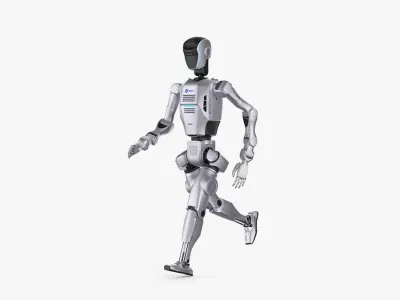
The SA01 by EngineAI Robotics serves as a development platform for advancing embodied intelligence in university labs and AI research. Positioned for educational demonstrations and bipedal gait research, it offers ROS 2 compatibility and SDK/API support at a price of $5,295-$5,400 USD. Its lighter 40 kg frame and 138 cm height distinguish it for reinforcement learning training over industrial applications.
The Atom by Dobot Corp Ltd targets precision tasks in biomedical research and assembly lines, priced at $27,500-$30,000 USD. Drawing from Dobot's experience in collaborative robots, it emphasizes 28 degrees of freedom and ±0.05mm precision for delicate handling. Its taller 153 cm stature and straight-knee gait, reducing energy use by 42%, set it apart for real-world deployment in unstructured environments.
Detailed Analysis
Design & Build Quality
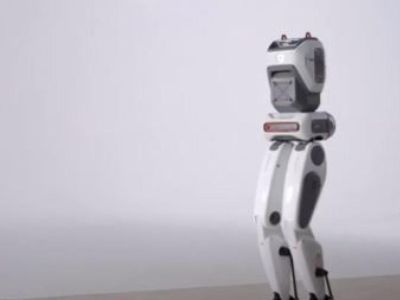
SA01 measures 138 cm in height, 50 cm width, and 30 cm depth at 40 kg, enabling easier handling in lab settings. Atom stands at 153 cm height with 50 cm shoulder width and 30 cm depth but weighs 62 kg, supporting heavier-duty tasks with 28 degrees of freedom and ±0.05mm precision. Both share similar depth profiles, though Atom's straight-knee design enhances stability on varied terrains.
Mobility & Navigation
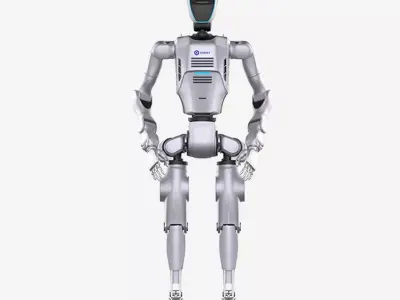
SA01 achieves 4.5 km/h speed using SLAM, optional LiDAR, and IMU for navigation in controlled research environments. Atom reaches 5 km/h with identical SLAM, optional LiDAR, and IMU, plus straight-knee gait that cuts energy consumption by 42% for better efficiency across difficult terrains. Both incorporate fall recovery for bipedal stability.
Sensors & Perception
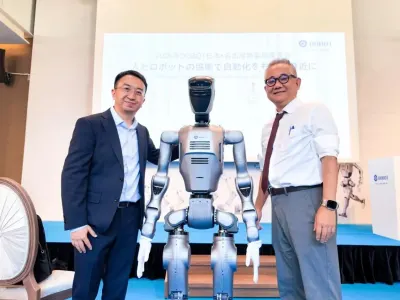
SA01 features 6 HD RGB cameras, Intel RealSense D435 stereo depth camera, 360-degree LiDAR, IMU, gyroscope, and force sensors. Atom includes Intel RealSense D455 depth camera, 60FPS Full HD RGB vision, multi-array microphones, optional LiDAR, ultrasonic radar, force sensors, IMU, and gyroscope. Atom's microphone system adds audio perception absent in SA01.
AI Capabilities
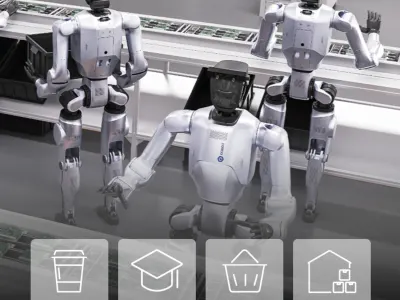
Both robots support AI automation via ROS 2 on Linux with SDK/API, alongside remote control and manual override. Atom leverages ROM-1 model with 1,500 TOPS computing for autonomous adaptation in unstructured settings. SA01 focuses on end-to-end neural networks for real-time gait adjustments in research contexts.
Battery & Power Efficiency
SA01 and Atom both claim 5-year battery longevity, supporting extended research and operational sessions. Atom's straight-knee walking reduces energy use by 42% compared to bent-knee designs, enhancing efficiency. Replaceable batteries in Atom further aid sustained deployment.
Use-Case Suitability
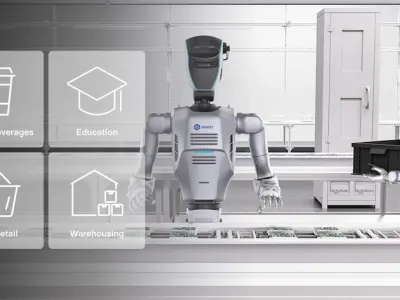
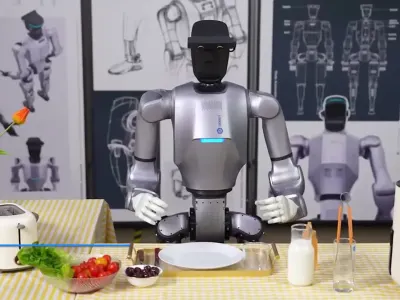
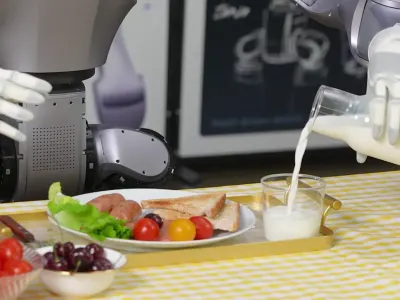
SA01 suits university labs, AI research, educational demos, bipedal gait studies, and reinforcement learning. Atom excels in micro-component assembly, meal prep, lab handling, biomedical research, microsurgery aid, and automotive support. SA01 prioritizes development, while Atom targets precision industrial applications.
Pricing & Value
SA01 ranges from $5,295-$5,400 USD, making it accessible for research institutions. Atom costs $27,500-$30,000 USD, reflecting advanced precision and computing for commercial use. Price difference aligns with SA01's lab focus versus Atom's production capabilities.
Safety Features
Both include emergency stop, obstacle detection, and fall recovery mechanisms. Shared IMU and force sensors contribute to balanced operation. No additional unique safety elements specified for either model.
Analysis Score Summary
Total Score
7
SA01
VS
Based on Detailed Analysis
Total Score
9
Atom
📊 Win: 2 points | Trade-off: 1 point each
Scores are summed across every insight: a clear winner earns 2 points, while balanced trade-offs give each robot 1 point. The total reflects how often each robot outperforms the other (or shares the spotlight) throughout the detailed analysis sections.
Capabilities & Operational Tasks
Head-to-head comparison of what SA01 and Atom can do, their applications, and capabilities.
What Can SA01 & Atom Do?
15Core operational tasks, activities, and physical manipulation duties evaluated side-by-side.
| Task & Description | Model ASA0111 supported | Model BAtom11 supported |
|---|---|---|
| Assembly | High | — |
| Autonomous task execution | High | High |
| Carrying and transport | High | High |
| Collaborative work | High | High |
| Human interaction | — | High |
| Loading and unloading | High | — |
| Machine operation | — | High |
| Machine tending | High | — |
| Material handling | High | — |
| Move objects | High | High |
| Navigation | High | High |
| Pick and place | High | High |
| Repetitive physical tasks | High | High |
| Sorting | — | High |
| Tool use | — | High |
Technical Specifications
Head-to-head performance data and metrics
| Specification | Model ASA01 | Model BAtom |
|---|---|---|
Functional Utility & Use Cases4 Comparative Metrics | ||
Control Method | AI automation, remote control, manual override | AI automation, remote control, manual override |
Use Cases | Biped locomotion research, reinforcement learning, humanoid control testing, university education, AI embodiment demos | Micro-component electronics assembly, biomedical lab handling, delicate specimen kitting, collaborative workstation support |
Multi Robot Coord | Limited multi-robot coordination via external software stack | (Inferred · Low confidence · General research-robot baseline) | Yes, cross-scenario and multi-robot collaboration support |
Pet Friendly | Yes | Not Applicable |
Manipulation & Load Capacity4 Comparative Metrics | ||
Carrying Capacity | 10 kg per arm | (Inferred · Low confidence · General humanoid robotics industry baseline) | 3.5 kg per arm |
Deadlift Capacity | 20 kg maximum | (Inferred · Low confidence · General humanoid robotics industry baseline) | 7 kg total |
Payload Type | Light tools, sensors, educational modules | 3.5 kg per arm rated payload (±0.05 mm repeatability) |
Modular Attachments | Yes; arms, sensors, grippers | Yes; arms, sensors, grippers |
Kinematic Architecture & Dexterity4 Comparative Metrics | ||
Degrees of Freedom | 12 total DOF including legs and torso interfaces | (Inferred · High confidence · Based on SA01 public specification) | 41 DoF full body (29 DoF Trainer model) |
Material | Aluminum alloy, steel joint modules, polymer covers | (Inferred · Medium confidence · Based on public frame/material descriptions) | Aluminum frame, composite materials, soft materials for safety |
Mobility Type | Bipedal | Legged (Straight-knee bipedal walking) |
Hardware Interface | USB-C, GPIO, CAN bus | USB, RJ45 |
Functional Utility & Use Cases
4 Comparative Metrics
Manipulation & Load Capacity
4 Comparative Metrics
Kinematic Architecture & Dexterity
4 Comparative Metrics
Related Comparisons
Discover similar robot matchups to expand your knowledge and find the perfect solution

Atom vs RAISE A1
Compare Atom and RAISE A1. Detailed analysis of navigation, battery, sensors.
T800 vs Phantom MK1
Compare T800 by EngineAI vs Phantom MK1 by Foundation for humanoid mobility, dexterity, autonomy, payload, and industrial vs defense use cases.
T800 vs 4NE-1 Mini
T800 or 4NE-1 Mini? See which humanoid robot performs better for manufacturing, logistics, and research with comparisons on dexterity, autonomy, and payload.

Optimus vs SE01
Head-to-head: Optimus vs SE01. Explore differences in sensors, battery, navigation, speed, and AI capabilities.
Disclaimer
All content, comparisons, and verdicts on this website are based on our research, testing, and opinion. While we strive for accuracy, we do not guarantee the completeness, reliability, or suitability of any information. Performance, specifications, and results may vary depending on usage and conditions. This website and its authors are not responsible for any decisions, actions, or outcomes based on the information provided. Always verify product details with the manufacturer before making purchase or operational decisions.