Epson
Epson Robots is the robotics division of Seiko Epson, the Japanese company known for watches and printers, whose precision watch-making led it into robots. Epson began robot production in 1980 and released the SSR-H series in May 1983, its first horizontally articulated SCARA precision assembly robot. Today it sells SCARA robots in four lines, the T, G, RS and LS series, plus 6-axis robots, Cartesian robots and linear modules, with PC-based controllers, integrated vision and cleanroom-compliant models. Small G-series SCARA arms are used to assemble Seiko watches. Epson describes itself as the number one SCARA manufacturer worldwide. The G6 series in the catalogue is a SCARA arm from the G range, which comes in many sizes and payloads for assembly and pick-and-place work.
💡Notable Achievement: Epson released its first SCARA robot, the SSR-H series, in May 1983 and calls itself the number one SCARA manufacturer worldwide.
What Does Epson Do?
Epson Robots is the robotics arm of Seiko Epson, best known for SCARA robots that grew out of its precision watch making.
“A leading SCARA robot maker from a watch and printer company.”
SCARA Focus
T, G, RS and LS series cover many sizes and payloads.
Since 1980
Robot production began in 1980, first SCARA in 1983.
Integrated Vision
PC-based controllers with vision.
What Can Epson Robots Actually Do?
Cross-portfolio operational capabilities, manipulation tasks, and environmental competencies
Fast, precise assembly robots.
SCARA Assembly
G-series SCARA arms for assembly and handling.
Epson Robots
Showing 1 of 1 total model
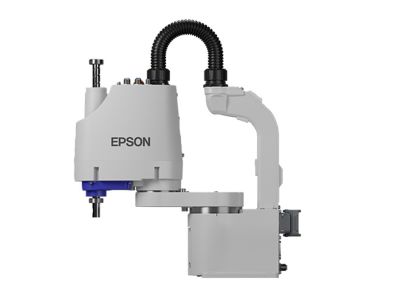
Epson G6 Series
Manufactured by Epson
The Epson G6 Series is a high-speed, high-precision SCARA robot designed for industrial automation. With a compact footprint and advanced arm design, it delivers smooth motion, low vibration, and high rigidity for demanding tasks. The G6 Series supports payloads up to 6 kg and offers arm lengths of 450, 550, and 650 mm, making it ideal for pick-and-place, assembly, dosing, and small-part handling. Its modular mounting options, cleanroom and ESD variants, and robust construction ensure versatility across manufacturing environments.
EpsonTimeline & Milestones
Evolutionary history, landmark prototypes, major acquisitions, and commercial roadmap
Epson begins robot production
Epson starts producing robots, building on its precision watch manufacturing background.
Source: en.wikipedia.org
SSR-H series, Epson's first SCARA robot
Epson releases the SSR-H series, its first horizontally articulated precision assembly robot, in May 1983.
Source: corporate.epson
Epson Competitors by Category
Direct industry rivals grouped by specific robotics domain
Fanuc
→Model: P-50iB
Focus: Industrial robot maker
Yaskawa
→Model: MOTOMAN-GP10
Focus: Industrial robot maker
Mitsubishi Electric Corporation
→Model: MELFA RH-10CRH
Focus: Industrial robot maker
Denso
→Model: COBOTTA PRO/HSR Series
Focus: Robots and QR code inventor
Kawasaki
→Model: Kawasaki BX200L
Focus: Industrial robot maker
What Makes Epson Different?
Editorial AnalysisOrigin of Bots objective strategic assessment, engineering moats, and commercial hurdles
Key Strengths & Moats
- ✓Four decades of SCARA experience.
- ✓Self-described number one SCARA maker worldwide.
Core Strategic Focus
SCARA and 6-axis automation.
Road Ahead & Challenges
- •Strong competition from Japanese and European robot makers.
- •Robotics is one division of a larger company.
Epson vs Key Competitors
Strategic capability matrix across platform categories, commercial readiness, and target markets
| Strategic Dimension | Epson G6 | Fanuc P-50iB | Yaskawa GP10 | Denso COBOTTA PRO |
|---|---|---|---|---|
| Category / Focus | SCARA robot | Industrial robot | Industrial robot | Collaborative robot |
| Est. Price | USD 10,000 - 25,000 | USD100,000 - 150,000 | USD 14,000 - 35,000 | USD 25,000 – 40,000 for the robot arm |
| Weight | 25-35 kg (varies by model) | 356 kg | 59 kg | 28.5-41kg |
| Release Year | 2018 | 2010 | 2025 | 2023 |
Corporate Ecosystem & Ownership Structure
Parent company relationships, historical acquisitions, and global operating facilities
Frequently Asked Questions
8 AnswersVerified answers, company specifications, and deployment details about Epson
What is Epson Robots?
Epson Robots is the robotics division of Seiko Epson. It makes SCARA, 6-axis and Cartesian robots for assembly and handling tasks in factories.
When did Epson start making robots?
Epson began robot production in 1980 and released its first SCARA robot, the SSR-H series, in May 1983, growing out of its precision watch manufacturing.
What is a SCARA robot?
SCARA stands for selective compliance articulated robot arm, a horizontally articulated robot that is fast and precise for assembly and pick-and-place. Epson's SCARA lines are the T, G, RS and LS series.
What is the Epson G6 series?
The G6 series is a SCARA robot from Epson's G-series range, which offers a variety of sizes, arm designs and payloads for assembly and handling jobs on factory lines.
What controllers do Epson robots use?
Epson offers PC-based controllers and integrated vision systems, and makes cleanroom-compliant and ESD-safe robot models for sensitive electronics manufacturing. Epson also lists the T, G, RS and LS SCARA lines alongside these options.
Is Epson the biggest SCARA maker?
Epson says it is the number one SCARA robot manufacturer worldwide, and states this on its US robotics pages. Market share figures vary by source and year.
Does Epson make robots other than SCARA?
Yes. Besides SCARA robots, Epson makes 6-axis industrial robots, Cartesian robots and linear modules for use on factory assembly and handling lines.
Where is Epson headquartered?
Epson robotics belongs to Seiko Epson, a Japanese company founded in Nagano in 1942 as an outgrowth of Seiko watch manufacturing. Its catalogue record lists Suwa, Japan.
Verified Data & Editorial Assurance
Compiled from verified corporate filings, official Epson datasheets, and robotics engineering registries. Information has been verified against official manufacturer documentation. For commercial procurement or proprietary integrations, contact the manufacturer directly.