Hitachi
Hitachi is a Japanese conglomerate founded in 1910 by engineer Namihei Odaira in Hitachi, Ibaraki, and now headquartered in Chiyoda, Tokyo, with about 287,900 employees and revenue of 10.59 trillion yen in 2025. Toshiaki Tokunaga is president and CEO. In service robotics its best-known project is EMIEW, a humanoid designed to work with people. The first EMIEW was introduced in 2005 and EMIEW2 in 2007. EMIEW3, announced on 8 April 2016, stands 90 cm tall, weighs 15 kg and moves at up to 6 km/h, and uses a remote brain, a cloud platform that handles voice recognition, image analysis and translation so many robots can be monitored together. Hitachi ran proof-of-concept tests of EMIEW3 as a multilingual guide at Haneda Airport from September 2016. The catalogue lists EMIEW.
💡Notable Achievement: Hitachi announced EMIEW3 on 8 April 2016 and tested it as a guide at Haneda Airport from September 2016.
What Does Hitachi Do?
Hitachi, the Tokyo conglomerate, developed the EMIEW humanoid series for customer service, culminating in EMIEW3 with a cloud-based remote brain.
“A conglomerate's service humanoid.”
EMIEW Series
EMIEW in 2005, EMIEW2 in 2007, EMIEW3 in 2016.
Remote Brain
Cloud platform for voice, image and language processing.
Airport Tests
EMIEW3 guided visitors at Haneda Airport.
What Can Hitachi Robots Actually Do?
Cross-portfolio operational capabilities, manipulation tasks, and environmental competencies
Humanoid customer service.
Customer Guidance
EMIEW3 greets and guides visitors in several languages.
Hitachi Robots
Showing 1 of 1 total model
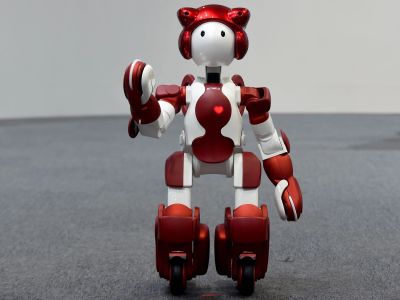
EMIEW
Manufactured by Hitachi
EMIEW is a compact wheeled social robot designed for human interaction in indoor environments like offices, airports, and retail stores. It serves as a workmate for tasks such as visitor reception, guidance, surveillance patrol, and customer greeting, moving at human walking speeds while avoiding obstacles. Key features include agile two-wheel self-balancing mobility, collision avoidance via sensors, natural voice recognition with 360-degree sound detection using microphone arrays, facial recognition, high-quality speech synthesis in multiple languages (Japanese, English, Chinese, Korean), and expressive arms for gesturing. It supports cloud-based processing for advanced voice/image recognition and can interact naturally without a microphone at 1m distance. Use cases involve assisting lost tourists to facilities, office worker support, and retail customer engagement, emphasizing safe symbiosis with people.
Hitachi Software & AI Ecosystem
Developer platforms, fleet management portals, autonomy intelligence, and enterprise integrations
Robotics IT Platform
Remote Brain
Cloud platform performing voice recognition, image analysis and translation for EMIEW3.
Hitachi Timeline & Milestones
Evolutionary history, landmark prototypes, major acquisitions, and commercial roadmap
Hitachi founded by Namihei Odaira
Engineer Namihei Odaira founds Hitachi in Hitachi, Ibaraki, as an electrical machinery manufacturer.
Source: en.wikipedia.org
First EMIEW humanoid introduced
Hitachi introduces the first EMIEW, a humanoid robot designed to communicate and work with people.
Source: en.wikipedia.org
EMIEW3 and robotics IT platform announced
Hitachi announces EMIEW3, a 90 cm, 15 kg humanoid that uses a cloud remote brain for voice, image and language processing.
Source: hitachi.com
EMIEW3 begins tests at Haneda Airport
Hitachi begins proof-of-concept tests of EMIEW3 as a multilingual guide in Haneda Airport Terminal 2, running until around December.
Source: hitachi.com
Hitachi Competitors by Category
Direct industry rivals grouped by specific robotics domain
What Makes Hitachi Different?
Editorial AnalysisOrigin of Bots objective strategic assessment, engineering moats, and commercial hurdles
Key Strengths & Moats
- ✓Huge corporate backing and a decade of EMIEW development.
- ✓Cloud platform approach scales to many robots.
Core Strategic Focus
Service robotics as part of digital systems and services.
Road Ahead & Challenges
- •EMIEW3 remained at proof-of-concept stage.
- •Service humanoids have had limited commercial uptake.
Hitachi vs Key Competitors
Strategic capability matrix across platform categories, commercial readiness, and target markets
Category / Focus
- Hitachi EMIEW
- Service humanoid
- SoftBank Pepper
- Humanoid service robot
- Honda ASIMO 2.0
- Humanoid research robot
- Toyota HSR
- Home support robot
Primary Use
- Hitachi EMIEW
- Visitor reception and guidance
- SoftBank Pepper
- Customer service, reception
- Honda ASIMO 2.0
- Historical bipedal walking, single-leg hopping
- Toyota HSR
- Not listed
Weight
- Hitachi EMIEW
- 70 kg
- SoftBank Pepper
- 28 kg
- Honda ASIMO 2.0
- 48 kg
- Toyota HSR
- 37 kg
Release Year
- Hitachi EMIEW
- 2005
- SoftBank Pepper
- 2014
- Honda ASIMO 2.0
- 2000 (Initial Debut); 2005 (Gen 2); 2011 (Final Redesign)
- Toyota HSR
- 2012
| Strategic Dimension | Hitachi EMIEW | SoftBank Pepper | Honda ASIMO 2.0 | Toyota HSR |
|---|---|---|---|---|
| Category / Focus | Service humanoid | Humanoid service robot | Humanoid research robot | Home support robot |
| Primary Use | Visitor reception and guidance | Customer service, reception | Historical bipedal walking, single-leg hopping | Not listed |
| Weight | 70 kg | 28 kg | 48 kg | 37 kg |
| Release Year | 2005 | 2014 | 2000 (Initial Debut); 2005 (Gen 2); 2011 (Final Redesign) | 2012 |
Corporate Ecosystem & Ownership Structure
Parent company relationships, historical acquisitions, and global operating facilities
Global Facilities & Operating Hubs
Hitachi Headquarters
HQTokyo, Japan
Articles & Industry News
Showing 1 recent article and news updates about Hitachi
Frequently Asked Questions
8 AnswersVerified answers, company specifications, and deployment details about Hitachi
What is Hitachi?
Hitachi is a Japanese conglomerate founded in 1910 and based in Tokyo, working across digital systems, green energy and mobility, and connective industries, including service robotics such as EMIEW.
What is EMIEW?
EMIEW is Hitachi's humanoid robot series for working with people. It was introduced in 2005, followed by EMIEW2 in 2007 and EMIEW3, announced in April 2016.
What is EMIEW3?
EMIEW3 is a 90 cm tall, 15 kg humanoid that moves at up to 6 km/h, handles differences in floor level up to 15 mm and uses a cloud remote brain for language and vision.
What is the remote brain?
The remote brain is a cloud-based IT platform that performs voice recognition, image analysis and language translation for EMIEW3, letting several robots be monitored and controlled from a remote location.
Where was EMIEW3 tested?
Hitachi ran proof-of-concept tests of EMIEW3 in Haneda Airport Terminal 2 from 2 September 2016, with the robot greeting visitors and guiding them in Japanese and English.
Who is the CEO of Hitachi?
Toshiaki Tokunaga is president and CEO of Hitachi, and Toshiaki Higashihara is executive chairman, according to its Wikipedia profile. Executive roles come from Hitachi's Wikipedia profile and can change over time.
How big is Hitachi?
Hitachi had about 287,901 employees in 2025 and revenue of about 10.59 trillion yen, roughly US$96 billion, with around 61 percent of revenue from outside Japan.
When was Hitachi founded?
Hitachi was founded in 1910 by engineer Namihei Odaira as an electrical machinery manufacturing subsidiary and became independent in 1911.
Verified Data & Editorial Assurance
Compiled from verified corporate filings, official Hitachi datasheets, and robotics engineering registries. Information has been verified against official manufacturer documentation. For commercial procurement or proprietary integrations, contact the manufacturer directly.