Karlsruhe Institute of Technology (KIT)
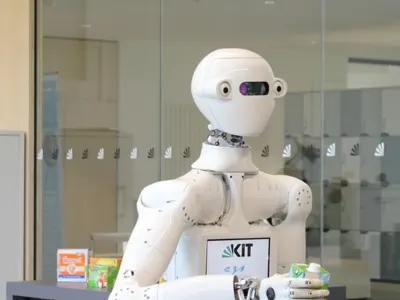
The Karlsruhe Institute of Technology (KIT) is one of Germany's largest research universities, created in October 2009 by merging the University of Karlsruhe, founded in 1825, with the Karlsruhe Research Center. Its president is Jan S. Hesthaven. KIT's High Performance Humanoid Technologies Lab (H²T), led by Professor Tamim Asfour, develops the ARMAR family of humanoid robots, one of the longest-running humanoid research programmes in Europe. The first ARMAR was built around 2000, and later versions such as ARMAR-III, ARMAR-6 and ARMAR-7 learned to work in kitchens, assist technicians and help people in daily life. ARMAR-6 was designed as a collaborative robot that could recognise when a person needs help and hand over tools during maintenance work. The newest ARMAR robots focus on supporting older people and care workers at home and in care settings. In September 2026 KIT presented ARMAR at Cyber Valley's tenth anniversary in Tübingen.
💡Notable Achievement: KIT's H²T lab has developed the ARMAR humanoids since about 2000; ARMAR-6 was designed to recognise when a technician needs help, and ARMAR robots target eldercare and home assistance.
What Does Karlsruhe Institute of Technology (KIT) Do?
The Karlsruhe Institute of Technology is a German research university whose High Performance Humanoid Technologies Lab, led by Tamim Asfour, develops the ARMAR family of humanoids.
“Europe's long-running ARMAR humanoid programme.”
ARMAR Family
The ARMAR series began around 2000 and includes ARMAR-III, ARMAR-6 and ARMAR-7.
Collaboration
ARMAR-6 recognises when a technician needs help and hands over tools.
Eldercare Focus
Newer ARMARs target care settings and home support.
What Can Karlsruhe Institute of Technology (KIT) Robots Actually Do?
Cross-portfolio operational capabilities, manipulation tasks, and environmental competencies
Collaborative and assistive humanoid research.
Maintenance Assistance
ARMAR-6 helps technicians with tools and parts.
Care Support
Research towards supporting older people at home.
Karlsruhe Institute of Technology (KIT) Robots
Showing 1 Humanoid Robots of 1 total model
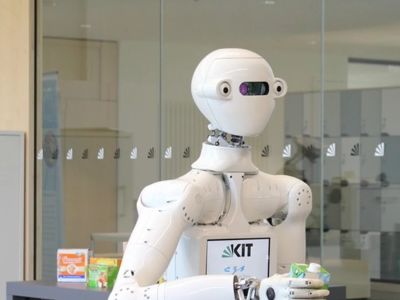
ARMAR-7
Manufactured by Karlsruhe Institute of Technology (KIT)
ARMAR-7 is the latest humanoid robot from KIT's ARMAR family, engineered for assistance in human environments like households and care facilities. Featuring dual torque-controlled 8-DoF arms, underactuated five-finger humanoid hands, a head with stereo vision, a torso, and a holonomic mobile platform, it stands at anthropomorphic dimensions for seamless interaction. With 32 controllable degrees of freedom driven by EtherCAT, it integrates torque sensors in joints, force-torque sensors in wrists, and absolute encoders for precise manipulation. ARMAR-7 excels in tasks such as opening doors, loading dishwashers, handing over objects, and recognizing speech commands like "Bring me the milk." It learns from human demonstrations via imitation learning, processes visual data for object recognition, interprets gestures and intentions, and employs cognitive architecture for contextual understanding, error recovery, and autonomous adaptation in daily activities.
Karlsruhe Institute of Technology (KIT)Software & AI Ecosystem
Developer platforms, fleet management portals, autonomy intelligence, and enterprise integrations
ArmarX
Robot Software Architecture
Software framework developed at KIT for controlling ARMAR humanoids.
Karlsruhe Institute of Technology (KIT)Timeline & Milestones
Evolutionary history, landmark prototypes, major acquisitions, and commercial roadmap
First ARMAR humanoid built
Karlsruhe researchers build the first ARMAR humanoid robot, starting a long-running series.
Source: robotsguide.com
KIT created by merger
The University of Karlsruhe merges with the Karlsruhe Research Center to form the Karlsruhe Institute of Technology.
Source: en.wikipedia.org
ARMAR-6 collaborative humanoid
KIT presents ARMAR-6, a humanoid designed to help technicians by recognising when they need assistance.
Source: spectrum.ieee.org
ARMAR shown at Cyber Valley Day
KIT presents its ARMAR humanoid to Baden-Württemberg's Minister-President at Cyber Valley's tenth anniversary in Tübingen.
Source: kit.edu
Karlsruhe Institute of Technology (KIT) Competitors by Category
Direct industry rivals grouped by specific robotics domain
What Makes Karlsruhe Institute of Technology (KIT) Different?
Editorial AnalysisOrigin of Bots objective strategic assessment, engineering moats, and commercial hurdles
Key Strengths & Moats
- ✓One of Europe's longest-running humanoid research programmes.
- ✓Strong links to German industry and the Cyber Valley network.
Core Strategic Focus
Physical AI for care and collaborative work.
Road Ahead & Challenges
- •ARMAR robots are research platforms, not products.
- •No commercial roadmap.
Karlsruhe Institute of Technology (KIT) vs Key Competitors
Strategic capability matrix across platform categories, commercial readiness, and target markets
| Strategic Dimension | ARMAR-7 (KIT) | NEXTAGE Fillie (Kawada) | TIAGo (PAL Robotics) | Apollo (Apptronik) |
|---|---|---|---|---|
| Hands | Anthropomorphic 5-Finger Hands | Parallel Grippers / Suction | Modular 2/3 Finger Gripper | Dexterous 5-Finger Hands |
| Mobility | Omnidirectional Wheeled Base | Stationary Pedestal | Differential Wheeled Base | Bipedal Locomotion |
| Software Stack | ArmarX Cognitive OS | Kawada QNX / ROS | ROS 2 / Navigation2 | Apptronik CoreOS |
Articles & Industry News
Showing 1 recent article and news updates about Karlsruhe Institute of Technology (KIT)
Frequently Asked Questions
8 AnswersVerified answers, company specifications, and deployment details about Karlsruhe Institute of Technology (KIT)
What is the Karlsruhe Institute of Technology (KIT)?
KIT is one of Germany's largest research universities, formed in 2009 by merging the University of Karlsruhe, founded in 1825, with the Karlsruhe Research Center.
What are the ARMAR robots?
ARMAR is a family of humanoid robots developed at KIT since about 2000. Versions such as ARMAR-III, ARMAR-6 and ARMAR-7 research household help, collaborative work and care assistance.
Who leads KIT's humanoid robotics research?
KIT's humanoid work is led by Professor Tamim Asfour, head of the High Performance Humanoid Technologies Lab (H²T), who has directed the ARMAR programme for many years.
What is ARMAR-6?
ARMAR-6 is a collaborative humanoid from KIT designed to help technicians. It can recognise when a person needs help, hold parts and hand over tools during maintenance.
What are KIT's humanoid robots used for?
KIT's ARMAR robots are research platforms for household assistance, industrial maintenance and eldercare, aimed at supporting people in aging societies.
Can you buy an ARMAR robot?
No. ARMAR robots are research platforms developed at KIT to study household help, collaboration and eldercare, and they are not sold commercially or offered as products.
Who is the president of KIT?
KIT's president is Professor Jan S. Hesthaven, who presented the ARMAR humanoid alongside Professor Tamim Asfour at the Cyber Valley anniversary in Tübingen in September 2026.
Where is KIT located?
KIT is in Karlsruhe, in the German state of Baden-Württemberg, and is part of the state's Cyber Valley AI research network.
Verified Data & Editorial Assurance
Compiled from verified corporate filings, official Karlsruhe Institute of Technology (KIT) datasheets, and robotics engineering registries. Information has been verified against official manufacturer documentation. For commercial procurement or proprietary integrations, contact the manufacturer directly.