BUTLERBOT W3 by KEENON Robotics, launched in 2022, is an enclosed delivery robot built to carry meals, amenities and parcels between floors of hotels, hospitals and office buildings. Its signature feature is a stack of up to four compartments, each with its own automatic door, so one trip can serve up to four rooms while keeping every order private and spill-free. It rides elevators through IoT integration, runs for up to 12 hours and carries 20 kg in total, which makes it a focused tool for room service and back-of-house delivery.
KAGO 5 by Yogo Robot, a Shanghai company whose KAGO 5 design won a Red Dot award, takes a different approach: it is a mobile base that clicks into swappable modules rather than a robot built for one job. With the Delivery Module it handles round-the-clock deliveries, while other modules turn it into a security patrol unit, an air purifier, a recycling station or a sanitation robot. Yogo pairs that flexibility with a top indoor speed of 2 m/s and cloud scheduling that coordinates many robots, elevators and turnstiles at once, aiming it at large buildings that want one fleet doing many tasks.
Detailed Analysis
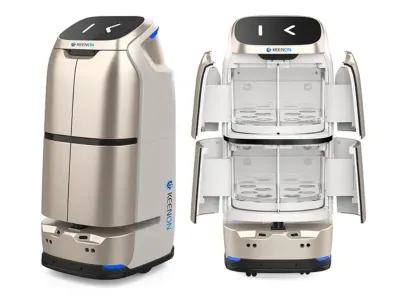
BUTLERBOT W3
What is the core difference between the two robots?
BUTLERBOT W3 is a dedicated delivery robot: its body is the cabinet, and everything about it is tuned to moving items from a front desk or kitchen to a door. KAGO 5 is a platform. Its base handles movement, navigation and docking, and the job it does depends on which module sits on top. Buyers who only need deliveries get a complete, purpose-built package with BUTLERBOT W3, while buyers who want delivery today and security or air care later can grow into new roles with KAGO 5 without buying a second robot.
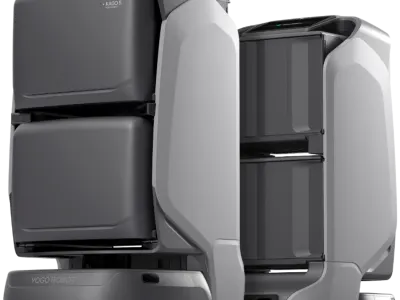
KAGO 5
Which robot carries more and keeps deliveries private?
BUTLERBOT W3 carries up to 20 kg across up to four compartments, and each compartment opens independently with an automatic door and built-in ventilation. That means a guest on one floor can only open their own cabin, and hot food or drinks travel enclosed. KAGO 5's Delivery Module uses a partitioned design with compartments measuring 182 mm wide, 246 mm high and 330 mm deep inside, and Yogo describes it as a two-way, 24/7 service that also protects privacy. BUTLERBOT W3 is the more proven multi-drop cabinet, while KAGO 5 offers a shoebox-sized secure locker that can also collect items and bring them back.
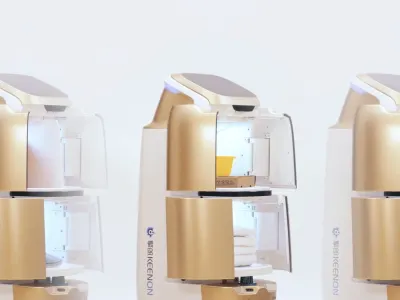
BUTLERBOT W3
How do speed and movement through buildings compare?
KEENON rates BUTLERBOT W3 at 0.8 m/s, a steady walking pace suited to narrow hotel corridors and busy lobbies. Yogo lists a maximum indoor speed of 2 m/s for KAGO 5, more than twice as fast, and says the robot adjusts its speed to the people around it. Yogo also claims KAGO 5 can move through spaces that meet 98% of building codes. In long office corridors or large hospital wings, KAGO 5's extra pace can shorten trips, while BUTLERBOT W3's slower, deliberate movement favors crowded guest areas.
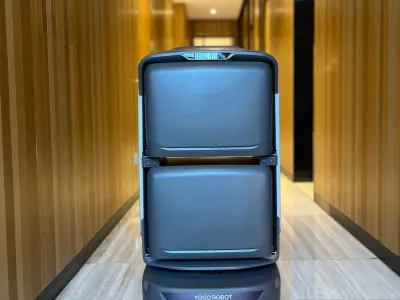
KAGO 5
Which robot handles elevators and multi-floor delivery better?
BUTLERBOT W3 was built as an elevator rider: KEENON's IoT elevator link lets it call a lift, ride between floors and finish deliveries without staff pressing buttons. KAGO 5 goes a step further on paper, with Yogo stating it coordinates multiple robots, multiple people, multiple elevators and multiple turnstiles in a changing environment. Both can serve tall buildings. KAGO 5 suits sites with security gates and several lifts working together, while BUTLERBOT W3 is a straightforward fit for hotels with standard guest elevators.
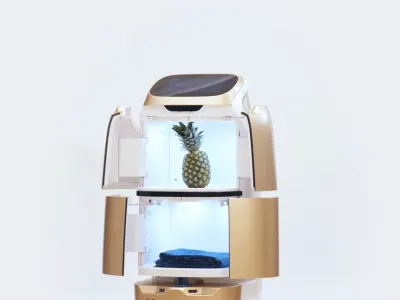
BUTLERBOT W3
How do sensors and obstacle avoidance compare?
BUTLERBOT W3 uses a 270° LiDAR, stereo vision cameras, ultrasonic sensors and a bumper-style emergency sensing strip for 3D obstacle avoidance and crowd avoidance. KAGO 5 relies on what Yogo calls a skin-like, multi-channel sensor network and L4-level driverless technology to read its surroundings and react instantly. When fitted with the Security Module, KAGO 5 adds a night vision camera and sensors for carbon monoxide, formaldehyde, TVOC, noise and light. BUTLERBOT W3 focuses its sensors on safe navigation, while KAGO 5 can also turn sensing into building monitoring.
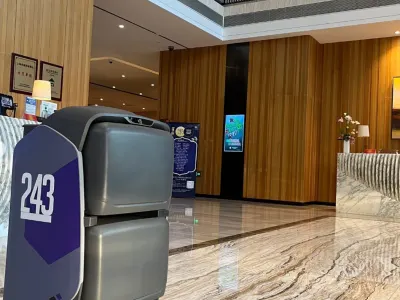
KAGO 5
What can each robot do beyond delivery?
BUTLERBOT W3 is primarily a delivery and concierge robot, using its 11.6-inch touchscreen and voice prompts to greet guests and hand over orders. KAGO 5's modules cover far more ground. The Security Module patrols day and night, flags people on a watch list and detects open flames or smoke. The Air Fresh Module moves at least 350 m³ of air per hour across about 200 m², filtering dust and PM2.5 and adding fragrance at 55 dB or less. Yogo also offers recycling and sanitation modules co-designed with a convention center and hospitals.
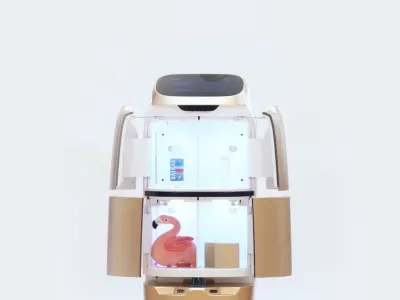
BUTLERBOT W3
How do battery life and charging compare?
KEENON quotes up to 12 hours of operation for BUTLERBOT W3, based on three deliveries per hour, and a 6.5-hour charge from 15% to full. That covers a long hotel shift, with recharging overnight. KAGO 5 docks into its modules with a single click through standardized rails that link power and communication, and Yogo lists 3 to 4 hours of battery life for the Air Fresh Module. For continuous delivery work through a full day, BUTLERBOT W3's long runtime is its clearest strength.
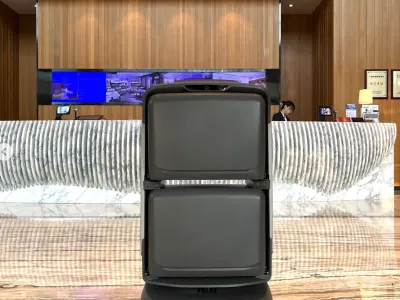
KAGO 5
Which robot fits which business?
BUTLERBOT W3 suits hotels, hospitals, nursing homes and offices that want reliable, enclosed room-to-room delivery with up to four drops per trip and a long working day. KAGO 5 suits large, complex buildings such as office towers, convention centers and hospitals that want one fleet to deliver, patrol, monitor air quality and support hygiene tasks. If delivery is the whole job, BUTLERBOT W3 is the simpler choice. If the building has several jobs a robot could do, KAGO 5's modular design gives more room to grow.
Technical Specifications
BUTLERBOT W3 and KAGO 5 differ on 36 of the 49 specifications listed for both.
Functional Utility & Use Cases
4 Comparative Metrics
Manipulation & Load Capacity
2 Comparative Metrics
Kinematic Architecture & Dexterity
3 Comparative Metrics
Frequently Asked Questions
What is the main difference between BUTLERBOT W3 and KAGO 5?
BUTLERBOT W3 is a dedicated delivery robot with up to four enclosed compartments. KAGO 5 is a modular base that can switch between delivery, security, air purification, recycling and sanitation modules.
Which is faster, BUTLERBOT W3 or KAGO 5?
KAGO 5 is faster, with a maximum indoor speed of 2 m/s according to Yogo Robot. BUTLERBOT W3 travels at 0.8 m/s.
Can BUTLERBOT W3 and KAGO 5 use elevators?
Yes. BUTLERBOT W3 rides elevators through KEENON's IoT elevator integration, and KAGO 5 coordinates with multiple elevators and smart turnstiles through cloud scheduling.
How many deliveries can BUTLERBOT W3 make in one trip?
BUTLERBOT W3 can serve up to four locations per trip, using up to four independently opening compartments with a combined 20 kg payload.
Can KAGO 5 do security patrols?
Yes. With the Security Module, KAGO 5 patrols around the clock, uses a night vision camera, identifies people on a watch list and detects fire, smoke and harmful gases such as carbon monoxide.
Which robot is better for hotel room service?
BUTLERBOT W3 is the more focused choice, with enclosed, ventilated compartments, elevator riding and up to 12 hours of runtime. KAGO 5 suits hotels that also want security or air-care tasks from the same robot.
Verdicts reflect our research and opinion. Confirm specifications with the manufacturer before buying.