Carnegie Mellon University
Carnegie Mellon University's Robotics Institute in Pittsburgh is one of the best-known academic robotics centres. This entry covers its LEAP Hand, an open, low-cost anthropomorphic robot hand for robot learning research created by Kenneth Shaw, Ananye Agarwal and Deepak Pathak. The original LEAP Hand, presented at Robotics: Science and Systems in 2023, can be assembled in under four hours for about US$2,000 from readily available parts, and outperformed the Allegro Hand in the authors' experiments at one-eighth of the cost. LEAP Hand V2 followed with a hybrid rigid-soft design: a 3D-printed soft exterior over an internal bone structure makes it strong yet compliant and durable, and it is priced at around US$3,000 to build. Because the design is public and cheap, labs worldwide use LEAP Hand to train dexterous manipulation policies.
💡Notable Achievement: The original LEAP Hand costs about US$2,000 to build and outperformed the Allegro Hand at one-eighth of the cost.
What Does Carnegie Mellon University Do?
Carnegie Mellon University's LEAP Hand is an open, low-cost anthropomorphic robot hand for robot learning research, created by Kenneth Shaw, Ananye Agarwal and Deepak Pathak.
“A cheap open hand for dexterity research.”
Low Cost
About US$2,000 for the original and about US$3,000 for V2.
Easy Assembly
The original builds in under four hours from available parts.
Hybrid Rigid-Soft
V2 pairs a printed bone frame with a soft exterior.
What Can Carnegie Mellon University Robots Actually Do?
Cross-portfolio operational capabilities, manipulation tasks, and environmental competencies
Dexterous research hand for robot learning.
Dexterous Manipulation
Anthropomorphic hand for learning-based manipulation.
Carnegie Mellon University Robot Hands
Showing 1 of 1 total model
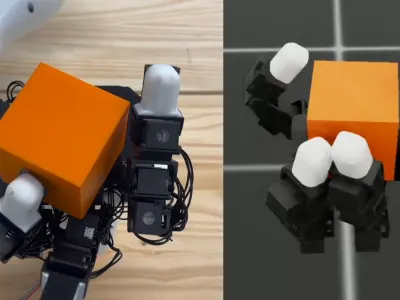
LEAP Hand V2
Manufactured by Carnegie Mellon University
LEAP Hand V2 is a low-cost, 8-DOF anthropomorphic robotic hand developed at Carnegie Mellon University for robot learning research. It features a hybrid rigid-soft structure with 3D-printed soft exterior skin over a robust internal bone structure, a foldable palm with two powered articulations (one for four fingers, one near thumb), and a highly dexterous MCP joint for human-like flexibility and grasping. Priced at $200, it assembles in under 2 hours and supports teleoperation, imitation learning, and sim2real tasks, outperforming pricier competitors.
Carnegie Mellon University Timeline & Milestones
Evolutionary history, landmark prototypes, major acquisitions, and commercial roadmap
LEAP Hand presented at RSS 2023
Kenneth Shaw, Ananye Agarwal and Deepak Pathak present LEAP Hand, a low-cost, efficient and anthropomorphic hand for robot learning, at Robotics: Science and Systems.
Source: roboticsproceedings.org
LEAP Hand paper posted on arXiv
The LEAP Hand paper appears on arXiv, describing a hand assembled in under four hours for about US$2,000 that beats the Allegro Hand at one-eighth of the cost.
Source: arxiv.org
LEAP Hand V2 presented at RSS 2025
The team presents LEAP Hand V2, a dexterous, low-cost anthropomorphic hybrid rigid-soft hand for robot learning, at Robotics: Science and Systems XXI.
Source: roboticsproceedings.org
Carnegie Mellon University Competitors by Category
Direct industry rivals grouped by specific robotics domain
What Makes Carnegie Mellon University Different?
Editorial AnalysisOrigin of Bots objective strategic assessment, engineering moats, and commercial hurdles
Key Strengths & Moats
- ✓Very low cost and open designs.
- ✓Widely used in robot learning research.
Core Strategic Focus
Refining V2 and supporting learning-based dexterity.
Road Ahead & Challenges
- •Research hardware without commercial support.
- •Durability and payload limits compared with industrial hands.
Carnegie Mellon University vs Key Competitors
Strategic capability matrix across platform categories, commercial readiness, and target markets
Category / Focus
- LEAP Hand V2
- Open low-cost research hand
- Allegro Hand V5
- Research robot hand
- Shadow Dexterous Hand
- Research dexterous hand
- ORCA Hand
- Open tendon-driven hand
Primary Use
- LEAP Hand V2
- Teleoperation, grasping
- Allegro Hand V5
- Teleoperation, assembly
- Shadow Dexterous Hand
- Teleoperation, assembly
- ORCA Hand
- Teleoperation, imitation learning
Degrees of Freedom
- LEAP Hand V2
- 22 joints (17 Actuated / Motors)
- Allegro Hand V5
- 9 (base, 3 fingers × 3 DOF); 16 (Plus, 4 fingers × 4 DOF)
- Shadow Dexterous Hand
- 24 (20 actuated + 4 underactuated)
- ORCA Hand
- 17 (16 in fingers + 1 in wrist)
Release Year
- LEAP Hand V2
- 2024
- Allegro Hand V5
- 2025
- Shadow Dexterous Hand
- 2004
- ORCA Hand
- 2025
| Strategic Dimension | LEAP Hand V2 | Allegro Hand V5 | Shadow Dexterous Hand | ORCA Hand |
|---|---|---|---|---|
| Category / Focus | Open low-cost research hand | Research robot hand | Research dexterous hand | Open tendon-driven hand |
| Primary Use | Teleoperation, grasping | Teleoperation, assembly | Teleoperation, assembly | Teleoperation, imitation learning |
| Degrees of Freedom | 22 joints (17 Actuated / Motors) | 9 (base, 3 fingers × 3 DOF); 16 (Plus, 4 fingers × 4 DOF) | 24 (20 actuated + 4 underactuated) | 17 (16 in fingers + 1 in wrist) |
| Release Year | 2024 | 2025 | 2004 | 2025 |
Corporate Ecosystem & Ownership Structure
Parent company relationships, historical acquisitions, and global operating facilities
Robotics Institute
Carnegie Mellon's Robotics Institute in Pittsburgh, where Deepak Pathak's group works.
Ownership & Acquisition History
Carnegie Mellon's Robotics Institute in Pittsburgh, where Deepak Pathak's group works.
Global Facilities & Operating Hubs
Carnegie Mellon University Headquarters
HQPittsburgh, Pennsylvania, United States
Frequently Asked Questions
8 AnswersVerified answers, company specifications, and deployment details about Carnegie Mellon University
What is the LEAP Hand?
LEAP Hand is an open, low-cost anthropomorphic robot hand from Carnegie Mellon University, built for robot learning research. Its designs are public so other labs can build and use it.
Who created the LEAP Hand?
Kenneth Shaw, Ananye Agarwal and Deepak Pathak of Carnegie Mellon University created the LEAP Hand and presented it at Robotics: Science and Systems in 2023.
How much does the LEAP Hand cost to build?
The original LEAP Hand can be assembled in under four hours for about US$2,000, and LEAP Hand V2 is described as a US$3,000 hybrid rigid-soft hand.
What is new in LEAP Hand V2?
LEAP Hand V2 adds a hybrid rigid-soft structure: a 3D-printed soft exterior over a printed internal bone frame, so it is strong yet compliant, durable and easy to assemble.
How does LEAP Hand compare with the Allegro Hand?
In the authors' experiments the LEAP Hand significantly outperformed its closest competitor, the Allegro Hand, in every test while costing one-eighth as much.
What is LEAP Hand used for?
LEAP Hand is used as a research platform for dexterous manipulation and robot learning, where policies are trained in simulation or from demonstrations and then run on the real hand.
Which lab is behind LEAP Hand?
LEAP Hand comes from Carnegie Mellon University in Pittsburgh, led by Deepak Pathak's group at the Robotics Institute, and is part of its work on robot learning.
Is Carnegie Mellon selling the LEAP Hand?
LEAP Hand is an open research design that labs build from public files and readily available parts. Check the LEAP Hand website for current information on kits and ordering.
Verified Data & Editorial Assurance
Compiled from verified corporate filings, official Carnegie Mellon University datasheets, and robotics engineering registries. Information has been verified against official manufacturer documentation. For commercial procurement or proprietary integrations, contact the manufacturer directly.