Light Origins
Light Origins is an embodied AI company building foundation models for physical AI and general-purpose robots, with offices in Singapore, Beijing and Shenzhen. It was founded in August 2024 by Roger Jiang, a former OpenAI researcher who contributed to GPT-4 and reinforcement learning from human feedback, and began as Light Robotics before rebranding to focus on embodied foundation models. The company applies the methods behind large language models to robotics, training models on large amounts of human activity so robots can learn many physical skills. In September 2026 Light Origins launched Light-O1, its first general-purpose embodied foundation model, which learns a reusable human action prior from structured human movements recovered from internet videos and then adapts it to different robot bodies and tasks. It has also open-sourced Light-O1-Preview, a 6-billion-parameter whole-body model. Its data infrastructure runs at thousand-GPU scale and processes about 200,000 hours of video a week. Its research humanoid is Lightbot-0.
💡Notable Achievement: Founded by a former OpenAI researcher; Light-O1-Preview weights and code were open-sourced.
What Does Light Origins Do?
Light Origins builds foundation models for physical AI, including the Light-O1 whole-body action model and LightNav-0, and trains them on its compact in-house LightBot humanoid.
“Foundation models for humanoids, demonstrated on a small in-house robot.”
Whole-Body Action Model
Light-O1 turns language into whole-body robot motion.
Open-Source Release
Light-O1-Preview weights and code have been open-sourced.
Sim-to-Real RL
Reinforcement-learning parkour and skill switching run on a 90 cm humanoid.
What Can Light Origins Robots Actually Do?
Cross-portfolio operational capabilities, manipulation tasks, and environmental competencies
Research humanoid with 21 degrees of freedom running foundation-model skills.
Language-to-Action Control
Light-O1 maps language instructions to whole-body actions.
Learned Navigation
LightNav-0 navigation model with depth-camera perceptive locomotion.
RL Parkour
Policies at 50 Hz for parkour and skill switching.
Household Task Demos
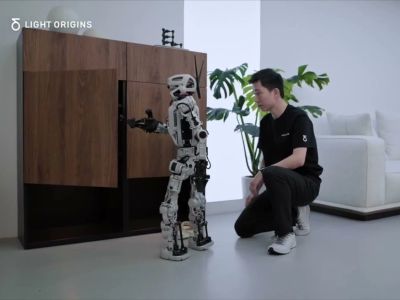
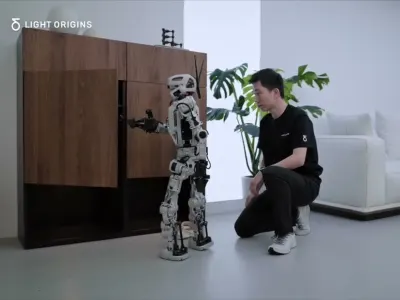
Demonstrates opening cabinets and tidying with light objects.
Light Origins Robots
Showing 1 Humanoid Robots of 1 total model
Lightbot-0
Manufactured by Light Origins
Lightbot-0 is Light Origins' compact in-house humanoid, about 90 cm tall and 18.9 kg with 21 actuated degrees of freedom. Built as a research platform, it runs reinforcement-learning parkour and skill-switching policies on an onboard Jetson Orin Nano and serves as a demonstration body for the company's Light-O1 whole-body foundation model, alongside a Unitree G1. It shows autonomous household tasks such as opening cabinets and putting away shoes.
Light Origins Software & AI Ecosystem
Developer platforms, fleet management portals, autonomy intelligence, and enterprise integrations
Light-O1
Whole-Body Action Model
Open-source preview weights with human-video action pretraining.
LightNav-0
Navigation Foundation Model
Navigation model for perceptive movement.
Light Origins Timeline & Milestones
Evolutionary history, landmark prototypes, major acquisitions, and commercial roadmap
Light Origins founded
Former OpenAI researcher Roger Jiang founds the company, first as Light Robotics, to build physical AI.
Source: runtimewire.com
Light-O1-Preview open-sourced
Light Origins open-sources Light-O1-Preview, a 6-billion-parameter whole-body model for humanoid robots.
Source: intelligentliving.co
Light-O1 foundation model launched
Light Origins launches Light-O1, an embodied foundation model that learns human action priors from internet video.
Source: prnewswire.com
Light Origins Competitors by Category
Direct industry rivals grouped by specific robotics domain
What Makes Light Origins Different?
Editorial AnalysisOrigin of Bots objective strategic assessment, engineering moats, and commercial hurdles
Key Strengths & Moats
- ✓Founded by a former OpenAI researcher, with model-first focus.
- ✓Open-source Light-O1 preview aids community adoption.
- ✓Pre-A round of several hundred million yuan (August 2026).
Core Strategic Focus
Improving foundation models, with Lightbot-0 as an internal training platform.
Road Ahead & Challenges
- •Lightbot-0 is not for sale and has only about 1 hour of runtime.
- •Revenue path depends on licensing or partner robots.
Light Origins vs Key Competitors
Strategic capability matrix across platform categories, commercial readiness, and target markets
Category / Focus
- Light Origins
- Compact Bipedal Humanoid
- Genesis AI Eno
- Physical-AI foundation model builder
- Unitree Robotics Unitree R1
- Compact low-cost humanoid
- X Square Robot Quanta X2
- Embodied foundation-model humanoid
- Booster Robotics K1 Humanoid
- Compact developer humanoid
Primary Use
- Light Origins
- Foundation-model research
- Genesis AI Eno
- Material handling, kitting
- Unitree Robotics Unitree R1
- High-speed dynamic acrobatics
- X Square Robot Quanta X2
- Commercial cleaning, home service
- Booster Robotics K1 Humanoid
- Education, research
Weight
- Light Origins
- 18.9 kg
- Genesis AI Eno
- 50–80 kg
- Unitree Robotics Unitree R1
- 25 kg
- X Square Robot Quanta X2
- 95 kg
- Booster Robotics K1 Humanoid
- 19.5 kg
Battery Runtime
- Light Origins
- 1 h
- Genesis AI Eno
- 4–6 h
- Unitree Robotics Unitree R1
- 1 h
- X Square Robot Quanta X2
- 4 h
- Booster Robotics K1 Humanoid
- N/A
| Strategic Dimension | Light Origins(Current) | Genesis AI Eno | Unitree Robotics Unitree R1 | X Square Robot Quanta X2 | Booster Robotics K1 Humanoid |
|---|---|---|---|---|---|
| Category / Focus | Compact Bipedal Humanoid | Physical-AI foundation model builder | Compact low-cost humanoid | Embodied foundation-model humanoid | Compact developer humanoid |
| Primary Use | Foundation-model research | Material handling, kitting | High-speed dynamic acrobatics | Commercial cleaning, home service | Education, research |
| Weight | 18.9 kg | 50–80 kg | 25 kg | 95 kg | 19.5 kg |
| Battery Runtime | 1 h | 4–6 h | 1 h | 4 h | N/A |
Corporate Ecosystem & Ownership Structure
Parent company relationships, historical acquisitions, and global operating facilities
Global Facilities & Operating Hubs
Light Origins Headquarters
HQSingapore
Offices in Beijing and Shenzhen.
Frequently Asked Questions
8 AnswersVerified answers, company specifications, and deployment details about Light Origins
What is Light Origins?
Light Origins is an embodied AI company, founded in August 2024, that builds foundation models for physical AI so general-purpose robots can learn many skills, with offices in Singapore, Beijing and Shenzhen.
Who founded Light Origins?
Light Origins was founded by Roger Jiang, a former OpenAI researcher who contributed to GPT-4 and reinforcement learning from human feedback.
What is Light-O1?
Light-O1 is Light Origins' first general-purpose embodied foundation model, launched in September 2026. It learns human action patterns from internet video and adapts them to different robots.
How does Light Origins train robots with video?
Light Origins recovers structured human movements from internet videos, pretrains a reusable human action model on them, then fine-tunes it for specific robot bodies and tasks.
Is Light Origins' model open source?
Yes, in part. Light Origins has open-sourced Light-O1-Preview, a 6-billion-parameter whole-body model, so that researchers and developers can build on its approach to learning from human video.
What is Lightbot-0?
Lightbot-0 is Light Origins' small research humanoid robot, used to test and demonstrate its embodied foundation models rather than sold as a product.
What was Light Origins called before?
Light Origins launched as Light Robotics before rebranding to focus on embodied foundation models for physical AI, a shift toward the model layer that general-purpose robots run on.
How much data does Light Origins process?
Light Origins says its data infrastructure runs at thousand-GPU scale and processes about 200,000 hours of video a week, up from 12,500 hours six months earlier.
Verified Data & Editorial Assurance
Compiled from verified corporate filings, official Light Origins datasheets, and robotics engineering registries. Data is monitored and audited on an ongoing basis for accuracy. For commercial procurement or proprietary integrations, contact the manufacturer directly.