Asimov Open-Sources Locomotion Policy and Reinforcement Learning Training Code for Asimov 1 Humanoid
Robot Details
Robotics & AI News • OriginOfBotsPublished
September 26, 2026
Reading Time
4 min read
Author
Origin Of Bots Editorial Team
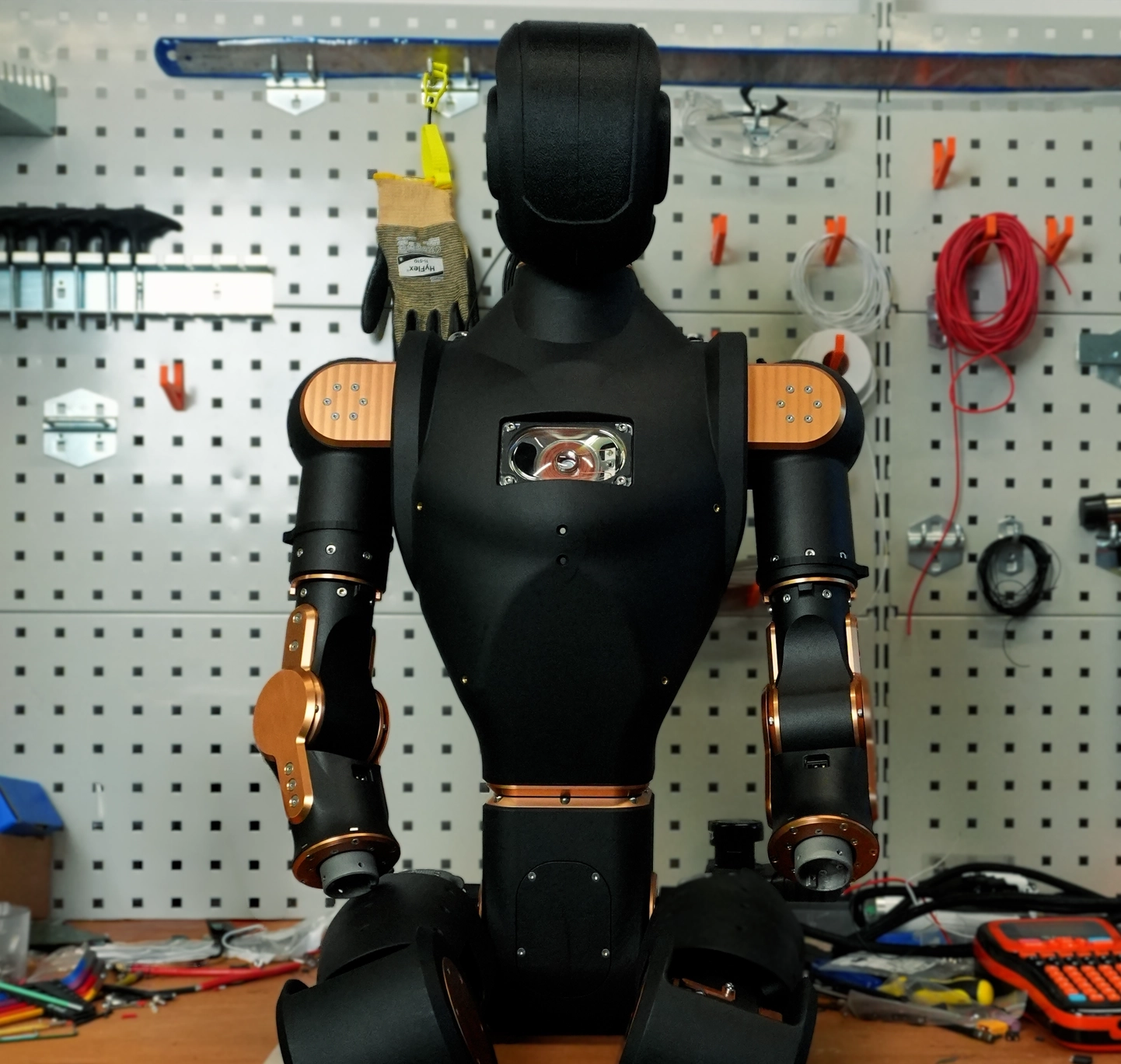
Democratizing the Software Foundation of Bipedal Locomotion
In an extraordinary milestone for open-source robotics, Menlo Research officially published the locomotion software powering its Asimov 1 humanoid. The release provides international roboticists with full access to the underlying neural controller and reinforcement learning training pipeline. By opening up the software architecture, the initiative allows independent engineers to inspect, modify, and retrain the robot's physical walking behaviors.
Proprietary robotics vendors typically guard their low-level balance algorithms and joint controllers behind encrypted commercial software barriers. Asimov shatters this black-box paradigm by releasing complete environment configurations, reward functions, and actuator parameters under a BSD-3-Clause license. This open-access framework transforms walking from an inaccessible vendor secret into an adaptable community-engineered development asset.
NVIDIA Isaac Lab Integration and Adversarial Motion Priors
The published codebase, hosted in the public isaac_asimov repository, is built directly atop NVIDIA’s GPU-accelerated Isaac Lab framework. The training architecture implements Proximal Policy Optimization combined with Adversarial Motion Priors, commonly designated in robotics as AMP. This algorithmic pairing encourages neural policies to mimic natural, fluid biological movements captured from kinematic reference data.
Rather than relying on unconstrained trial-and-error exploration, the discriminator network guides the robot toward biomimetic stability. The simulation evaluates joint kinematics at thousands of simulated steps per second, learning to maintain dynamic equilibrium across varied walking gaits. Packaging production-grade Isaac Lab pipelines into an open repository dramatically lowers the technical threshold for training legged physical artificial intelligence.
Bridging the Reality Gap with Domain Randomization
Transferring learned control policies from virtual simulation to noisy physical hardware represents one of robotics' most formidable hurdles. To overcome this simulation-to-reality transfer gap, Asimov’s training environment incorporates rigorous, randomized physical perturbations. The training loops systematically inject unpredictable noise into foot ground friction, motor latency, joint friction, and sensory observations.
Simultaneously, the reward architecture severely penalizes foot slipping, sharp motor torque spikes, and dangerous self-collisions between limbs. Exposure to thousands of simulated joint disruptions forces the neural network to develop robust, generalizable recovery strategies. When deployed onto real physical hardware, the resulting policy maintains stability despite real-world mechanical backlash and uneven walking surfaces.
Exposing Hardware Parameters for Physical Customization
A core strength of the Asimov training framework is its explicit exposure of low-level electromechanical joint variables. Developers can directly modify torque thresholds, joint stiffness coefficients, damping ratios, and communication delays within configuration files. This configurability enables builders to adapt software controllers seamlessly when swapping motors or altering physical limb lengths.
Furthermore, the bundled walking motion references provide a transparent baseline that roboticists can alter to explore novel locomotive styles. Builders can train the robot to walk with wider stances, adjust gait cadences for outdoor terrain, or optimize foot clearance over obstacles. Decoupling physical hardware adaptation from proprietary vendor firmware empowers developers to customize bipedal dynamics without restrictions.
Accompaniment to the $20,000 Asimov 1 DIY Hardware Kit
The release of the locomotion training codebase directly complements the ongoing commercial shipments of Asimov’s physical DIY hardware kits. Earlier this month, Menlo Research commenced customer deliveries of the 1.2-meter bipedal platform, priced at $20,000 through a structured group-buy program. The hardware incorporates CNC-machined 7075 aluminum joints, high-strength Multi Jet Fusion nylon body shells, and parallel ankle actuators.
Onboard computing is divided between a Raspberry Pi 5 managing high-level network communications and a Radxa CM5 executing real-time motor loops. Assembling the physical robot requires approximately one hundred hours of hands-on mechanical wiring, torquing, and calibration labor. Providing the complete reinforcement learning code ensures that builders possess both the physical skeleton and the neural software to achieve independent operation.
Hardware Verification Ecosystem and Community Livestreams
To support developers deploying custom policies, the Asimov core engineering team announced plans for interactive community validation sessions. Menlo Research will host scheduled public livestreams where developer-submitted policy weights will be executed directly on reference hardware. Engineers can observe how their experimental training variations perform in real time without risking damage to their own personal robots.
The training pipeline is fully optimized for mainstream workstation hardware, supporting single- and multi-GPU setups on RTX 4090 and RTX 6000 silicon. Comprehensive documentation details how to export trained policy checkpoints into lightweight ONNX format for on-robot edge deployment. This collaborative testing ecosystem accelerates algorithmic iteration across an international collective of academic researchers and independent builders.
Establishing the Open Foundation for Embodied Bipedal AI
Asimov’s release marks an indispensable evolutionary step in preventing humanoid robotics from becoming monopolized by closed corporate giants. By providing unrestricted access to mechanical CAD files, simulation models, and locomotion training pipelines, the project establishes a true open standard. Much like the Linux operating system democratized enterprise server software, open robotics toolchains will democratize physical labor automation.
As hundreds of independent developers train, refine, and share novel motor controllers, the collective capabilities of open humanoids will compound exponentially. The project proves that high-performance bipedal locomotion can be engineered collaboratively in the open commons. Asimov 1 stands as a compelling proof that the future of humanoid robotics will belong to transparent, community-driven innovation.
Related Articles
Boston Dynamics Opens Robotics Metaplant Application Center to Train Atlas Humanoid Fleet for Hyundai Manufacturing

Intel Unveils Open Edge Infrastructure Strategy to Scale Physical AI and Humanoid Robotics
Saudi Arabia and Humanoid AI Form Strategic Partnership for Up to 10,000 Humanoid Robots Under Vision 2030
Agility Robotics Explores Wheeled Humanoid Variants to Complement Bipedal Digit Fleet
Learn More About This Robot
Discover detailed specifications, reviews, and comparisons for Robotics & AI News.
View Robot Details →