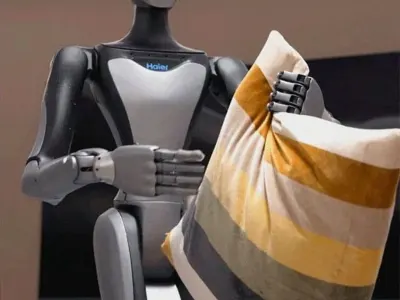
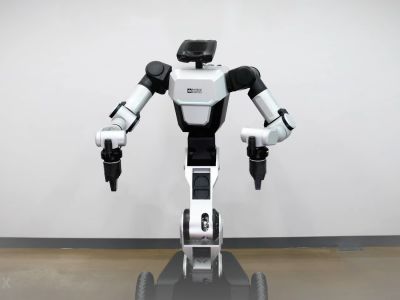
The Hiva Humanoid by Haier is positioned as a versatile household assistant robot, focusing on domestic tasks such as cleaning, cooking support, and laundry handling. It features a lightweight, slim humanoid design with a height optimized for indoor home environments. Its long battery life of 4 years and extensive sensor suite including RGB, depth, tactile, and force sensors distinguish it in the realm of smart home robotics.
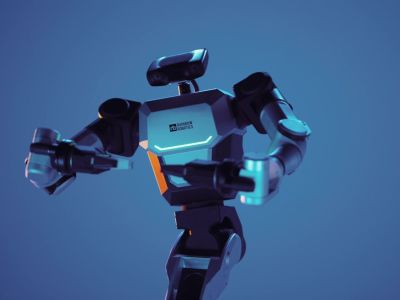
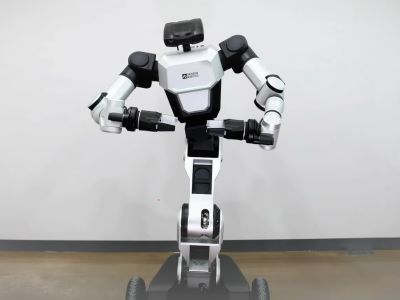
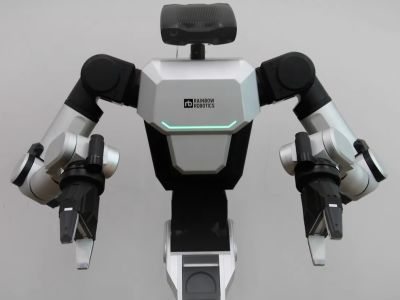
The RB-Y1 by Rainbow Robotics targets industrial automation and research sectors, emphasizing high mobility and manipulation capabilities with its dual-arm setup and wheeled base. It is heavier and faster than the Hiva Humanoid, with a design that supports manufacturing and logistics use cases. The robot incorporates advanced AI integration for precision tasks and has been adopted by top academic and industrial institutions since its launch.
Detailed Analysis
Design & Build Quality
The Hiva Humanoid has a compact footprint (50x50x165 cm) and is relatively lightweight at 70 kg, suited for household environments. In contrast, the RB-Y1 is larger (60x69x140 cm) and significantly heavier at 131 kg, reflecting its industrial-grade construction and robust design. RB-Y1's single leg with six degrees of freedom combined with its wheeled base enables dynamic height adjustment and stable movement, whereas Hiva focuses on slim vertical form factor with tactile interaction.
Mobility & Navigation
Hiva Humanoid moves at a modest speed of 1.5 km/h using SLAM, visual odometry, and IMU for navigation, optimized for indoor home use. RB-Y1 operates at a higher speed of 5.4 km/h, utilizing SLAM and an IMU with additional omnidirectional Mecanum wheels for enhanced maneuverability in industrial spaces. RB-Y1’s mobility includes agile turning and vertical height adjustments, supporting fast and complex movement patterns appropriate for factory floors.
Sensors & Perception
The Hiva robot incorporates a diverse sensor suite including RGB and depth cameras, tactile and force sensors, and ultrasonic sensors to interact safely and effectively in a home setting. RB-Y1 employs a more industrial-focused sensor array, including LiDAR, IMU, and grippers, designed for precise manipulation and environment mapping in manufacturing or logistics contexts. RB-Y1’s sensors support advanced AI-driven tasks and collision avoidance critical to industrial use.
AI Capabilities
Hiva utilizes AI-assisted autonomous control and remote teleoperation with a Linux-based OS integrated with ROS, supporting Python and C++ APIs for customization. RB-Y1 also runs on ROS/Linux and offers extensive AI integration with open APIs and SDKs targeting complex industrial processes and research applications. RB-Y1 supports advanced remote teaching and simulation environments, facilitating sophisticated AI model training and collaborative robotics.
Battery & Power Efficiency
Hiva is designed with a very long battery life rated at 4 years, indicating energy-efficient operation suited for low-intensity domestic tasks. RB-Y1 offers a battery life ranging from 3 to 5 years depending on usage scenarios and supports operational runtimes around 3 hours per charge typical for industrial robots with higher power demands. Power management in RB-Y1 balances speed, mobility, and manipulation workload.

Use-Case Suitability
Hiva targets household chores such as cleaning, cooking assistance, and laundry, making it an ideal smart home companion robot. RB-Y1 is suited for industrial automation including manufacturing and logistics, capable of repetitive, precise dual-arm manipulation in dynamic environments. Their differing sensor suites and mobility profiles reflect this specialization, with Hiva focusing on safe human-robot interaction at home and RB-Y1 optimizing flexibility and payload for complex industrial tasks.
Software Ecosystem
Both robots run on ROS and Linux, facilitating integration and development. Hiva provides Python and C++ APIs enabling application customization for domestic automation. RB-Y1 extends this with modular software development kits and support for AI research, offering advanced teaching controls such as Master Arm and VR interfaces, targeting developers and industrial users looking for extensible platforms.
Safety Features
Safety in Hiva includes emergency stop, obstacle avoidance, and collision detection tailored for home environments to protect users and property. RB-Y1 incorporates emergency stop, obstacle avoidance, and self-collision prevention mechanisms suited for industrial safety standards. RB-Y1 dynamically adjusts its center of gravity to prevent tipping during high-speed movements and heavy manipulation.
Pricing & Value
Hiva Humanoid is priced between $50,000 and $70,000, reflecting its role as a consumer-oriented household robot. RB-Y1 has a broader price range of $50,000 to $100,000, corresponding to its advanced industrial capabilities and customization options. The higher cost of RB-Y1 aligns with its heavier build, greater speed, and dual-arm manipulation suited for professional use.
Analysis Score Summary
Total Score
8
Hiva Haiwa
VS
Based on Detailed Analysis
Total Score
10
RB-Y1
📊 Win: 2 points | Trade-off: 1 point each
Scores are summed across every insight: a clear winner earns 2 points, while balanced trade-offs give each robot 1 point. The total reflects how often each robot outperforms the other (or shares the spotlight) throughout the detailed analysis sections.
Capabilities & Operational Tasks
Head-to-head comparison of what Hiva Haiwa and RB-Y1 can do, their applications, and capabilities.
What Can Hiva Haiwa & RB-Y1 Do?
17Core operational tasks, activities, and physical manipulation duties evaluated side-by-side.
| Task & Description | Model AHiva Haiwa8 supported | Model BRB-Y114 supported |
|---|---|---|
| Assembly | — | High |
| Autonomous task execution | High | — |
| Carrying and transport | High | High |
| Cleaning | High | — |
| Collaborative work | High | High |
| Human interaction | High | — |
| Inspection | — | High |
| Loading and unloading | — | High |
| Machine operation | — | High |
| Machine tending | — | High |
| Material handling | — | High |
| Move objects | High | High |
| Pick and place | High | High |
| Quality control | — | High |
| Repetitive physical tasks | — | High |
| Sorting | High | High |
| Tool use | — | High |
Technical Specifications
Head-to-head performance data and metrics
| Specification | Model AHiva Haiwa | Model BRB-Y1 |
|---|---|---|
Functional Utility & Use Cases4 Comparative Metrics | ||
Control Method | Remote teleoperation, AI-assisted autonomous control, app control | Remote, AI, manual |
Use Cases | Teleoperated clothes folding, ironing, dish sorting, imitation-learning data collection | Industrial automation, manufacturing, logistics |
Multi Robot Coord | Supported within the Haier Smart Home network for fleet-wide chore management | Limited |
Pet Friendly | Not Applicable / In-Development | No |
Manipulation & Load Capacity4 Comparative Metrics | ||
Carrying Capacity | 2–3 kg per arm | 6 kg |
Deadlift Capacity | 5 kg | 6 kg |
Payload Type | Domestic item manipulation (clothes, dishes, household objects under teleoperation) | Tools, packages |
Modular Attachments | Interchangeable grippers, tool holders, sensor modules | Grippers, sensors |
Kinematic Architecture & Dexterity4 Comparative Metrics | ||
Degrees of Freedom | 28+ DOF | - |
Material | Aluminum, composite, plastic | Metal, plastic |
Mobility Type | Wheeled mobile domestic base | Wheeled |
Hardware Interface | USB, Ethernet, GPIO | USB, GPIO |
Functional Utility & Use Cases
4 Comparative Metrics
Manipulation & Load Capacity
4 Comparative Metrics
Kinematic Architecture & Dexterity
4 Comparative Metrics
Related Comparisons
Discover similar robot matchups to expand your knowledge and find the perfect solution
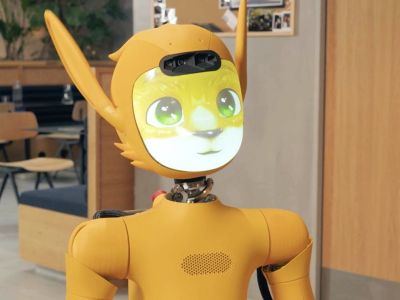
Hiva Haiwa vs Mirokaï
In-depth comparison of Hiva Haiwa by Haier and Mirokaï by Enchanted Tools. Analyze sensors, navigation, battery, and mobility differences.
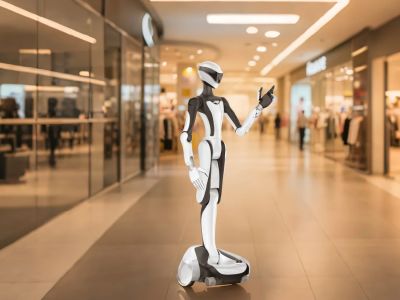
RB-Y1 vs Q5
Compare RB-Y1 and Q5. Detailed analysis of sensors, navigation, speed, and battery life.
Hiva Haiwa vs Q5
In-depth comparison of Hiva Haiwa by Haier and Q5 by Robot Era. Analyze sensors, navigation, speed, and software capabilities.
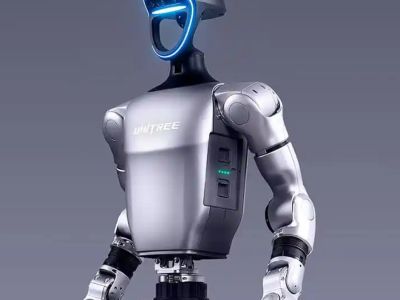
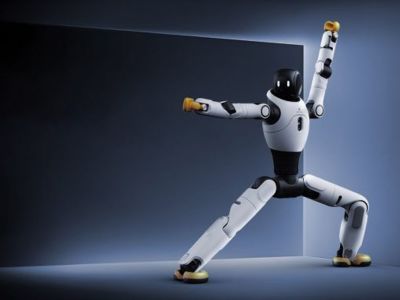
Unitree G1 vs AgiBot X2-N
Compare Unitree G1 vs AgiBot X2 for humanoid mobility, dexterity, autonomy, and payload capacity.
Disclaimer
All content, comparisons, and verdicts on this website are based on our research, testing, and opinion. While we strive for accuracy, we do not guarantee the completeness, reliability, or suitability of any information. Performance, specifications, and results may vary depending on usage and conditions. This website and its authors are not responsible for any decisions, actions, or outcomes based on the information provided. Always verify product details with the manufacturer before making purchase or operational decisions.