The Roborock Q7 Max is a mid-range robot vacuum positioned in the $400-$600 price bracket, offering advanced navigation through PreciSense™ LiDAR with SLAM technology and comprehensive sensor integration.[1] This model distinguishes itself through superior suction power, with approximately 4,800-5,000 pascals compared to competing models in its category.[1] The Q7 Max supports mopping functionality alongside vacuuming, though its mopping implementation involves dragging a mop pad rather than utilizing separate clean and dirty water tanks.[1] It delivers faster mapping capabilities and demonstrates solid battery endurance for whole-home cleaning sessions.[1]
The Eufy C10 is a budget-conscious robot vacuum priced between $200-$400, making it accessible for cost-conscious consumers seeking reliable home cleaning.[2] It features LiDAR-based navigation combined with multi-infrared obstacle avoidance sensors, delivering a more compact footprint at 32.53 x 32.3 x 7.2 cm and lighter weight of 2.5 kg compared to larger competitors.[2] The C10 maintains a suction rating of 4,000 pascals, positioning it as a capable entry-level option for general residential cleaning, particularly in apartments and homes with low-clearance furniture.[2] Its streamlined design emphasizes portability and ease of maintenance while retaining core navigation and safety features.
Detailed Analysis
Design & Build Quality
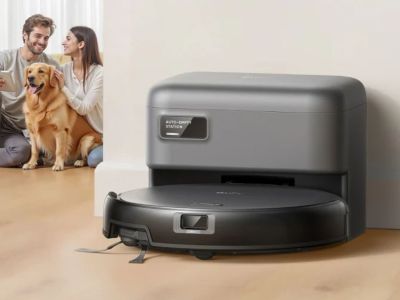
The Roborock Q7 Max measures 35 x 35 x 9.65 cm and weighs 5.54 kg, providing a larger chassis designed to accommodate additional water tank systems for mopping functionality.[1] The Eufy C10 is considerably more compact at 32.53 x 32.3 x 7.2 cm with a weight of just 2.5 kg, making it easier to maneuver in tight spaces and lift for maintenance.[2] The Q7 Max's heavier construction reflects its dual-function design, while the C10's lighter profile prioritizes accessibility and storage convenience. Both models operate at identical speeds of 0.3 m/s and feature comparable battery lifespans of 2-3 years, indicating similar engineering approaches to component durability.
Mobility & Navigation
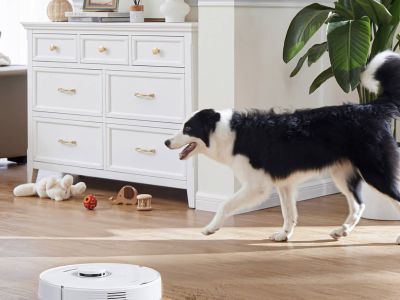
The Roborock Q7 Max employs PreciSense™ LiDAR with SLAM technology, enabling faster mapping speeds and more efficient route optimization during cleaning cycles.[1] The model demonstrated superior performance in battery efficiency during extended cleaning sessions, avoiding mid-session recharges in larger living spaces.[1] The Eufy C10 utilizes LiDAR-based navigation paired with multi-infrared obstacle avoidance sensors, providing adequate navigation for residential environments despite slightly lower mapping efficiency.[2] Both systems include cliff sensors and bump sensors for obstacle detection, though the Q7 Max's advanced SLAM implementation offers measurably faster initial mapping capabilities.
Sensors & Perception
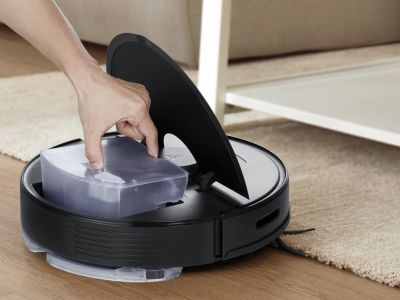
The Roborock Q7 Max integrates LiDAR, cliff sensors, bump sensors, and ultrasonic sensors for comprehensive environmental awareness during operation.[1] The Eufy C10 combines LiDAR with multi-infrared sensors and cliff detection systems, providing a streamlined sensor suite optimized for residential obstacle avoidance.[2] The Q7 Max's additional ultrasonic sensing capability provides supplementary obstacle detection beyond the C10's infrared approach. Both models implement cliff detection as a critical safety feature, though the Q7 Max's expanded sensor array contributes to its superior performance in complex floor layouts.
AI Capabilities
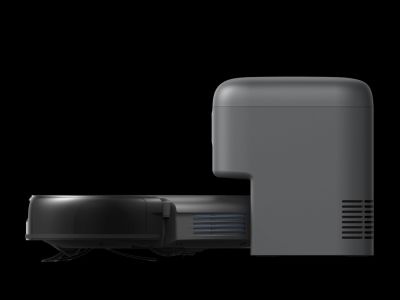
The Roborock Q7 Max operates on proprietary Roborock OS with firmware updates delivered through mobile app integration, enabling continuous algorithm improvements and feature additions.[1] The Eufy C10 uses proprietary firmware with app-based ecosystem support for updates and remote control functionality.[2] Both robots support voice control integration with Alexa and Google Assistant, allowing hands-free operation and smart home ecosystem compatibility. The Q7 Max's SLAM-based navigation represents a more sophisticated AI implementation for route optimization, while the C10's approach emphasizes simplicity and reliability for basic cleaning scenarios.
Battery & Power Efficiency
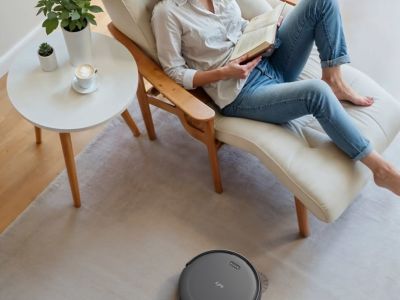
The Roborock Q7 Max demonstrated extended runtime capability, enabling completion of living room, dining room, and kitchen cleaning cycles without mid-session battery depletion in typical home environments.[1] The Eufy C10, while featuring comparable 2-3 year battery lifespan specifications, may require recharging during extensive multi-room cleaning sessions due to its lower suction power and smaller battery capacity.[2] Both models feature autonomous operation and app-based control, though the Q7 Max's power management proves more suitable for homes exceeding 1,060 square feet in cleaning coverage. The Q7 Max's superior power efficiency translates directly to longer operational sessions between charging cycles.
Use-Case Suitability
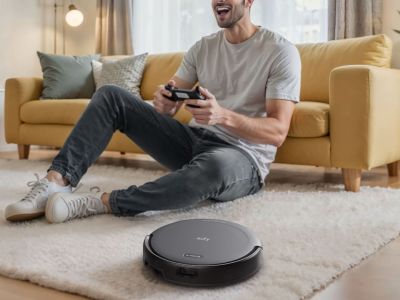
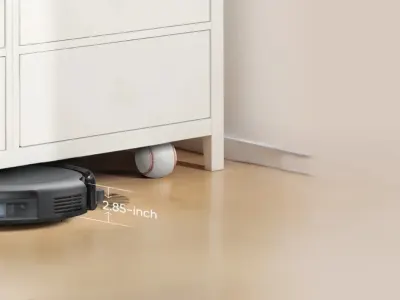
The Roborock Q7 Max is optimized for comprehensive home cleaning, pet hair removal, and mixed flooring scenarios requiring sustained suction power and extended runtime.[1] Its mopping capability adds functional versatility, though implementation via dragging mop pads limits effectiveness compared to dedicated wet-cleaning systems.[1] The Eufy C10 is specifically designed for residential homes, pet-friendly households, apartments, and spaces with low-clearance furniture where compact design and budget constraints take priority.[2] The Q7 Max suits homeowners with larger properties and multi-surface cleaning demands, while the C10 addresses space-constrained environments and cost-conscious consumers seeking reliable basic cleaning functionality.

Control & Connectivity
The Roborock Q7 Max provides multi-modal control through the Roborock mobile app, voice commands via Alexa and Google Assistant, physical buttons on the device, and fully autonomous operation without user intervention.[1] The Eufy C10 similarly supports mobile app control, voice assistant integration, and autonomous scheduling through proprietary firmware.[2] Both models implement child lock safety features accessible through their respective control ecosystems. The Q7 Max's additional physical button interface provides redundant control options, enhancing usability for users preferring direct device interaction over app-based management.
Safety Features
The Roborock Q7 Max incorporates cliff detection, anti-collision sensors, and app-based child lock functionality to prevent accidental activation and stair descents.[1] The Eufy C10 implements identical cliff detection and anti-collision sensor systems with app-accessible child lock controls.[2] Both robots prioritize household safety through redundant detection systems, though the Q7 Max's additional ultrasonic sensing provides supplementary hazard awareness. Neither model specifies RGB camera-based obstacle avoidance technology, limiting their ability to detect fine hazards like small toys or cables compared to advanced premium models.
Analysis Score Summary
Total Score
10
Roborock Q7 Max
VS
Based on Detailed Analysis
Total Score
6
Eufy C10
📊 Win: 2 points | Trade-off: 1 point each
Scores are summed across every insight: a clear winner earns 2 points, while balanced trade-offs give each robot 1 point. The total reflects how often each robot outperforms the other (or shares the spotlight) throughout the detailed analysis sections.
Technical Specifications
Head-to-head performance data and metrics
| Specification | Model ARoborock Q7 Max | Model BEufy C10 |
|---|---|---|
Functional Utility & Use Cases4 Comparative Metrics | ||
Control Method | Roborock app, voice control (Alexa, Google Assistant), physical buttons on device, autonomous operation | Mobile app control, voice control (via Alexa and Google Assistant), autonomous operation |
Use Cases | Home cleaning, pet hair removal, mixed flooring | Residential homes, pet-friendly households, apartments, homes with low-clearance furniture |
Multi Robot Coord | Yes, multi-floor mapping | Not supported (single robot operation) |
Pet Friendly | Yes, designed to handle pet hair with anti-tangle brushes and strong suction | Yes, designed to handle pet hair effectively |
Kinematic Architecture & Dexterity3 Comparative Metrics | ||
Material | ABS plastic, rubber brushes | Plastic body with metal components |
Mobility Type | Wheeled robot with brush roll and suction | Wheeled robot with rolling brush and suction system |
Hardware Interface | Charging contacts on dock, no USB interface | Charging contacts on base station; no USB interface reported |
Intelligence & Computing Power2 Comparative Metrics | ||
Software System | Proprietary Roborock OS with firmware updates via app | Proprietary firmware with app ecosystem for updates and control |
Learning Capabilities | Room mapping, cleaning preferences | Multi-level room mapping, customizable cleaning zones, no-go areas, cleaning preference learning |
Functional Utility & Use Cases
4 Comparative Metrics
Kinematic Architecture & Dexterity
3 Comparative Metrics
Intelligence & Computing Power
2 Comparative Metrics
Related Comparisons
Discover similar robot matchups to expand your knowledge and find the perfect solution
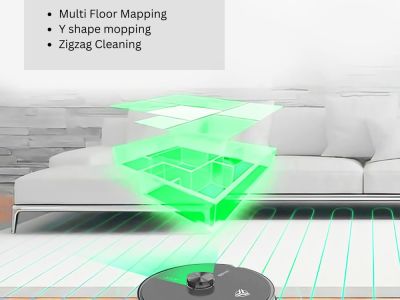
Laseron S9 Pro+ vs Eufy C10
Laseron S9 Pro+ or Eufy C10? Compare for pet hair handling, navigation accuracy, battery runtime, and home size suitability to pick the right vacuum.

Laseron S9 Pro+ vs Roborock Q7 Max
Head-to-head: Laseron S9 Pro+ vs Roborock Q7 Max compared on cleaning performance, mapping accuracy, battery runtime, and pet hair handling.
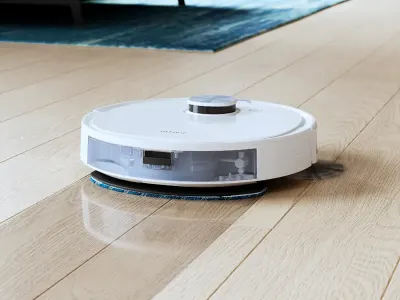
Ecovacs Deebot N10 Plus vs Roborock Q7 Max
Ecovacs Deebot N10 Pro+ or Roborock Q7 Max? Compare specs, navigation, sensors, and battery performance.
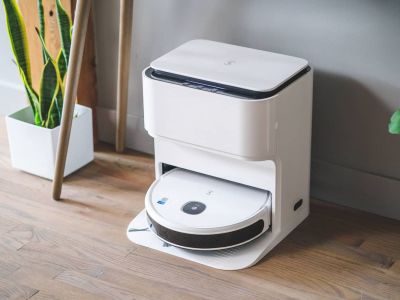
Ecovacs Deebot N9+ vs Roborock Q7 Max
Head-to-head: Ecovacs Deebot N9+ vs Roborock Q7 Max. Explore differences in navigation, sensors, dimensions, and software.
Disclaimer
All content, comparisons, and verdicts on this website are based on our research, testing, and opinion. While we strive for accuracy, we do not guarantee the completeness, reliability, or suitability of any information. Performance, specifications, and results may vary depending on usage and conditions. This website and its authors are not responsible for any decisions, actions, or outcomes based on the information provided. Always verify product details with the manufacturer before making purchase or operational decisions.