Kinetix AI
Kinetix AI is an embodied artificial intelligence company pioneering biological-grade physical intelligence and ultra-high-DoF humanoid platforms. Its flagship humanoid, KAI, features an industry-leading 115 degrees of freedom across its face, hands, and body, designed to match the complete range of biological human movement. Governed by the proprietary AMS humanoid training system and physics world models, Kinetix AI develops humanoids for domestic assistance, eldercare, and high-dexterity manufacturing.
💡Notable Achievement: Kinetix AI unveiled KAI, a revolutionary full-sized humanoid robot boasting a record-breaking 115 degrees of freedom (including 36 DoF across each hand and wrist) designed to achieve biological-grade physical intelligence.
What Does Kinetix AI Do?
Kinetix AI is pioneering the physical frontier of humanoid embodiment by building robots with biological-grade mechanical complexity. Believing that true physical intelligence cannot emerge from mechanically constrained hardware, Kinetix AI designed KAI—a full-sized humanoid robot featuring a world-record 115 active degrees of freedom. From hands that match the exact bone and tendon articulation of human fingers to a fluid multi-joint spine and legs, KAI provides the ultimate physical avatar for next-generation world models and embodied foundation AI.
“Kinetix AI builds ultra-dexterous 115-DoF humanoid robots that unlock biological-grade physical intelligence.”
115 Degrees of Freedom
Unrivaled mechanical articulation matching biological human joint flexibility across hands, spine, and lower limbs.
AMS Foundation System
Comprehensive training suite combining large-scale physical simulation with real-world reinforcement learning.
Human-Equivalent Hand Dexterity
36 DoF per hand-wrist complex enabling manipulation of fine tools, flexible textiles, and delicate electronics.
What Can Kinetix AI Robots Actually Do?
Cross-portfolio operational capabilities, manipulation tasks, and environmental competencies
Kinetix AI produces ultra-high-DoF humanoids, biomimetic dexterous hands, and AI world model training suites.
Micro-Dexterous Manipulation
36-DoF hand articulation capable of handling surgical tools, threading needles, and folding fabric.
Fluid Anthropomorphic Mobility
Multi-jointed flexible spine and bipedal legs that reproduce human-like expressive body language.
AMS Physical World Modeling
Learns complex physical dynamics and contact mechanics directly from multimodal sensor telemetry.
Kinetix AI Robots
Showing 1 Humanoid Robots of 1 total model

KaiBot
Manufactured by Kinetix AI
KaiBot by Kinetix AI is a full-size humanoid robot standing 173 cm tall, engineered for household services, light industrial tasks, and research with human-like dexterity and safety. Featuring 115 degrees of freedom—including 36 per hand (22 active, 14 compliant)—it excels in fine grasping, pinching, and compliant interactions mimicking human motion ranges like shoulder lift (-20° to 0°), torso flexion (-15° to 75°), and neck rotation (-15° to 50°). Covered in full-body tactile skin with 18,000 sensing points detecting 0.1N forces, it enables haptic-aware manipulation for safe close-range collaboration. Powered by a 1.7 kWh semi-solid-state battery, it supports 3-4 hours of dual-arm operation at up to 20 kg payload, reaching 5 km/h speeds. The KAI World Model with base-action-evaluation layers predicts environments via simulation-first training, integrating LLMs for intelligent, low-latency responses in dynamic settings.
Kinetix AISoftware & AI Ecosystem
Developer platforms, fleet management portals, autonomy intelligence, and enterprise integrations
Software Feature
What Makes Kinetix AI Different?
Editorial AnalysisOrigin of Bots objective strategic assessment, engineering moats, and commercial hurdles
Key Strengths & Moats
- ✓Unprecedented 115-DoF mechanical articulation setting an industry record for humanoid mobility
- ✓Remarkable hand dexterity addressing the most difficult fine-motor manipulation bottlenecks
- ✓Innovative AMS training system bridging physical simulation with real-world deployment
Core Strategic Focus
Refining actuator reliability across high joint counts and scaling developer shipments to global AI labs.
Road Ahead & Challenges
- •High mechanical complexity increases maintenance and calibration requirements
- •Thermal dissipation management across dense micro-actuator clusters in the hands
Kinetix AI vs Key Competitors
Strategic capability matrix across platform categories, commercial readiness, and target markets
| Strategic Dimension | KAI (Kinetix AI) | Phoenix (Sanctuary) | Clone Alpha | Figure 02 |
|---|---|---|---|---|
| Degrees of Freedom | 115 DoF (Full Body) | 20 DoF Hands / Upper | Musculoskeletal Hyd. | 40+ DoF |
| Hand Degrees of Freedom | 36 DoF (with wrist) | 20 DoF per hand | Musculoskeletal Hand | 16 DoF per hand |
| Actuation Type | Electric Micro-Rotary | Electric Rotary | Hydraulic / Artificial | Electric Rotary |
| Primary Mission | Bio-Physical Intelligence | Retail & Commercial | Biomimetic Research | Automotive & Logistics |
Corporate Ecosystem & Ownership Structure
Parent company relationships, historical acquisitions, and global operating facilities
Articles & Industry News
Showing 1 recent article and news updates about Kinetix AI
Frequently Asked Questions
10 AnswersVerified answers, company specifications, and deployment details about Kinetix AI
What is the unit purchase price or RaaS lease pricing model for KAI?
KAI is positioned as a premier research and high-capability developer platform, with complete 115-DoF units priced around $110,000 to $140,000 USD, while modular subsystems including the AMS training software are offered through institutional enterprise subscriptions.
What is the commercial timeline and current availability status of KAI?
Kinetix AI completed development of the AMS simulation training suite in late 2025 and publicly debuted KAI in April 2026. The robot is actively supplied in small batches to elite robotics research labs and commercial pilot partners worldwide.
Where are KAI robots actively deployed in real-world facilities?
KAI is deployed across embodied intelligence research institutes in Shenzhen, robotics laboratories in Hong Kong, and partner AI testbeds in California.
What target industrial and everyday workflows does KAI automate?
KAI is engineered for tasks requiring human-like fine motor control: assembling intricate electronics, folding garments, handling fragile glassware, operating complex tools, and providing conversational social service.
What mechanical drivetrain and actuator architecture powers KAI?
KAI incorporates 115 active degrees of freedom driven by custom micro-rotary actuators, tendon transmissions in the hands, and high-torque electric motors in the spine and legs providing human-equivalent joint ranges of motion.
What end-effector dexterity, hand degrees of freedom (DoF), and tactile sensing does KAI feature?
KAI features unprecedented dexterity with 36 active DoF across each hand and wrist assembly, reproducing biological opposable thumb motion, independent finger articulation, and full tactile skin arrays across all contact zones.
What is KAI's continuous battery runtime, capacity, and charging mechanism?
KAI is powered by a high-discharge 48V 1.4 kWh lithium battery system supporting 3 to 4.5 hours of continuous whole-body dexterous movement, with autonomous charging docking support.
What is KAI's operational autonomy level versus remote teleoperation dependency?
KAI leverages the AMS physics foundation model for autonomous fine manipulation and bipedal balance, while supporting full-body exoskeleton teleoperation for collecting high-dimensional demonstration datasets.
What sensory perception suite and foundation AI models govern KAI?
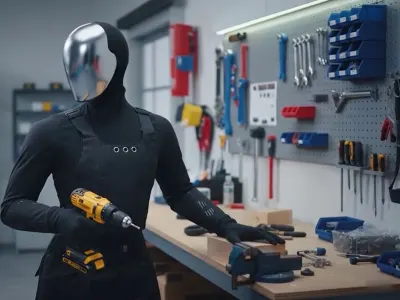
KAI uses a faceless sensor cluster integrating multi-wavelength depth cameras, high-framerate stereo RGB vision, and tactile skin feedback, governed by the AMS world foundation model.
What worker safety mechanisms, force compliance, and physical limits protect human collaborators?
KAI features elastic compliant joint mechanisms, software torque limiting on every joint, and soft aesthetic coverings to ensure collaborative human safety in shared indoor spaces.
Verified Data & Editorial Assurance
Compiled from verified corporate filings, official Kinetix AI datasheets, and robotics engineering registries. Information has been verified against official manufacturer documentation. For commercial procurement or proprietary integrations, contact the manufacturer directly.