Humanoid Robots Summit Europe 2026 Concludes in Stuttgart with Commercial Orders Reaching $2.4 Billion
Category
humanoidPublished
September 11, 2026
Reading Time
3 min read
Author
Origin Of Bots Editorial Team
Summit Concludes with Historic Multi-Billion-Dollar Milestone
The Humanoid Robots Summit Europe 2026 concluded its landmark three-day conference at the Kultur- und Kongresszentrum Liederhalle in Stuttgart on Friday. During the closing executive sessions, industry leaders and market analysts revealed that cumulative commercial orders for humanoid robots worldwide have crossed $2.4 billion.
This staggering valuation marks a profound psychological turning point for the robotics industry, transforming bipedal automation from an experimental R&D expense into a major capital expenditure category. Manufacturing leaders confirmed that enterprise customers are no longer ordering single evaluation units, but booking multi-hundred-unit fleet deliveries.
Schaeffler Commits to Thousands of Deployed Humanoids
Providing concrete industrial grounding for these multi-billion-dollar estimates, German automotive supplier Schaeffler detailed its commercial deployment roadmap. Following successful pilot integrations, Schaeffler confirmed plans to deploy between 1,000 and 2,000 humanoid robots across its global manufacturing network starting in late 2026.
The bipedal workforce will be stationed along precision machining cells and bearing assembly lines to handle ergonomically demanding material transfers. Automating heavy parts staging allows the tier-one supplier to alleviate severe labor shortages while safeguarding skilled human machinists from repetitive strain.
Five-Year Supply Agreement for Over One Million Joint Drives
In an unprecedented dual role, Schaeffler positioned itself not merely as an enterprise customer, but as a tier-one component supplier to the broader robotics industry. The German industrial giant formalized a five-year agreement to supply more than half of the joint actuators for a major humanoid production initiative.
Under the contract terms, Schaeffler will manufacture and deliver at least one million high-precision humanoid drive units by 2031. This massive production commitment confirms that global tier-one automotive suppliers are retooling their high-volume production lines to supply the humanoid robotics revolution.
Achieving Strict Industrial Takt-Time Harmonization
Throughout technical working sessions at the Stuttgart summit, engineers presented data resolving the challenging friction between humanoid pacing and factory takt times. In automotive assembly plants, every station cycle must execute within a rigid 60-to-90-second window to prevent stalling entire vehicle lines.
Presenting robotics firms demonstrated updated whole-body trajectory planners that eliminate hesitations during part handoffs, achieving continuous fluid motion. Demonstrating cycle times that match seasoned factory line workers has removed the final technical reservation holding back conservative automotive plant managers.
Active Thermal Management for Continuous Double-Shift Operations
Another critical engineering breakthrough detailed on the summit floor was the mastery of actuator thermal dissipation during intensive manufacturing duty. Continuous high-torque lifting historically generated dangerous heat buildup inside compact joint housings, causing emergency shutdowns after two hours of operation.
Exhibiting component specialists showcased new phase-change cooling sleeves and high-conductivity thermal interfaces that dissipate heat directly through structural aluminum bones. These thermal innovations enable humanoids to operate across continuous eight-hour industrial shifts without requiring cooling pauses or degraded cycle speeds.
Standardized European Machinery Directives and CE Marking
A major policy triumph emerging from the summit was the harmonization of safety compliance frameworks under the European Union Machinery Regulation. European safety inspectors outlined standardized certification protocols for cage-free humanoid collaboration with unionized plant personnel.
The certification framework establishes mandatory dual-channel torque limiters, fail-safe mechanical brakes, and certified stereoscopic safety exclusion zones. Establishing clear regulatory pathways gives European enterprise buyers the legal certainty required to deploy autonomous bipedal workers on active shop floors.
Forging Europe's Leadership in the Industrial Humanoid Revolution
The conclusion of the European Humanoid Robots Summit in Stuttgart cements Europe's determination to lead the industrial implementation of embodied AI. By pairing world-renowned precision manufacturing infrastructure with frontier robotics engineering, European industry is establishing a resilient technological bulwark.
With over $2.4 billion in commercial backlogs and million-unit component contracts signed, the commercial trajectory of humanoid robotics is now irrevocable. The machines showcased at the Liederhalle will permanently reshape the future of industrial production across Europe and the world.
Sources
Related Articles
Unitree’s Superman humanoid puts speed first as China’s robotics race accelerates
Lumos Robotics positions MOS 2 as a factory-ready humanoid built for teleoperation and heavy handling
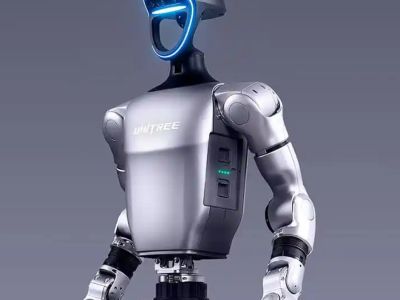
Unitree Expands Commercial Footprint with G1 Mass Deployments and Shanghai Market Momentum