Minerva Humanoids Raises $10M for Roger, a Humanoid Robot Built for Dangerous Jobs
Category
humanoidPublished
October 6, 2026
Reading Time
4 min read
Author
Origin Of Bots Editorial Team
A Robot Sent Where People Should Not Go
A new robotics start-up called Minerva Humanoids stepped out of stealth on October 6, 2026, announcing roughly $10 million in pre-seed funding led by venture firm General Catalyst. Its first product is Roger, a humanoid robot designed to do the most dangerous work in energy plants, airports and bomb disposal.
The pitch is simple and aimed at ordinary human stakes: instead of sending a person to defuse a device or climb into a hazardous plant, send a machine that has two arms and hands, controlled by a trained specialist standing safely somewhere else.
The Problem With Dangerous Work
Minerva points to a grim statistic from the energy industry: roughly 7,000 energy workers die on the job worldwide each year, which the company says works out to one death every 75 minutes. Offshore oil rigs and high-voltage power stations sit at the heart of that number.
Public safety work carries similar risks. Bomb disposal teams have relied for decades on tracked robots with a single arm. According to Minerva, those machines often cannot finish the job, because many tasks need two hands and real dexterity, and a technician must then make the dangerous walk up to the device.
Meet Roger, the Remote-Controlled Human Stand-In
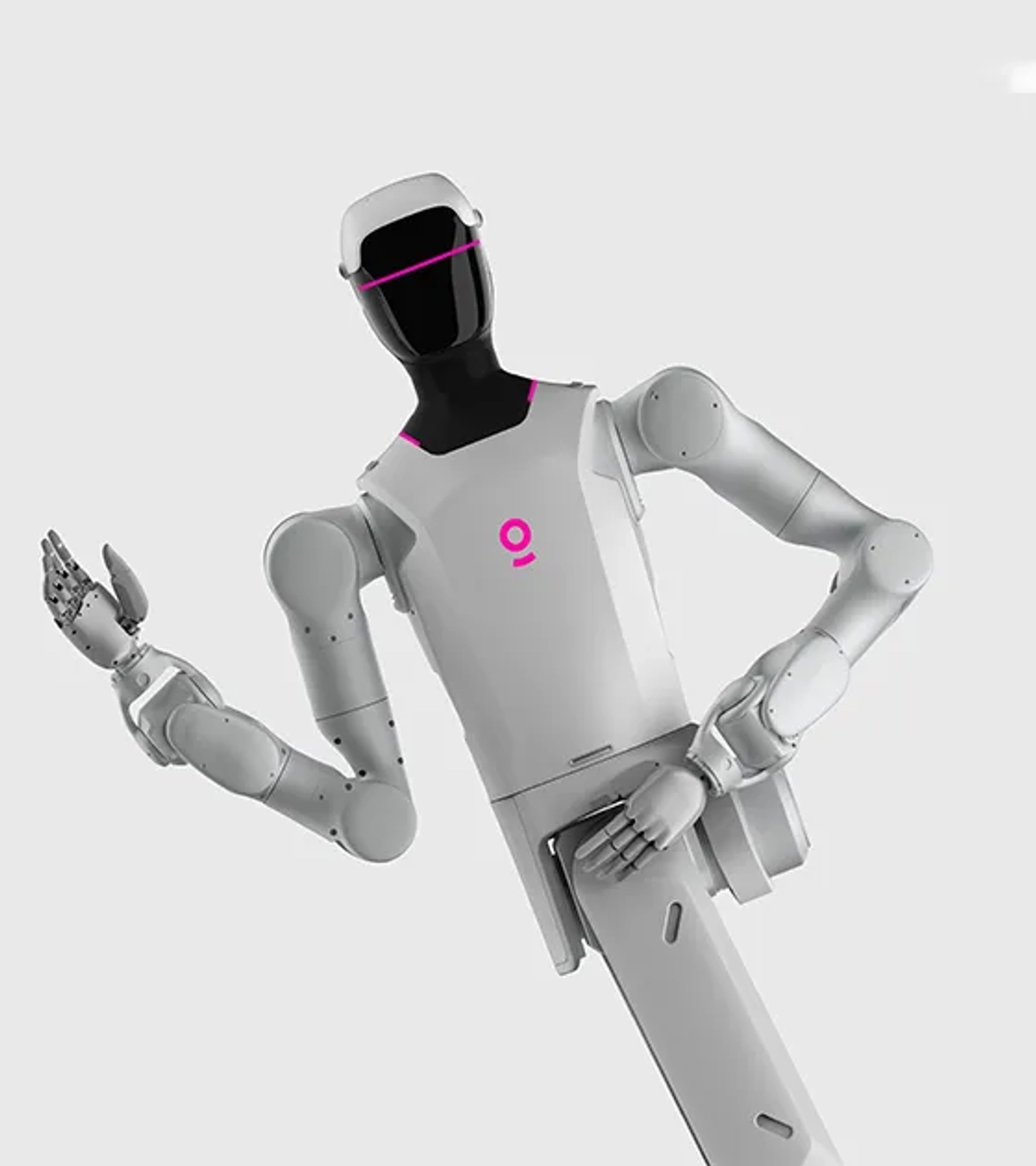
Roger is what the company calls a semi-autonomous humanoid, meaning a robot shaped roughly like a person that does some things by itself while a human guides the rest. A trained operator wears a virtual reality headset and sees through the robot's cameras.
From there, the operator's movements steer the robot's body and hands, allowing delicate manipulation from a distance. Minerva says operators can learn the full-body controls within minutes. Dominic Asquith, its head of hazardous operations, says the operator's judgement and hands reach the scene while their body stays safe.
The Software That Keeps It Upright
Steering a two-legged machine by hand would be exhausting and risky if the human had to manage every step. So the company layers its own software, called Minerva Intelligence, underneath the operator's commands. It handles balance, recovery from falls and navigation on its own.
That split matters. The person makes the high-stakes decisions about what to touch and what to leave alone, while the software deals with the unglamorous problem of staying on two feet. The company also says the controls respond with very little delay, which is critical when fingers are working near explosives.
Built in Five Months
Minerva was founded at the end of 2025 and is based in San Francisco, with offices in Cambridge, Massachusetts, and Sindelfingen, Germany. The company says it developed Roger in just five months, a pace unusual for a machine this complicated.
Robin Dechant of General Catalyst said building a humanoid from scratch is often a years-long project, but that the founders did it in under six months. Roger is currently manufactured in Germany, and the company says it plans to build in the United States using the Western industrial base.
The Team Behind the Machine
Chief executive Sandor Felber previously worked on humanoid research at MIT's computer science and artificial intelligence lab and on Tesla's Optimus humanoid program. Chief technology officer Maurice Rahme spent six years at Boston Dynamics, where he was a technical lead on the warehouse robot Stretch.
Rounding out the leadership is Asquith, a British Special Forces veteran who brings the end user's view. The mix of robot engineering and field experience is deliberate, since the company is selling to people whose workdays involve explosives, high voltage and open sea.
Early Tests in the Real World
Minerva says it has already shown Roger at the NATO Explosive Ordnance Disposal Centre of Excellence in Samorin, Slovakia, and has done on-site testing at two of the world's ten busiest airports. It also lists research partnerships with Mohamed bin Zayed University of Artificial Intelligence and the University of Waterloo.
The first paid pilots are due to start in fall 2026, according to the announcement. A pilot is a limited trial with a real customer, which is a far cry from large-scale deployment, so the company's claims are still waiting to be proven in daily use.
Who Is Betting on It, and What Is Still Unknown
Alongside General Catalyst, the round was co-led by Long Journey Ventures and Credo Ventures. Other backers include MVP Ventures, RunwayVC, Hugging Face and several more firms and individuals. About $10 million is a small sum in a field where rivals have raised far more.
Plenty remains undisclosed. The announcement does not give Roger's height, weight or price, and it does not say how long the battery lasts or how it performs outside demonstrations. Felber says the aim is not to replace the people doing these jobs, but to keep them out of harm's way.