Spirit AI Forecasts General-Purpose Humanoid Robot Brains Poised for a 'ChatGPT-Style' Inflection by 2027
Robot Details
Robotics & AI News • OriginOfBotsPublished
September 18, 2026
Reading Time
5 min read
Author
Origin Of Bots Editorial Team
Anticipating the Tipping Point for Physical Intelligence
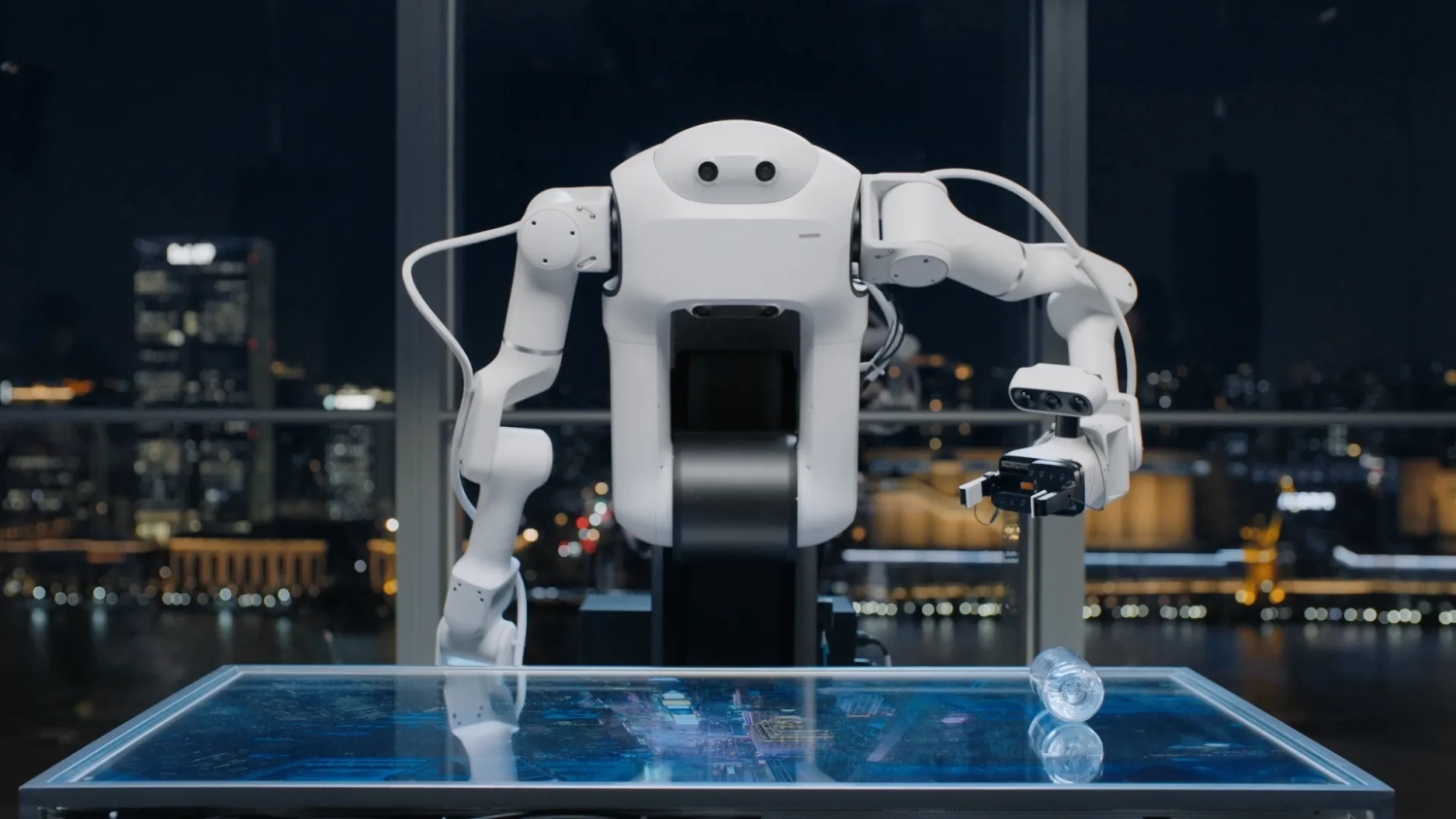
In an exclusive interview with Reuters, leadership at Beijing-based embodied AI startup Spirit AI announced that humanoid robotics is approaching its definitive breakthrough. The company predicts that general-purpose 'robot brains' will achieve a generalized inflection analogous to OpenAI's ChatGPT moment as early as 2027. Founded by elite roboticists from Tsinghua University, Spirit AI argues that physical foundational intelligence is evolving along identical exponential scaling curves.
Historically, bipedal humanoids remained severely constrained by task-specific neural policies that failed whenever workspace conditions shifted unexpectedly. By transitioning to multi-modal foundation models that unify semantic reasoning and low-level joint actuation, the barrier to general-purpose utility is falling. This cognitive transformation marks the threshold where humanoids evolve from programmed mechanical executors into self-directing physical agents.
Deploying Moz1 in High-Dexterity Retail Service Workflows
To prove its cognitive architecture outside research cleanrooms, Spirit AI demonstrated its proprietary Moz1 humanoid operating in commercial retail environments. In public demonstrations, Moz1 autonomously executed delicate food service workflows, successfully skewering and serving traditional candied hawthorn treats. The sequence required dynamic bimanual coordination, delicate tactile pressure modulation to avoid crushing brittle sugar crusts, and fluid customer interaction.
Spirit AI confirmed that Moz1 has achieved a verified ninety percent autonomous task success rate across structured commercial pilot installations. Handling delicate consumables proves that physical AI models can regulate force exertion with sub-millimeter precision in response to tactile sensations. Mastering fragile objects in public retail venues demonstrates that cognitive robot brains are moving steadily beyond coarse warehouse cartage.
The Convergence of Cerebrum Reasoning and Cerebellum Kinematics
A central architectural challenge in building generalized robot brains is harmonizing high-level symbolic logic with millisecond motor reflexes. Spirit AI's neural framework implements a dual-tier cognitive hierarchy linking a multi-modal reasoning 'cerebrum' to a dynamic motor 'cerebellum.' The upper cerebrum parses spoken natural language instructions, analyzes visual scenes, and decomposes long-horizon workflows into discrete procedural sub-tasks.
Simultaneously, the high-frequency cerebellum translates these task tokens into continuous, compliant joint torque trajectories at kilohertz frequencies. This unified end-to-end design eliminates the awkward computational pauses and jerky hesitations that plague legacy multi-module architectures. Achieving seamless cognitive-motor synthesis enables humanoid robots to move with biological fluidity while adapting dynamically to environmental interruptions.
Overcoming the Data Scarcity Barrier in Physical Robotics
While large language models scale effortlessly across trillions of web text tokens, embodied robotics has long confronted an acute physical data drought. Spirit AI circumvents this bottleneck by synthesizing massive real-world video datasets, human teleoperation recordings, and physics-based simulations. The startup’s generative world models generate millions of synthetic physical interactions, allowing neural policies to explore rare edge cases safely.
Virtual simulation clusters expose the model to slippery floor surfaces, dropping objects, and sudden human obstacles across trillions of training cycles. Pretraining across synthetic physical environments enables zero-shot skill transfer onto physical humanoid hardware with minimal manual fine-tuning. Scaling physical simulation data transforms robotic training into an abundant, software-driven process that bypasses hardware fleet collection limits.
Commercial Strategy: From Service Niches to Scaled Manufacturing
Spirit AI’s commercial roadmap reflects a disciplined, stepped strategy designed to build operational cash flow while refining general capabilities. The company is prioritizing initial commercial rollouts across customer service, retail food prep, and hospital hospitality before entering heavy industrial plants. Structured retail settings provide predictable lighting and defined workspaces that maximize autonomous success rates while building public comfort.
As cognitive foundation models mature and accumulate diverse edge-case data from service deployments, Spirit AI will expand into complex electronics manufacturing. Partnering with tier-one hardware manufacturers allows the startup to focus exclusively on software intelligence without shouldering heavy factory capital expenditure. This asset-light software licensing model positions the venture to scale its robot brain across multiple competing humanoid hardware platforms.
Geopolitical Dynamics in the Global Embodied AI Race
Spirit AI’s aggressive commercial forecast underscores China’s rapid emergence as a global epicenter for embodied artificial intelligence innovation. While North American frontier labs lead in raw compute capacity, Chinese robotics ventures enjoy unmatched access to dense domestic supply chains and manufacturing sandboxes. Close proximity to world-class precision actuator, harmonic reducer, and sensor manufacturers drastically compresses hardware iteration cycles.
Governmental policy incentives and vast domestic retail markets provide an eager testbed for deploying thousands of prototype humanoids into live operations. Western technology analysts acknowledge that China’s combined hardware ecosystem and aggressive software scaling could accelerate its path toward physical AGI. This fierce international competition is propelling massive capital inflows into robotic foundation models, speeding the global arrival of autonomous labor.
The Impending Dawn of Universal Physical General Intelligence
Spirit AI’s projected 2027 milestone represents far more than an incremental performance upgrade for industrial automation. A genuine 'ChatGPT moment' in robotics means machines will possess common-sense physical intuition, allowing them to perform unfamiliar chores upon unboxing. Human workers will collaborate with intuitive humanoid assistants that understand natural speech, perceive physical contexts, and self-correct unexpected errors.
The transition from specialized, brittle automation to universal physical intelligence will fundamentally redefine global manufacturing and domestic living. As foundational robot brains continue ingesting the sensory complexity of our world, the boundary between biological and mechanical skill dissolves. By setting a 2027 timeline, Spirit AI has sounded a clarion call that the era of general-purpose embodied intelligence is within arm's reach.
Sources
- Chinese 'robot brain' startup sees ChatGPT-style breakthrough as soon as next year - Reuters / BNN Bloomberg
- Founder of Chinese startup Spirit AI says robot brains set for 2027 breakthrough - KSL News
- Founder of Chinese startup Spirit AI says robot brains set for 2027 breakthrough - The Economic Times
Related Articles

Tesla Optimus Scales Internal Gigafactory Operations and Reaffirms 2027 Consumer Target

International Broadcasters Spotlight Viral Milestone of Humanoid Robot Autonomously Walking Off Assembly Line
Samsung Begins Prototype 2nm AI5 Chip Fabrication for Tesla FSD and Optimus Humanoid Robots
ETH Zurich Unveils 'Fingers as Legs': Anthropomorphic Hands Master Untethered Locomotion and Mobile Manipulation
Learn More About This Robot
Discover detailed specifications, reviews, and comparisons for Robotics & AI News.
View Robot Details →