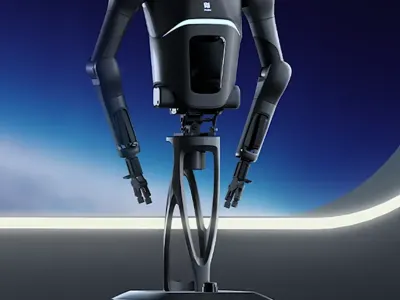
The AgiBot G2 by AgiBot is presented as an industrial-grade humanoid aimed at precision manufacturing, logistics, and collaborative industrial tasks, positioned for enterprises seeking highly articulated manipulation and autonomous task execution; it distinguishes itself with a 49+ degree-of-freedom humanoid body, high-precision torque sensing and a proprietary AI OS on powerful onboard compute platforms[1][3]. The G2’s estimated price band ($50,000–$200,000+ USD) and emphasis on fine manipulation, 360° spatial perception, and reinforcement-learning-ready software mark it as a higher-capability production humanoid for automation and research deployments[1][3].
The D7 by Pudu Robotics is a humanoid platform targeted at manufacturing, research, logistics and inspection use cases, emphasizing robust navigation (visual SLAM and LiDAR mapping), ROS 2 compatibility and a developer-friendly Python SDK for integration and teleoperation[?]. The D7’s physical specs (170 cm × 55 cm × 38 cm, 50–80 kg) and estimated price range ($50,000–$150,000) frame it as a practical platform for organizations that prioritize navigation, mapping and integration into ROS-based environments[?].
Detailed Analysis
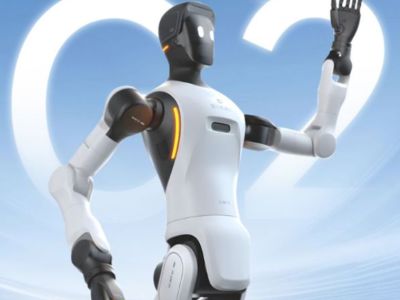
Design & Build Quality
AgiBot G2 uses a highly articulated, human-like body with 49+ degrees of freedom and a 55 kg mass, designed for precise, humanlike motions and manipulation in industrial environments, with reported features such as cross-moment wrists and high-performance actuators[1][3]. The D7 is presented as a humanoid of similar stature (170 cm height, 50–80 kg weight) with typical humanoid proportions and an emphasis on balance-assisted walking and structural robustness for field tasks, reflecting a build optimized for mobility and payload flexibility[?]. Both platforms cite industrial deployment intent, but AgiBot emphasizes fine manipulation hardware while D7 emphasizes structural balance and practical field durability[1][?].

Mobility & Navigation
AgiBot G2 advertises a top speed of 7 km/h and advanced 360-degree spatial perception with obstacle avoidance, suggesting gait and motion control tuned for both speed and precise positioning in factory scenarios[1][3]. D7 specifies walking speeds in the 1.5–3 m/s range (equivalent to 5.4–10.8 km/h) and lists visual SLAM plus LiDAR mapping with balance-assisted walking, indicating strong mapping and dynamic stability for inspection and logistics routes[?]. Navigation-wise, both platforms support SLAM-like approaches and obstacle avoidance, with D7 explicitly calling out LiDAR mapping and ROS 2 integration for navigation stacks while AgiBot emphasizes proprietary spatial perception and AI-driven planning[1][?].
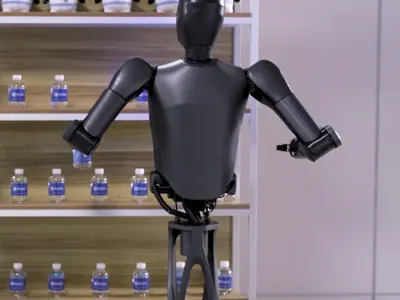
Sensors & Perception
AgiBot G2 lists high-precision torque sensors, 360-degree spatial perception, cameras, force sensors and environmental sensors, with emphasis on torque-based touch/force detection for manipulation and comprehensive situational awareness[1][3]. D7’s sensor suite includes RGB cameras, depth camera, LiDAR, IMU, gyroscope, accelerometer, force/torque sensors and joint encoders, supporting multimodal perception for mapping, balance and interaction in unstructured environments[?]. In comparison, AgiBot emphasizes tactile and torque precision for manipulation while D7 emphasizes multimodal sensing (LiDAR + vision + inertial) for navigation and stability[1][?].
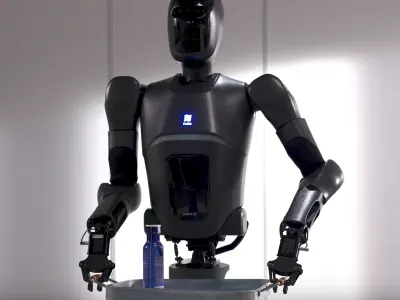
AI Capabilities
AgiBot G2 runs a proprietary AI OS (likely Linux-based) with reinforcement learning and simulation support, reportedly using onboard high-performance compute such as NVIDIA Jetson-class platforms and AgiBot’s large models for task planning and rapid learning[1][3]. D7 offers autonomous and teleoperation modes with learned behaviors and explicitly supports ROS 2 plus a Python SDK, enabling integration with external AI stacks and research workflows for custom autonomy[?]. The primary distinction is AgiBot’s emphasis on embedded proprietary AI and rehearsal-driven task planning versus D7’s emphasis on open integration and ROS-compatible development for bespoke autonomy[1][?].
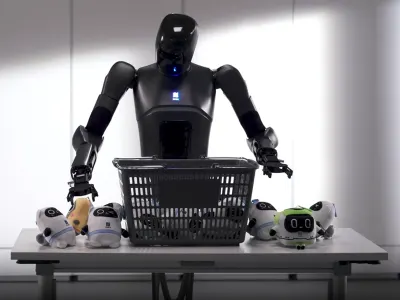
Battery & Power Efficiency
AgiBot G2’s battery details are not fully specified in the provided data but estimates and demonstrations reference hot-swappable dual batteries and an estimated multi-year battery lifecycle typical of industrial lithium packs (3–5 years), implying design for continuous operation and rapid swap/charging[1][3]. D7 lists a 3–5 year battery lifecycle and is positioned for field usage with typical industrial battery longevity and swap/charging workflows, indicating similar maintenance expectations[?]. Both platforms therefore present comparable battery longevity estimates, with AgiBot G2 additionally referenced in demonstrations for hot-swappable operation to support near-continuous uptime[3][?].

Use-Case Suitability
AgiBot G2 is positioned for auto parts production, precision manufacturing, logistics sorting, guided tours and collaborative industrial tasks where dexterous manipulation and precise force control are required, supported by its torque sensing and fine-actuation design[1]. D7 targets manufacturing, research, logistics, infrastructure inspection and remote operations, favoring scenarios where mapping, stability and ROS-based integration are priorities[?]. Selecting between them depends on task emphasis: choose AgiBot G2 for fine manipulation and embedded AI-driven task planning, and D7 for navigation-heavy or ROS-integrated inspection and logistics tasks[1][?].
Software Ecosystem
AgiBot G2 runs proprietary AI OS (likely Linux-based) with reinforcement learning and simulation support, implying a closed but highly tuned software stack intended for enterprise deployments and on-device model execution[1]. D7 provides a Linux-based OS with ROS 2 support and a Python SDK, which facilitates development, researcher access and integration with standard robotics toolchains and external AI services[?]. The trade-off is AgiBot’s integrated, proprietary stack optimized for specific workflows versus D7’s openness and developer accessibility for custom solutions[1][?].
Safety Features
AgiBot G2 lists emergency stop, real-time force sensing, obstacle avoidance and impedance control as safety mechanisms tailored to human-robot collaboration and delicate handling, leveraging torque sensing for contact-aware motion limits[1]. D7 implements force limiting, collision detection, emergency stop and redundant sensors to meet safety needs across inspection, logistics and human-adjacent environments, with explicit mention of redundant sensor systems for fail-safety[?]. Both platforms emphasize collision detection and emergency stop, with AgiBot adding impedance control and torque-based contact awareness for manipulation safety[1][?].
Analysis Score Summary
Total Score
10
AgiBot G2
VS
Based on Detailed Analysis
Total Score
6
D7
📊 Win: 2 points | Trade-off: 1 point each
Scores are summed across every insight: a clear winner earns 2 points, while balanced trade-offs give each robot 1 point. The total reflects how often each robot outperforms the other (or shares the spotlight) throughout the detailed analysis sections.
Capabilities & Operational Tasks
Head-to-head comparison of what AgiBot G2 and D7 can do, their applications, and capabilities.
What Can AgiBot G2 & D7 Do?
18Core operational tasks, activities, and physical manipulation duties evaluated side-by-side.
| Task & Description | Model AAgiBot G217 supported | Model BD79 supported |
|---|---|---|
| Assembly | High | — |
| Autonomous task execution | High | High |
| Carrying and transport | High | High |
| Collaborative work | High | — |
| Human interaction | — | High |
| Inspection | High | — |
| Loading and unloading | High | — |
| Machine operation | High | High |
| Machine tending | High | — |
| Material handling | High | High |
| Move objects | High | High |
| Navigation | High | — |
| Packaging | High | — |
| Pick and place | High | High |
| Quality control | High | — |
| Repetitive physical tasks | High | High |
| Sorting | High | High |
| Tool use | High | — |
Technical Specifications
Head-to-head performance data and metrics
| Specification | Model AAgiBot G2 | Model BD7 |
|---|---|---|
Functional Utility & Use Cases4 Comparative Metrics | ||
Control Method | AI autonomous, remote teleoperation, multimodal voice interaction | Teleoperation, autonomous, learned behaviors |
Use Cases | Sub-millimeter precision assembly, hole searching, machine tending, industrial kitting, commercial showroom tours | Manufacturing, research, logistics, infrastructure inspection, remote operations |
Multi Robot Coord | Yes | (Inferred · Medium confidence · Typical for industrial fleets) | Multi-robot coordination via network |
Pet Friendly | Not Applicable (Industrial & Commercial Robot) | Yes, with safety protocols |
Manipulation & Load Capacity4 Comparative Metrics | ||
Carrying Capacity | 5 kg per arm (10 kg total) | 10 kg lifting capacity |
Deadlift Capacity | 5 kg per arm | 50 kg |
Payload Type | 5 kg per arm (Dual 7-DoF force-controlled arms) | Tools, sensors, industrial equipment |
Modular Attachments | Grippers, sensors, possibly custom end-effectors | Tool changers, gripper interfaces, sensor mounts |
Kinematic Architecture & Dexterity4 Comparative Metrics | ||
Degrees of Freedom | 26 DoF base (expandable to 50) | 30 |
Material | Aluminum frame, automotive-grade composites | Aluminum frame, composite joints, polymer covers |
Mobility Type | Wheeled (Omnidirectional mobile base, speed up to 1.5 m/s) | Wheeled-based |
Hardware Interface | USB, Ethernet, GPIO (typical for industrial robots) | USB-C, Ethernet, GPIO, CAN bus |
Functional Utility & Use Cases
4 Comparative Metrics
Manipulation & Load Capacity
4 Comparative Metrics
Kinematic Architecture & Dexterity
4 Comparative Metrics
Related Comparisons
Discover similar robot matchups to expand your knowledge and find the perfect solution
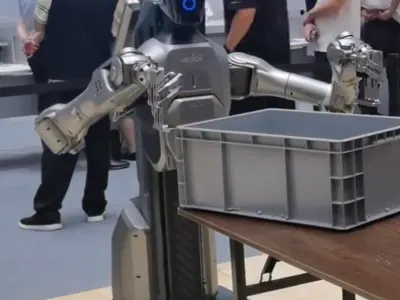
AgiBot G2 vs Cruzr Y1
Compare AgiBot G2 vs Cruzr Y1 for humanoid mobility, dexterity, autonomy, and payload capacity.
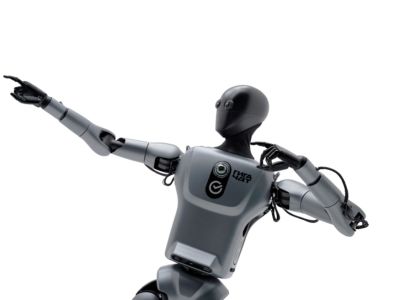
AgiBot G2 vs Green
Head-to-head: AgiBot G2 vs Green. Explore differences in navigation, sensors, and battery.
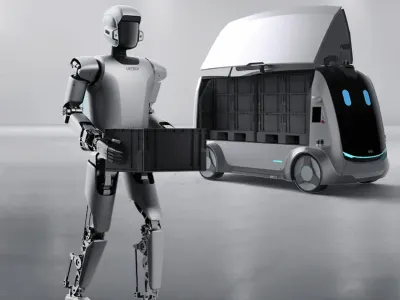
Walker S1 vs AgiBot G2
Walker S1 or AgiBot G2? Compare specs, sensors, navigation, speed, and real-world performance.
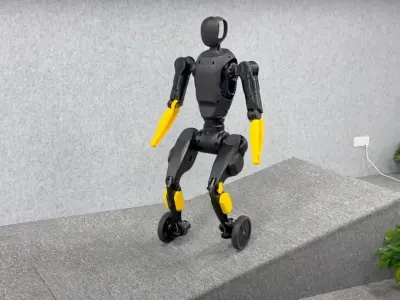
AgiBot G2 vs AgiBot X2-N
AgiBot G2 or AgiBot X2-N? Compare specs, navigation, battery, and sensors.
Disclaimer
All content, comparisons, and verdicts on this website are based on our research, testing, and opinion. While we strive for accuracy, we do not guarantee the completeness, reliability, or suitability of any information. Performance, specifications, and results may vary depending on usage and conditions. This website and its authors are not responsible for any decisions, actions, or outcomes based on the information provided. Always verify product details with the manufacturer before making purchase or operational decisions.