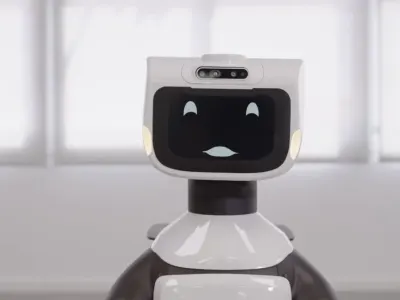
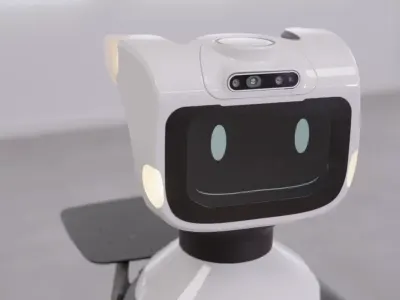
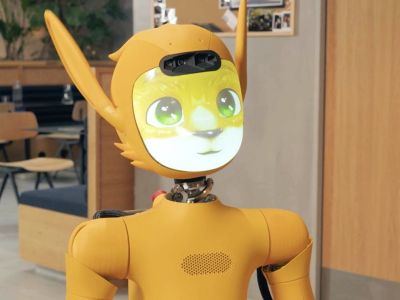
Mirokaï is presented by Enchanted Tools as a lightweight, interactive humanoid aimed at social logistics and HRI-focused service tasks; it is compared here to assess how its compact, ball‑based mobility, multichannel perception suite, and interaction‑first design position it against established mobile manipulators. The comparison highlights Mirokaï’s emphasis on social awareness, visual SLAM navigation, a large array of time‑of‑flight and RGB‑D cameras, and a design optimized for guiding, carrying light loads, and repetitive manipulation in public spaces. Mirokaï’s market positioning centers on visitor engagement, reception and hospitality workflows where agility, expressive interaction, and consistent grasping are prioritized over heavy payloads.
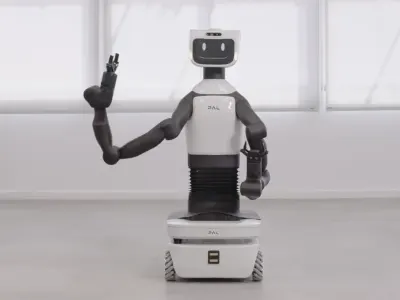
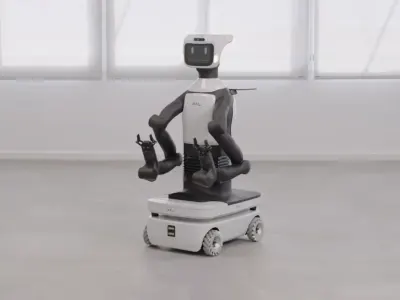
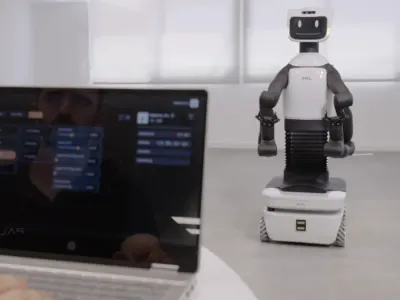
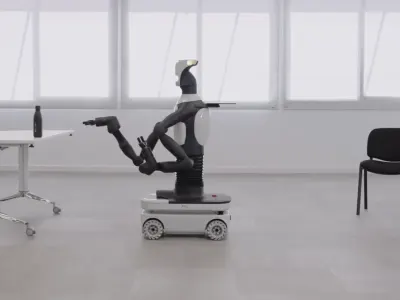
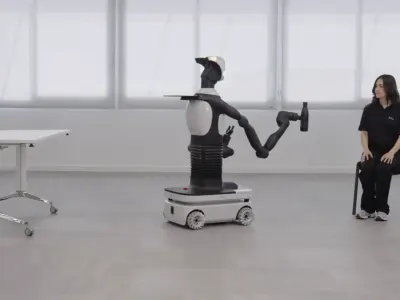
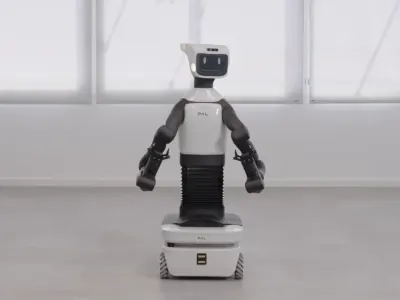
TIAGo Pro from PAL Robotics is an established humanoid mobile manipulator targeted at research, industrial prototyping, healthcare assistance and HRI, and it is compared here to measure differences in robustness, payload, and industrial sensor suites. The comparison highlights TIAGo Pro’s heavier build, larger payload and battery footprint, laser‑based SLAM with LiDAR, and ROS 2–centric software ecosystem designed for manipulation, navigation and integration into labs and facilities. TIAGo Pro’s market positioning centers on flexible manipulation, telepresence and integration into robotics development workflows where durability and standard ROS tooling matter.
Detailed Analysis
Design & Build Quality
Mirokaï is a compact humanoid with dimensions 123 cm x 52.5 cm x 50 cm and a mass around 29 kg, using a ball‑based mobile platform and animation‑style exterior focused on social presence and lightweight operation. TIAGo Pro is physically larger and heavier with variable height 120–155 x 50 x 72 cm and mass ~95 kg, built as a robust mobile manipulator with conventional wheeled base and industrial‑grade structural components. The two platforms reflect different tradeoffs: Mirokaï emphasizes low mass and expressive form for public interaction, while TIAGo Pro emphasizes structural heft and payload capacity for manipulation and prototyping. Materials and joint architectures differ accordingly, with Mirokaï optimized for safe social contact and TIAGo Pro for sustained manipulation workloads.
Mobility & Navigation
Mirokaï navigates indoors using Visual SLAM (VSLAM) with social awareness and reports speeds around 3.2 km/h (0.8–0.9 m/s) on a spherical/omnidirectional base enabling agile, human‑paced movement. TIAGo Pro uses laser‑based SLAM (LiDAR) with longer‑range self‑localization and obstacle avoidance and a top speed of 1.5 m/s (5.4 km/h), reflecting a design for faster transit and long‑range mapping in mapped facilities. Mirokaï’s VSLAM and social navigation optimize proxemic behavior and interaction in crowded public spaces, whereas TIAGo Pro’s LiDAR SLAM favors accurate mapping, loop closure and navigation to arbitrary map points. Both support autonomous navigation and teleoperation, but sensor modalities and base designs produce different operational envelopes.
Sensors & Perception
Mirokaï carries a dense multi‑camera and proximity array (2 RGB‑D cameras, 2 infrared cameras, 9 time‑of‑flight cameras, 6 ultrasound sensors, 4 microphones, 3 IMUs, torque sensors and hand contact/Hall sensors) to enable 360° perception and rich HRI capabilities. TIAGo Pro bundles 2x LiDAR units (10–25 m, 360° FoV), an RGB‑D camera (Intel RealSense D435), IMU, encoders, force/torque sensors at the wrist and joint torque sensing, plus a 4‑mic array and motor current feedback for situational awareness. Mirokaï’s sensor set targets multimodal social perception and close‑range object handling, while TIAGo Pro’s LiDAR and wrist F/T sensors prioritize mapping accuracy and manipulation feedback. Both platforms provide microphones and IMUs, but their complementary sensor choices reflect different perception tradeoffs.
AI Capabilities
Mirokaï uses onboard learned behaviors, VLMs and multi‑LLM integrations for real‑time speech recognition, multilingual dialogue and social awareness tied to its VSLAM navigation and grasping routines. TIAGo Pro relies on ROS 2–based frameworks supporting learned behaviors, teleoperation and autonomous navigation/manipulation workflows via standard ROS tooling and user‑supplied models. Mirokaï’s stack is oriented toward integrated HRI, expressive animation and out‑of‑the‑box interaction primitives, while TIAGo Pro emphasizes modularity for research and deployment with ros_control and ros2_controllers for custom AI stacks. Both support programming in Python and C++ and can execute learned behaviors, but Mirokaï foregrounds VLM/LLM interaction features versus TIAGo Pro’s developer‑centric ROS 2 ecosystem.
Battery & Power Efficiency
Both platforms report battery lifetimes described in multi‑year terms for battery usable life (3–5 years typical), with Mirokaï optimized for repeated short public‑space missions and TIAGo Pro sized for longer operational demands and heavier loads. Reported operating speed and mass differences imply different runtime profiles: Mirokaï’s lighter 29 kg mass and omnidirectional ball base favor lower mechanical power draw during short tasks, while TIAGo Pro’s 95 kg mass and higher top speed support extended transit and manipulation at higher energy cost. Specific runtime per charge is not provided in the source data, so direct per‑charge endurance comparisons cannot be made from the supplied specs. Both indicate typical battery service life rather than single‑use runtime metrics.
Use-Case Suitability
Mirokaï is specified for guiding and informing visitors, carrying trays and light packages, repetitive manipulation tasks and social engagement in public spaces such as hotels, hospitals and airports. TIAGo Pro is specified for human‑robot interaction, pick‑and‑place, telepresence, healthcare assistance and lab prototyping, supporting heavier manipulation and research integrations. For pure social logistics and lightweight HRI, Mirokaï’s compact form and perception set align closely with those applications, while TIAGo Pro better fits scenarios requiring higher payloads, manipulation robustness and ROS‑driven integration. Both support collaborative modes and emergency stop features for deployment in human environments.
Software Ecosystem
Mirokaï runs a custom Linux OS with ROS 2 compatibility and provides APIs for Python and C++, with integrated VLM/LLM features and HRI primitives exposed for developers. TIAGo Pro is natively ROS 2 based, supports ros_control and ros2_controllers, and exposes navigation, manipulation and HRI APIs in Python and C++ tailored for research and industrial prototyping. The two ecosystems enable developer extension, but TIAGo Pro’s out‑of‑the‑box ROS 2 tooling and RViZ plugin support are optimized for labs and integrators, whereas Mirokaï packages additional integrated speech/VLM stacks aimed at turnkey interaction deployments.
Safety Features
Mirokaï includes force limiting, collision detection, emergency stop and collaborative mode features designed for safe operation around people and compliant interactions in public spaces. TIAGo Pro provides joint safety brakes, torque‑based force limiting, collision detection, emergency stop and collaborative‑mode compliance aligned with industrial safety standards. Both platforms implement multiple safety measures and force sensing for human environments, with TIAGo Pro adding mechanical joint brakes and commonly used industrial safety primitives and Mirokaï emphasizing soft compliance and proxemic behavior for social contexts.
Pricing & Value
Mirokaï’s purchase price is listed at US $30,000 plus monthly maintenance fees, reflecting a service‑oriented commercial offering with ongoing support costs. TIAGo Pro’s price range is €29,000 to €59,000, reflecting configurable hardware and payload options for research and enterprise customers. The two pricing models differ in currency, range and recurring maintenance emphasis: Mirokaï cites a base price with ongoing fees while TIAGo Pro lists a broader purchase price range depending on configuration. Comparisons of value depend on required payload, sensors, software openness and intended deployment scale.
Analysis Score Summary
Total Score
4
Mirokaï
VS
Based on Detailed Analysis
Total Score
14
TIAGo Pro
📊 Win: 2 points | Trade-off: 1 point each
Scores are summed across every insight: a clear winner earns 2 points, while balanced trade-offs give each robot 1 point. The total reflects how often each robot outperforms the other (or shares the spotlight) throughout the detailed analysis sections.
Capabilities & Operational Tasks
Head-to-head comparison of what Mirokaï and TIAGo Pro can do, their applications, and capabilities.
What Can Mirokaï & TIAGo Pro Do?
15Core operational tasks, activities, and physical manipulation duties evaluated side-by-side.
| Task & Description | Model AMirokaï8 supported | Model BTIAGo Pro13 supported |
|---|---|---|
| Assembly | — | High |
| Autonomous task execution | High | High |
| Carrying and transport | High | High |
| Collaborative work | High | High |
| Greeting and guiding visitors | Moderate | — |
| Human interaction | High | High |
| Inspection | — | High |
| Loading and unloading | High | — |
| Machine operation | — | High |
| Move objects | High | High |
| Navigation | High | High |
| Pick and place | — | High |
| Quality control | — | High |
| Sorting | — | High |
| Tool use | — | High |
Technical Specifications
Head-to-head performance data and metrics
| Specification | Model AMirokaï | Model BTIAGo Pro |
|---|---|---|
Functional Utility & Use Cases4 Comparative Metrics | ||
Control Method | Autonomous navigation, teleoperation, learned behaviors via AI | Teleoperation, autonomous navigation and manipulation, learned behaviors via ROS 2 framework |
Use Cases | Reception and greeting, wayfinding, visitor engagement, demo hosting, light delivery, concierge support, and social presence tasks | Human-robot interaction, pick-and-place, telepresence, healthcare assistance, lab prototyping |
Multi Robot Coord | Yes | (Inferred · Low confidence · Fleet coordination likely for enterprise deployment) | Yes |
Pet Friendly | Yes, with safety protocols | Yes, with safety protocols |
Manipulation & Load Capacity4 Comparative Metrics | ||
Carrying Capacity | 1.5 kg per arm | 3 kg per arm |
Deadlift Capacity | 15 kg | 3 kg maximum |
Payload Type | Tools, packages, precision instruments, human interaction objects | Tools, packages, precision instruments, human interaction tasks |
Modular Attachments | Tool changers for end-effectors, interchangeable grippers | Quick tool changer flange for interchangeable end-effectors |
Kinematic Architecture & Dexterity4 Comparative Metrics | ||
Degrees of Freedom | 26 | 23 DOF |
Material | Aluminum internal structure with composite/plastic external shell | (Inferred · Medium confidence · Based on public product descriptions) | Aluminum, composite, plastic |
Mobility Type | Wheeled | Wheeled |
Hardware Interface | USB-C, GPIO, CAN bus, serial ports | USB 3.0, HDMI, Ethernet, EtherCAT, CAN bus, GPIO |
Functional Utility & Use Cases
4 Comparative Metrics
Manipulation & Load Capacity
4 Comparative Metrics
Kinematic Architecture & Dexterity
4 Comparative Metrics
Related Comparisons
Discover similar robot matchups to expand your knowledge and find the perfect solution
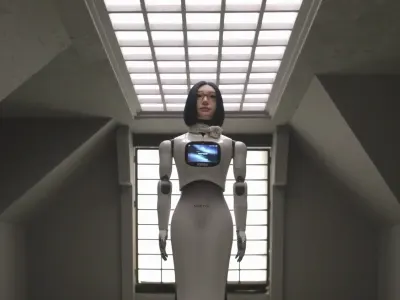
Mirokaï vs Hobbs W1(Guidance Expert)
Head-to-head: Mirokaï vs Hobbs W1(Guidance Expert) compared on bipedal balance, AI learning, dexterity, payload, and real-world service deployment.
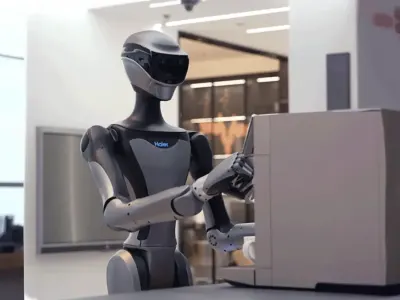
Hiva Haiwa vs Mirokaï
In-depth comparison of Hiva Haiwa by Haier and Mirokaï by Enchanted Tools. Analyze sensors, navigation, battery, and mobility differences.
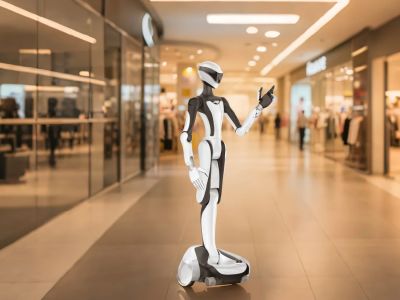
Mirokaï vs Q5
Which robot wins? Mirokaï vs Q5 compared across sensors, navigation, speed, battery, and price for service robotics applications.

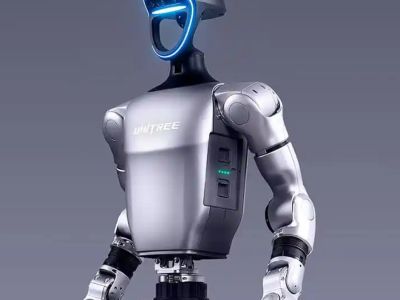
Optimus vs Unitree G1
Compare Optimus vs Unitree G1 for humanoid mobility, dexterity, autonomy, and payload capacity.
Disclaimer
All content, comparisons, and verdicts on this website are based on our research, testing, and opinion. While we strive for accuracy, we do not guarantee the completeness, reliability, or suitability of any information. Performance, specifications, and results may vary depending on usage and conditions. This website and its authors are not responsible for any decisions, actions, or outcomes based on the information provided. Always verify product details with the manufacturer before making purchase or operational decisions.