
VR-M3
Last updated:
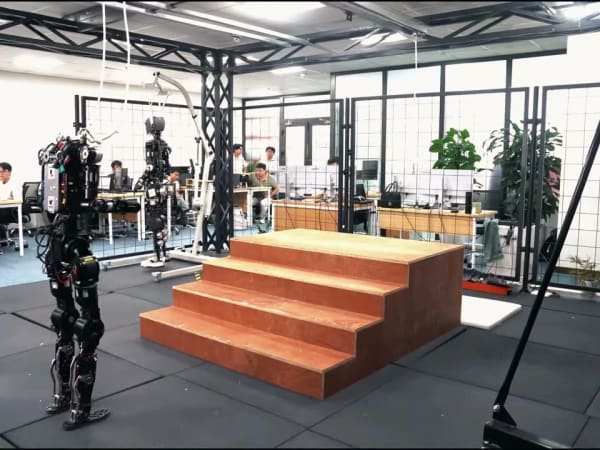
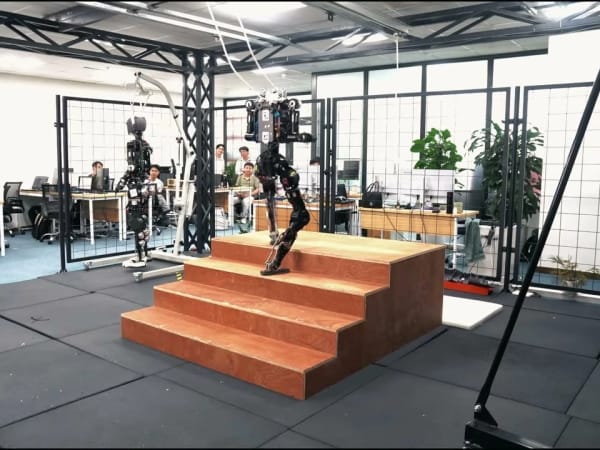
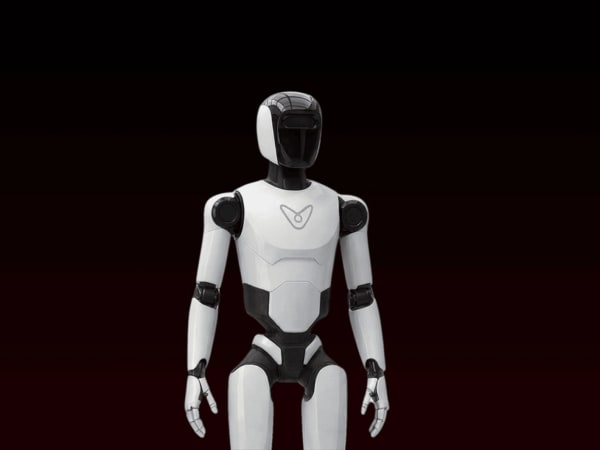
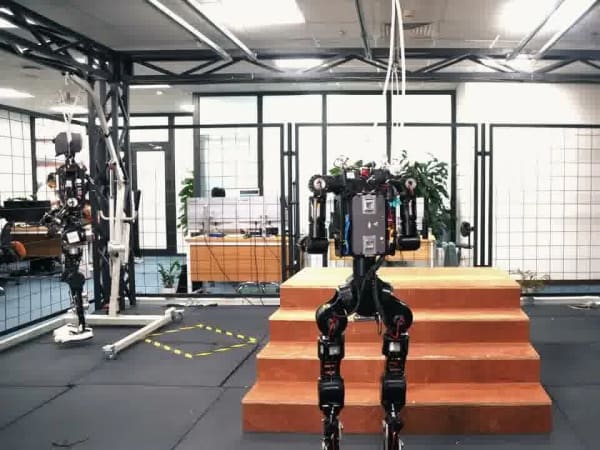
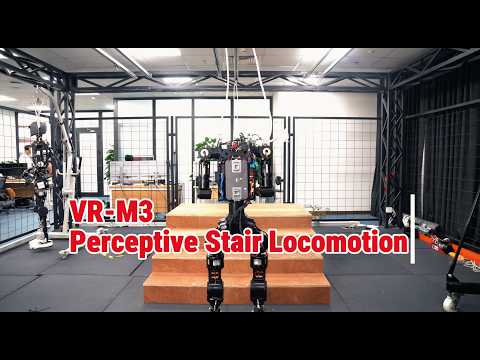
VR-M3 is the mid-range humanoid robot in VinRobotics' lineup, the Vingroup robotics company that builds Vietnam's first industrial humanoids. VinRobotics lists it as the third prototype of its mid-range humanoid line for industrial and service applications, and it is one of the two robots, with the high-end VR-H5, that make up the VinRobotics Humanoid Platform. The company describes it as a roughly 60 kg humanoid and calls it the world's first heavy humanoid to climb unfamiliar staircases with a 5 kg payload. In a May 2026 demonstration it climbed stairs at 0.6 m/s using only a single onboard camera, with no LiDAR, no motion capture, no handrails, no teleoperation and no pre-mapped environment. The camera builds a 3D picture of the terrain ahead, a learned locomotion policy picks safe footholds, and the robot shortens its stride when it carries extra weight. The policy was trained entirely in simulation and transferred to the real robot without any real-world fine-tuning. VinRobotics builds the platform on ROS 2, MuJoCo, Isaac Lab and LeRobot, with SDKs and APIs, and plans to release the VR-M3 URDF model and a reinforcement-learning training pipeline as open source.
Quick Overview & Key Facts
VR-M3 is a humanoid robot made by VinRobotics in Vietnam, launched in 2026 and built for industrial and service applications, humanoid locomotion and reinforcement-learning research, and and application development on the VinRobotics Humanoid Platform. Its estimated price is USD 75,000–100,000.
- Weight
- Approx. 60 kg
- Mobility
- Bipedal (legged) humanoid
- Top speed
- Climbs stairs at 0.6 m/s
- Payload capacity
- Light loads carried in the arms, with 5 kg demonstrated on stairs
- Sensors
- Single first-person camera for real-time terrain perception (no LiDAR)
- Operating environment
- Indoor industrial and service environments with stairs and varied terrain
What Can VR-M3 Do?
Core operational tasks and activities demonstrated or performed by VR-M3.
Real-World Applications of VR-M3
Industries, working environments, and deployment suitability for VR-M3.
VR-M3 Capabilities
Inherent physical, perceptual, and cognitive abilities built into VR-M3.
Download Media Cards
Story CardExport high-resolution story cards summarizing VR-M3's operational tasks, real-world applications, and capabilities.
Image Gallery
Below images are from VinRobotics's official sources
Review Videos
Watch expert reviews and demonstrations of this robot
Robot Specifications
Values without a Confirmed badge are compiled from public sources and may not be manufacturer-verified.
Not yet published by VinRobotics: warranty terms, safety certifications, EMC compliance, noise level, expected lifespan, maintenance schedule, firmware version, update method and 6 more.
Robot Timeline
Key milestones in this robot's development and rollout
VinRobotics publishes a demo of VR-M3 climbing unfamiliar stairs at 0.6 m/s with a 5 kg payload, using only a single onboard camera and a learned locomotion policy.
Source: VinRobotics (YouTube) ↗
More Robots from VinRobotics
Explore other robots from this manufacturer
More Humanoid Robots
Discover more robots in the same category


Robots From Other Categories
Discover complementary robots from different categories that work well together
Frequently Asked Questions
Get answers to common questions about this robot
Q1. What is VR-M3, and what problem is it designed to solve?
VR-M3 is a mid-range walking humanoid robot from VinRobotics, the Vingroup robotics company in Vietnam. It is built for industrial and service work and for developers who want a heavy-duty humanoid body to build applications on.
Q2. What are the main capabilities and key features of VR-M3?
Its standout skill is climbing stairs it has never seen before, using a single onboard camera and a learned walking policy. It can do this while carrying a load, and it walks more carefully when it carries extra weight.
Q3. Who is VR-M3 built for, and which industries can benefit from it?
It is aimed at factories, service environments and robotics developers and researchers who work with the VinRobotics Humanoid Platform.
Q4. Is VR-M3 a commercial product or still a research prototype?
It is the third prototype of VinRobotics mid-range humanoid line, so it is still a developing product rather than a mass-market machine, although the company calls the platform commercial.
Q5. Is VR-M3 currently available for purchase, and when is it expected to ship?
VinRobotics has not announced public pricing or a shipping date. Interested buyers can contact the company through its website.
Q6. How does VR-M3 actually work in real-world environments?
A camera looks at the steps ahead and builds a 3D picture of the terrain. A walking policy trained in simulation then chooses where to place each foot, entirely on the robot with no external sensors or remote control.
Q7. When was VR-M3 announced or officially launched?
VinRobotics showed the VR-M3 stair-climbing demo in May 2026 and introduced it as part of its humanoid platform later in 2026.
Q8. How is VR-M3 different from other robots in the same category?
Most stair-climbing humanoid demos use lighter robots or extra sensors such as LiDAR. VR-M3 does it on a heavier body with just one camera, and VinRobotics says it designs and builds the robot hardware itself.
Q9. Does VR-M3 require additional development or customization after purchase?
It works out of the box for walking demonstrations. Application work such as manipulation or task automation is built by developers using the platform SDKs, ROS 2 and the open-source tools.
Q10. What is the future roadmap or planned upgrades for VR-M3?
VinRobotics plans to release the VR-M3 robot model and a reinforcement-learning training pipeline as open source and to keep expanding the platform.
Rating and Reviews
Share your experience and help others decide!
Loading...
User Reviews
No user reviews. Be the first one to review!
User Comments (No Login needed)
Share your thoughts, experiences, or questions about this robot.
Comments appear after moderator review.