Foundation
Foundation, formally Foundation Future Industries, is a San Francisco start-up that builds the Phantom humanoid robot for heavy industrial and military work. It was founded in April 2024 by Sankaet Pathak, its chief executive and previously the chief executive of fintech company Synapse, Arjun Sethi, chief executive of Tribe Capital, and Mike LeBlanc, a 14-year Marine Corps veteran and co-founder of Cobalt Robotics. Phantom MK-1 stands 5 ft 9 in (175 cm), weighs 176 lb (80 kg), walks at 1.7 m/s, carries about 20 kg and uses eight cameras with no LiDAR, at a reported cost of about US$150,000 per unit. Foundation has won about US$24 million in research contracts with the US Army, Navy and Air Force, and in February 2026 sent two Phantom MK-1 robots to Ukraine for logistics and reconnaissance testing, described as the first humanoids in a combat zone. It raised an US$11 million pre-seed round led by Tribe Capital, and its plans to scale production have drawn questions about feasibility and political scrutiny.
💡Notable Achievement: Foundation Robotics' Phantom MK1 is engineered specifically for defense logistics and contested environments with a titanium structural skeleton, demonstrated navigating a gauntlet of dynamic obstacles and field-tested in defense pilot programs.
What Does Foundation Do?
Foundation Robotics is building ruggedized humanoid 'war machines' designed to safeguard human lives in high-stakes environments. Founded by serial entrepreneur Sankaet Pathak, Foundation rejects fragile consumer toy robots in favor of titanium-built, dual-use bipedal robots engineered for the grueling demands of defense logistics, munitions handling, and hazardous heavy industry. Its flagship robot, Phantom MK1, merges robust mechanical resilience with the proprietary Cortex physics-action model, allowing robots to traverse rubble, absorb heavy mechanical shocks, and handle rugged military supplies autonomously or via encrypted teleoperation.
“Foundation Robotics creates ruggedized, titanium-framed humanoid robots built for defense logistics and hazardous heavy industry.”
Ruggedized Titanium Hardware
Constructed with aircraft-grade titanium and shock-absorbing cycloidal actuators to survive extreme physical environments.
Dual-Use Mission Focus
Bridges industrial factory heavy lifting with frontline military logistics and munitions handling.
Cortex Physics-Action Engine
Employs an advanced whole-body balance and action model optimized for dynamic obstacle navigation and heavy load carrying.
What Can Foundation Robots Actually Do?
Cross-portfolio operational capabilities, manipulation tasks, and environmental competencies
Foundation Robotics manufactures ruggedized bipedal humanoids, teleoperation control stations, and industrial fleet software.
Extreme Environmental Durability
High-strength titanium chassis resistant to severe impacts, moisture, dust, and drop perturbations.
Heavy Munitions & Cargo Transport
Lifts and carries payloads up to 25 kg across broken terrain, staircases, and loading ramps.
Encrypted Tactical Teleoperation
Secure remote tele-embodiment enabling operators to manipulate hazardous materials from miles away.
Foundation Robots
Showing 1 Humanoid Robots of 1 total model
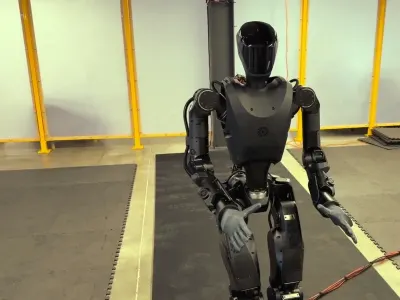
Phantom MK1
Manufactured by Foundation
The Phantom MK1 is a robust humanoid robot engineered for industrial, warehouse, and defense applications, standing at human scale with advanced manipulation capabilities. Featuring proprietary cycloidal actuators that deliver high torque up to 160 Nm while remaining back-drivable for safe human interaction, it excels in precise grasping and tool use with 19 upper body degrees of freedom and five-fingered hands. Its camera-first vision system, powered by large language models, enables natural language commands like "pick that up" to translate into fluid whole-body motions without bulky LiDAR. Capable of 1.7 m/s walking speed, 20 kg payload, and near-24/7 operation, the Phantom MK1 navigates human environments seamlessly, handling assembly, inspections, logistics, and reconnaissance. Bipedal design with active balance supports rough terrain and confined spaces, prioritizing reliability, speed, and adaptability over gimmicks for real-world productivity.
Foundation Software & AI Ecosystem
Developer platforms, fleet management portals, autonomy intelligence, and enterprise integrations
Cortex Physics Model
Dynamic Action & Balance Engine
Spinal-cord neural controller managing dynamic stabilization across marbles, slippery obstacles, and uneven terrain.
Fleet Coherence Stack
Distributed Data Flywheel
Shared operational network allowing deployed humanoids to learn from collective fleet experiences.
Tactical TeleLink
Encrypted Remote Control
Military-grade encrypted wireless control protocol for remote EOD and heavy handling.
Foundation Timeline & Milestones
Evolutionary history, landmark prototypes, major acquisitions, and commercial roadmap
$11 million pre-seed led by Tribe Capital
Foundation raises an US$11 million pre-seed round led by Tribe Capital.
Source: thenextweb.com
Foundation Future Industries founded
Sankaet Pathak, Arjun Sethi and Mike LeBlanc found Foundation in San Francisco to build humanoids for industrial and military work.
Source: thenextweb.com
$24 million in US military research contracts
Foundation secures about US$24 million in research agreements with the US Army, Navy and Air Force.
Source: thenextweb.com
Phantom MK-1 tested in Ukraine
Foundation sends two Phantom MK-1 humanoids to Ukraine for logistics and reconnaissance testing, described as the first humanoids in a combat zone.
Source: thenextweb.com
Foundation Competitors by Category
Direct industry rivals grouped by specific robotics domain
What Makes Foundation Different?
Editorial AnalysisOrigin of Bots objective strategic assessment, engineering moats, and commercial hurdles
Key Strengths & Moats
- ✓Unapologetic focus on defense and heavy industrial applications with high commercial willingness-to-pay
- ✓Rugged titanium structural engineering delivering superior impact resilience compared to consumer humanoids
- ✓Proprietary cycloidal actuator design providing high shock tolerance and durability
Core Strategic Focus
Scaling manual assembly at San Francisco Robo Factory 1, fulfilling defense evaluation contracts, and developing Phantom 2.
Road Ahead & Challenges
- •Stringent defense procurement timelines and regulatory compliance requirements
- •Higher manufacturing unit costs associated with titanium airframes and mil-spec components
Foundation vs Key Competitors
Strategic capability matrix across platform categories, commercial readiness, and target markets
Airframe Material
- Phantom MK1
- Titanium & Steel
- Atlas (Electric)
- Aluminum & Composite
- Digit v5
- Carbon Fiber & Aluminum
- Unitree H1
- Aluminum & Composites
Primary Mission
- Phantom MK1
- Defense & Heavy Logistics
- Atlas (Electric)
- Automotive & Industrial
- Digit v5
- 3PL Warehouse Logistics
- Unitree H1
- Industrial & Research
Actuator Architecture
- Phantom MK1
- High-Torque Cycloidal
- Atlas (Electric)
- Custom Electric Rotary
- Digit v5
- Brushless Planetary
- Unitree H1
- High-Torque Rotary
Dual-Use Focus
- Phantom MK1
- Defense & Commercial (50/50)
- Atlas (Electric)
- Commercial Automotive
- Digit v5
- Commercial Logistics
- Unitree H1
- Industrial & General
| Strategic Dimension | Phantom MK1 | Atlas (Electric) | Digit v5 | Unitree H1 |
|---|---|---|---|---|
| Airframe Material | Titanium & Steel | Aluminum & Composite | Carbon Fiber & Aluminum | Aluminum & Composites |
| Primary Mission | Defense & Heavy Logistics | Automotive & Industrial | 3PL Warehouse Logistics | Industrial & Research |
| Actuator Architecture | High-Torque Cycloidal | Custom Electric Rotary | Brushless Planetary | High-Torque Rotary |
| Dual-Use Focus | Defense & Commercial (50/50) | Commercial Automotive | Commercial Logistics | Industrial & General |
Corporate Ecosystem & Ownership Structure
Parent company relationships, historical acquisitions, and global operating facilities
Global Facilities & Operating Hubs
Foundation Headquarters
HQSan Francisco, California, United States
Articles & Industry News
Showing 1 recent article and news updates about Foundation
Robot Comparisons
Showing 4 in-depth comparisons featuring Foundation — Explore all comparisons →

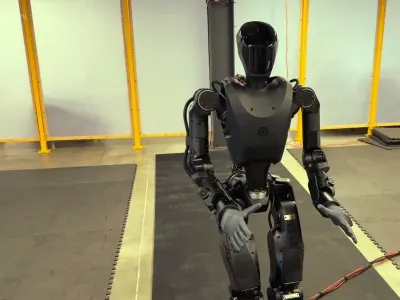
T800 by EngineAI vs Phantom MK1 by Foundation
Compare T800 by EngineAI vs Phantom MK1 by Foundation for humanoid mobility, dexterity, autonomy, payload, and industrial vs defense use cases.

Optimus (Tesla) vs Phantom MK1 (Foundation)
Optimus or Phantom MK1? See which humanoid robot performs better for manufacturing, logistics, defense, dexterity, autonomy, and payload in enterprise deployments.

AgiBot A2 Ultra vs Phantom MK1
Which humanoid robot is better? AgiBot A2 Ultra vs Phantom MK1 compared for dexterity, AI capabilities, payload, and defense use cases.
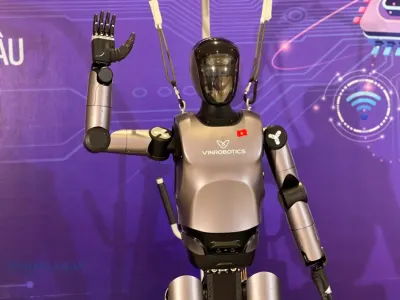
VR-H3 by VinRobotics vs Phantom MK1 by Foundation
Head-to-head: VR-H3 vs Phantom MK1 compared on bipedal balance, AI learning, payload strength, and real-world deployment for enterprise robotics.
Frequently Asked Questions
8 AnswersVerified answers, company specifications, and deployment details about Foundation
What is Foundation Future Industries?
Foundation Future Industries is a San Francisco start-up, founded in April 2024, that builds the Phantom humanoid robot for heavy industrial and military work.
Who founded Foundation robotics?
Foundation was founded by Sankaet Pathak, its chief executive and former chief executive of Synapse, Arjun Sethi of Tribe Capital, and Mike LeBlanc, a Marine Corps veteran and co-founder of Cobalt Robotics.
What is the Phantom MK-1 robot?
Phantom MK-1 is Foundation's humanoid. It stands 175 cm tall, weighs about 80 kg, walks at 1.7 m/s, carries about 20 kg and relies on eight cameras rather than LiDAR.
How much does the Phantom robot cost?
Each Phantom MK-1 has been reported to cost about US$150,000 to build. Foundation has not published a public sale price for the robot.
Is the Phantom robot used by the military?
Foundation has about US$24 million in research contracts with the US Army, Navy and Air Force, and in February 2026 sent two Phantom MK-1 robots to Ukraine to test logistics and reconnaissance tasks.
How much funding has Foundation raised?
Foundation raised an US$11 million pre-seed round led by Tribe Capital, and has been reported to be seeking much larger funding to scale production.
Why is Foundation controversial?
Foundation's military work and its links to Eric Trump, who serves as chief strategy adviser, have drawn political criticism, and analysts have questioned whether its production targets are achievable.
What is Phantom 2?
Phantom 2 is Foundation's upgraded humanoid, which the company has said it plans to send to Ukraine for testing in 2026.
Verified Data & Editorial Assurance
Compiled from verified corporate filings, official Foundation datasheets, and robotics engineering registries. Information has been verified against official manufacturer documentation. For commercial procurement or proprietary integrations, contact the manufacturer directly.