Foundation's Phantom MK-2 Is a 200-Pound Aluminum Humanoid Hardened for Factories and Battlefields, With a Lower Expected Lease Than Its Predecessor
Robot Details
Phantom MK-2 • FoundationPublished
November 19, 2026
Reading Time
5 min read
Author
Origin Of Bots Editorial Team
The Robot Behind the Red Light
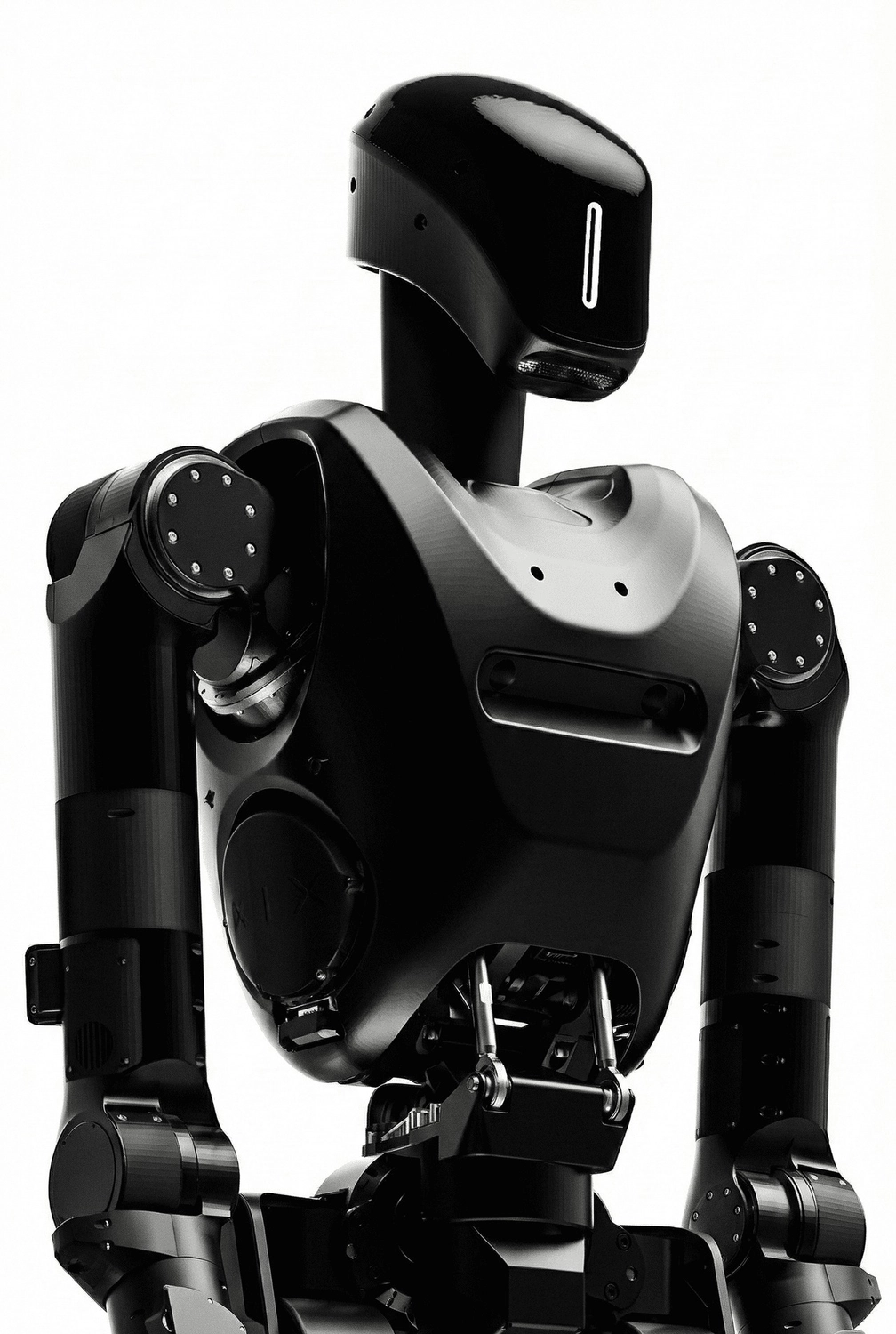
At Foundation's office in San Francisco's SoMa district there is a curtained-off room with a light over the door. When the light blinks red, nobody goes in, not the technicians, not the engineers, not even co-founder Sankaet Pathak. Inside stands Phantom MK-2, the company's second-generation humanoid, a six-foot, roughly 200-pound machine wrapped in an aluminum shell that keeps out dust and water.
The precautions exist because the robot has not yet been fitted with the software limits Pathak calls sedation, the settings that cap how much force a robot can use. In his words, it could literally pick a human up. The San Francisco Standard described the room and the robot in a profile published on November 14, 2026, the most detailed public look at Phantom MK-2 ahead of its formal debut.

Why Toughness Is the Headline Feature
Most humanoid robots today are built for clean, dry, climate-controlled rooms. Phantom MK-2 is designed for the opposite. Foundation says it carries an IP67 rating, which in plain terms means dust cannot get inside and it can survive being dunked in water, and that it tolerates shocks and vibration of up to 100G. Those are numbers more often seen on rugged phones and military electronics than on walking robots.
That is the real story of this machine. Walking and grasping have become table stakes for humanoids, but very few have been engineered to keep working after rain, mud, dust and hard knocks. If Foundation can prove those ratings in the field, Phantom MK-2 would move humanoids out of the showroom and into the kind of messy places where people most want to send a machine instead of a person.
What Changed Since the First Phantom
The original Phantom MK-1 stands about five feet eleven and weighs around 176 pounds. Foundation has used it in customer pilots and for teleoperated demonstrations, and the company says its machines helped build more than 24,000 cars in 2025, work Pathak described as mostly racking and kitting, preparing parts for final assembly. But the first model was a working prototype with clear limits, and it was never built to shrug off weather or rough handling.
MK-2 is taller, heavier and sealed. Foundation also says it adds 360-degree vision. Taken together, the changes read less like a refresh and more like a shift in purpose: MK-1 proved the idea in workshops and factories, and MK-2 is meant to carry it into harsher environments.
A Brain Built on AMD Instead of Nvidia
In July 2026, at AMD's Advancing AI event, Foundation said Phantom MK-2 would be built from the start around AMD's new Ryzen AI Embedded X100 processors. The chip combines up to 16 Zen 5 processor cores, built-in graphics and a dedicated AI engine on one package, sharing a single pool of memory so the robot can read its cameras, run AI models and plan movements without shuttling data between separate chips.
That choice is worth watching. Nvidia's chips and software have been the default brains of most humanoid projects, so a company with robots already doing paid work picking AMD is a meaningful vote for a second supplier. Foundation has also said AMD's programmable FPGA chips help it run a custom robotic hand in a tight, fast control loop. The performance claims attached to the deal come from the companies themselves and have not been independently tested.
One Robot for the Factory and the Front Line
Foundation describes itself as building dual-use humanoids, machines meant for both heavy industry and defense. On the factory side that means materials handling and repetitive physical work. On the military side the company talks about supply pickup, reconnaissance, hazard inspection and recovering equipment, tasks that put soldiers at risk today.
The defense angle is what makes Foundation stand out, and also what draws the most scrutiny. Phantom MK-1 robots have been tested in Ukraine, Foundation holds research contracts with the US military, and Pathak openly talks about future weaponized roles. Whatever one thinks of that direction, it explains why MK-2 is built to be so tough: a robot meant for a battlefield cannot fall apart in the first rainstorm.
The Surprising Part: A Lower Expected Lease
New models usually cost more. Foundation is going the other way. According to the San Francisco Standard, the company was leasing Phantom MK-1 for about 100,000 dollars per unit per year as of August, with a 100-unit minimum, while Phantom MK-2 is expected to lease at 75,000 dollars a unit. Pathak says he hopes to push the price down to 10,000 dollars eventually.
For buyers, that is the most practical detail in the whole story. A tougher robot at a lower expected lease price would change the math for factories weighing a humanoid against a human shift or a fixed industrial arm. It is still a planned price for a robot that is not yet shipping, so the real terms, including contract length, service and uptime guarantees, will matter as much as the headline figure.
What to Verify When It Launches
Foundation's toughness ratings are bold for a walking robot, and the real test is field work: rain, dust, falls and long shifts. When Phantom MK-2 appears in public, the details that will matter most are how much it can carry, how long it runs between charges, and how much of its work is autonomous rather than remote-controlled.
Foundation's figures on deployments and factory capacity are company-reported, so the clearest proof will be customers showing MK-2 at work in their own facilities.
What to Watch Next
The next milestone is the public debut, ideally with footage of the robot working outside the lab, in the dust and weather it was designed for. The hands are the other thing to watch: Foundation says AMD's FPGA chips let it coordinate its custom robotic hand in one fast, precise control loop, and real tasks will show how much that adds.
Foundation has said it plans to scale production in its own factories, and AMD expects its X100 chips to reach volume production in the fourth quarter of 2026, so the first MK-2 units built on that hardware are likely still months away. Origin of Bots will update the Phantom MK-2 page as official specifications and footage arrive.
Explore Humanoids
Sources
Related Articles

GXO and Apptronik Plan Up to 1,000 Apollo Humanoid Robots in Warehouses Over Four Years
OpenMind Iris Humanoid Uses Living Human Neurons to Read Social Cues
Boston Dynamics Atlas Lands First Non-Auto Customer in GlobalFoundries
JAKA Lumi 2.0 Patrols a Cluttered Warehouse on Its Own With 96 TOPS of Onboard AI and a Bigger Battery
Related Comparisons
Compare Phantom MK-2 with similar robots
T800 vs Phantom MK1
Compare T800 by EngineAI vs Phantom MK1 by Foundation for humanoid mobility, dexterity, autonomy, payload, and industrial vs defense use cases.

Optimus vs Phantom MK1
Optimus or Phantom MK1? See which humanoid robot performs better for manufacturing, logistics, defense, dexterity, autonomy, and payload in enterprise deployments.

AgiBot A2 Ultra vs Phantom MK1
Which humanoid robot is better? AgiBot A2 Ultra vs Phantom MK1 compared for dexterity, AI capabilities, payload, and defense use cases.
VR-H3 vs Phantom MK1
Head-to-head: VR-H3 vs Phantom MK1 compared on bipedal balance, AI learning, payload strength, and real-world deployment for enterprise robotics.
Learn More About This Robot
Discover detailed specifications, reviews, and comparisons for Phantom MK-2.
View Robot Details →