Last updated:
Which one fits your use?
Based on the uses each robot is built and marketed for. Open a use to see the specs that matter for it.
| Comparing for… | AgiBot G2 | AgiBot X2-N |
|---|---|---|
| Suited | Not marketed | |
| Suited | Not marketed | |
| Not marketed | Suited | |
| Not marketed | Suited | |
| Not marketed | Suited |
- Only AgiBot G2 is marketed for warehouse and logistics work and factory and manufacturing work.
- Only AgiBot X2-N is marketed for research labs, education and training and hospitality, retail and public-facing roles.
AgiBot G2 by AgiBot is presented here as a versatile industrial humanoid targeting precision manufacturing and collaborative industrial tasks; it is being compared to highlight its positioning as a high‑precision, sensor‑rich platform for factory and logistics environments and to show how its broader sensor suite and proprietary AI OS distinguish it from other AgiBot humanoids. Key differentiators for the AgiBot G2 include a height adjustable from 122.5 to 179.5 cm on a 185 kg wheeled base.
AgiBot X2-N by AgiBot is included as an alternative humanoid configuration from the same manufacturer, emphasizing proprioceptive control and mission-focused autonomy for logistics and dynamic environments. The AgiBot X2-N is far smaller than the G2, standing 131 cm tall and weighing from about 35 kg against the G2's 185 kg, and it relies primarily on internal proprioceptive sensors for navigation and gait adjustment, using a Linux/ROS software stack and targeting logistics, healthcare and public services.
Detailed Analysis
Design & Build Quality

AgiBot G2
The two robots differ sharply in scale. AgiBot G2 is a 185 kg wheeled-base humanoid whose height adjusts from 122.5 to 179.5 cm on a 64 x 76 cm footprint, while AgiBot X2-N is a compact 131 cm biped of about 35 kg measuring 46 cm wide and 21 cm deep. The G2 description emphasizes high-precision torque sensors and a spatial perception exterior designed for interaction with the external environment and tooling, whereas the X2-N emphasizes proprioceptive components (joint torque, pressure, internal gyros) integrated for internal state sensing and gait control. Both designs include safety features such as emergency stop and real-time force sensing.
Mobility & Navigation
AgiBot X2-N
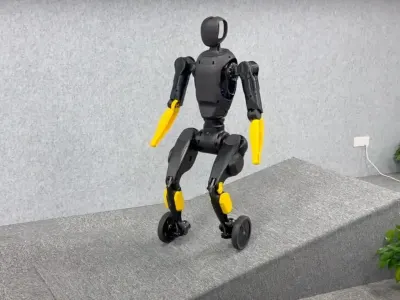
AgiBot G2 reaches 5.4 km/h (1.5 m/s) on its wheeled base, while AgiBot X2-N walks at up to about 1.8 m/s and can switch to rolling on its foot wheels, making the X2-N the faster mover. AgiBot G2 lists advanced spatial perception and SLAM-style navigation with obstacle avoidance, enabling environment mapping and external sensor-based path planning, while AgiBot X2-N relies on proprioceptive feedback without cameras, GPS, or LiDAR, navigating through internal state estimation and reactive gait adjustment rather than map-based SLAM. The X2‑N’s approach favors environments where internal stability and gait adaptation are essential (uneven terrain, dynamic obstacles), and the G2’s external sensing favors structured or mixed human environments requiring explicit obstacle detection and scene understanding.
Sensors & Perception

AgiBot G2
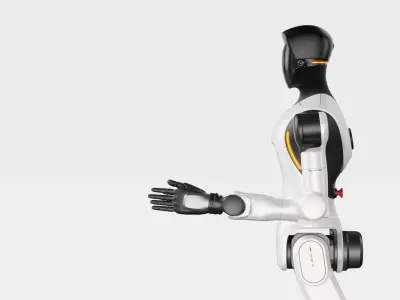
AgiBot G2 includes high‑precision torque sensors, a 360‑degree spatial perception system, cameras, force sensors and environmental sensors, indicating a broad external sensing suite for vision and scene understanding. In contrast, AgiBot X2‑N is described as having primarily proprioceptive sensors — joint torque, pressure, and internal gyros — and explicitly notes the absence of cameras or external sensors, which limits external scene perception but strengthens internal state awareness and joint‑level control. The G2’s external sensors support tasks requiring object recognition, guided tours, and collaborative work with humans, while the X2‑N’s sensor set supports robust locomotion and gait control where external sensing is unnecessary or undesirable. Sensor differences imply different software and data‑processing demands: vision/SLAM pipelines on G2 versus high‑frequency proprioceptive control loops on X2‑N.
AI Capabilities
AgiBot X2-N
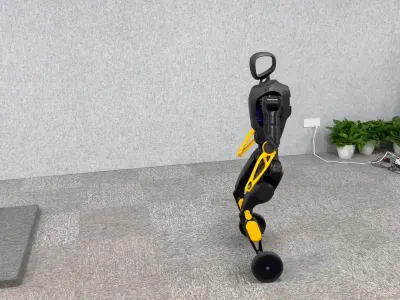
AgiBot G2 is reported to use a proprietary AI OS, likely Linux‑based, with support for reinforcement learning and simulation, indicating capabilities for advanced autonomy, learning in simulation, and integration of multimodal inputs including voice. AgiBot X2‑N is described as Linux/ROS‑based with AI autonomous and real‑time control systems, suggesting a more open robotics middleware approach emphasizing deterministic control and integration with ROS tooling. G2’s software emphasis on proprietary AI and reinforcement learning aligns with tasks requiring perception‑driven decision making and continual improvement, while X2‑N’s ROS focus supports interoperability, modular algorithm deployment, and field customization for logistics or rescue operators.
Battery & Power Efficiency
AgiBot G2
AgiBot G2 runs for 4 hours per charge and recharges in up to 2 hours. AgiBot X2-N runs for about 2 hours per charge and recharges in about 1.5 hours. AgiBot G2 lasts longer on a charge. AgiBot X2-N has 25 degrees of freedom and carries 6 kg. AgiBot G2 stands 180 cm tall and weighs 185 kg. AgiBot X2-N stands 131 cm tall and weighs 35 kg. AgiBot G2's safety features include emergency stop, real-time force sensing, obstacle avoidance and impedance control. AgiBot X2-N's safety features include emergency stop and real-time gait adjustment.
Use-Case Suitability
AgiBot X2-N
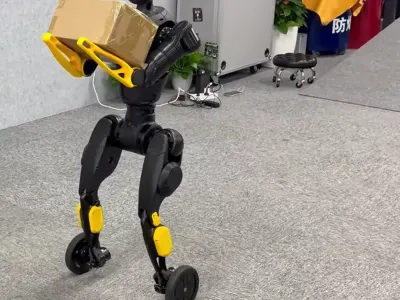
AgiBot G2 is positioned for auto parts production, precision manufacturing, logistics sorting, guided tours, and collaborative industrial tasks where external perception, fine force control, and integration with manufacturing workflows are required. AgiBot X2‑N is positioned for logistics, search‑and‑rescue, industrial automation, and dynamic environment navigation where robust proprioceptive gait control and real‑time adjustments are prioritized. The G2’s sensor and software suite favors tasks involving object interaction and human environments, while the X2‑N’s sensor and control focus favors locomotion resilience and operations in situations where external sensors may be limited or intentionally omitted.
Safety Features
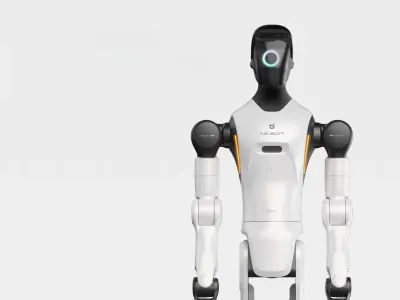
AgiBot G2
Both robots include emergency stop capability and real‑time force sensing to reduce collision forces and allow rapid shutdown, with impedance control listed for the G2 and real‑time gait adjustment for the X2‑N, indicating active safety strategies tied to their sensor suites. G2’s obstacle avoidance and impedance control rely on external sensing and force feedback to modulate interactions, while X2‑N’s obstacle avoidance is implemented via proprioception and rapid gait adaptation without external vision. Both approaches provide safety mechanisms appropriate to their sensing philosophies and intended operational environments.
Software Ecosystem
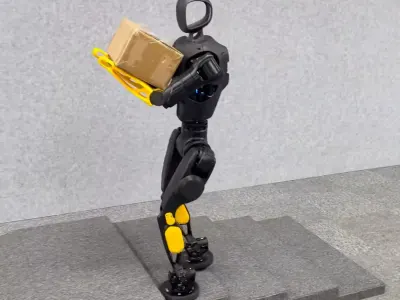
AgiBot X2-N
AgiBot G2 is described as running a proprietary AI OS that is likely Linux‑based and supports reinforcement learning and simulation workflows, suggesting a closed but task‑oriented software stack optimized by the manufacturer. AgiBot X2‑N is explicitly Linux/ROS‑based, indicating compatibility with ROS tools, community packages, and easier third‑party integration for custom autonomy or fleet management. The G2’s proprietary stack may provide turnkey features optimized for manufacturing, while the X2‑N’s ROS orientation supports customization and integration into existing robotics infrastructures. AgiBot G2's control method is listed as AI autonomous, remote teleoperation, multimodal voice interaction. AgiBot X2-N's control method is listed as AI autonomous, real-time control systems.
Capabilities & Operational Tasks
Head-to-head comparison of what AgiBot G2 and AgiBot X2-N can do, their applications, and capabilities.
What Can AgiBot G2 & AgiBot X2-N Do?
154 tasks listed for both, 4 only for AgiBot G2, 7 only for AgiBot X2-N.
Tap a circle area to filter the lists
Only AgiBot G2
Not listed for the other robot
Shared by both
Listed for AgiBot G2 and AgiBot X2-N
Only AgiBot X2-N
Not listed for the other robot
Technical Specifications
AgiBot G2 and AgiBot X2-N differ on 41 of the 43 specifications listed for both.
Manipulation & Load Capacity
4 Comparative Metrics
Kinematic Architecture & Dexterity
4 Comparative Metrics
Energy & Power Management
7 Comparative Metrics
Frequently Asked Questions
Which uses is each robot marketed for, AgiBot G2 or AgiBot X2-N?
Only AgiBot G2 is marketed for warehouse and logistics work and factory and manufacturing work. Only AgiBot X2-N is marketed for research labs, education and training and hospitality, retail and public-facing roles.
How much does AgiBot G2 cost?
AgiBot G2 is listed at $100,000–$125,000.
Where can I buy AgiBot G2?
AgiBot G2 is sold through AgiBot's sales team; request a quote.
How autonomous are AgiBot G2 and AgiBot X2-N?
AgiBot G2: Semi-autonomous with vision-language-action (VLA) models. AgiBot X2-N: Autonomous gait and walk/roll switching from proprioception.
How are AgiBot G2 and AgiBot X2-N controlled?
AgiBot G2: AI autonomous, remote teleoperation, multimodal voice interaction. AgiBot X2-N: AI autonomous, real-time control systems.
What safety features do AgiBot G2 and AgiBot X2-N have?
AgiBot G2: Emergency stop, real-time force sensing, obstacle avoidance, impedance control. AgiBot X2-N: Emergency stop, obstacle avoidance via proprioception, real-time gait adjustment.
Related Comparisons
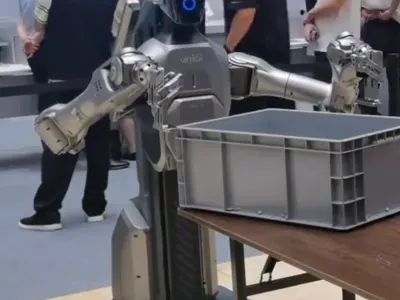
AgiBot G2 vs Cruzr Y1
Compare AgiBot G2 vs Cruzr Y1 for humanoid mobility, dexterity, autonomy, and payload capacity.
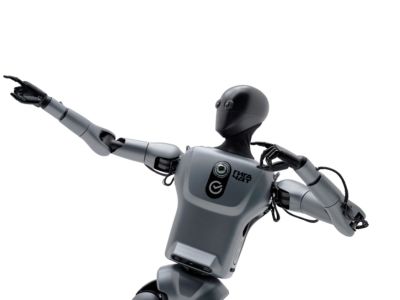
AgiBot G2 vs Green
AgiBot G2 vs Green: AgiBot's wheeled precision-assembly humanoid against Sber's walking GigaChat robot, compared on build, sensors, battery and price.

AgiBot G2 vs Pudu D7
AgiBot G2 vs D7: AgiBot's wheeled precision-assembly humanoid against Pudu's wheeled semi-humanoid, compared on size, mobility, sensors, AI and best uses.
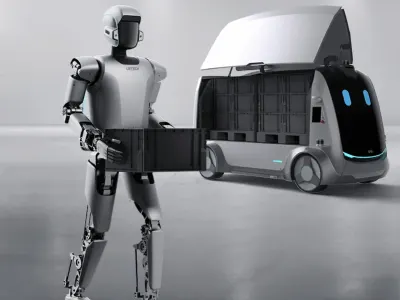
Walker S1 vs AgiBot G2
Walker S1 vs AgiBot G2: UBTECH's factory humanoid against AgiBot's wheeled precision-assembly humanoid, compared on size, mobility, sensors, AI and best uses.
Verdicts reflect our research and opinion. Confirm specifications with the manufacturer before buying.