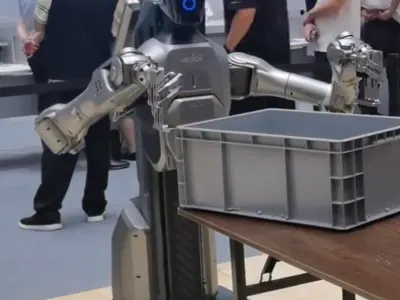
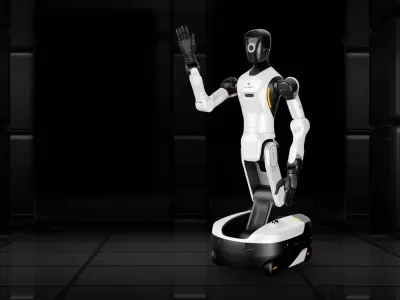
AgiBot G2 is positioned as an industrial humanoid for precision work that needs force-controlled manipulation, broad perception, and a high-DOF upper body. Its 26 active degrees of freedom, dual 7-DoF arms, and 5 kg per-arm payload make it more suited to structured manipulation tasks than general service robotics. The platform also emphasizes industrial sensing and safety features such as dual LiDAR, RGB-D cameras, torque sensing, and impedance control. In this comparison, AgiBot G2 represents the higher-spec, heavier industrial option focused on controlled factory and logistics environments.
Cruzr Y1 is positioned as a lighter humanoid platform oriented toward service, remote operation, and industrial support tasks. Compared with AgiBot G2, it has fewer degrees of freedom, a lower mass, and a simpler payload profile, but it is specified with teleoperation capability and a broader deployment profile across manufacturing, research, logistics, and inspection. Its sensor and safety stack is centered on collaborative operation, force limiting, and collision detection. In this comparison, Cruzr Y1 represents the more compact and flexible platform for mixed-use enterprise deployments where teleoperation and mobility efficiency matter.
Detailed Analysis
How do they differ in bipedal mobility and balance?
AgiBot G2 and Cruzr Y1 are both presented as humanoid systems, but their mobility profiles are likely designed for different operating assumptions. AgiBot G2 uses a wheeled humanoid base with a reported top speed of 1.5 m/s, which prioritizes stable movement in industrial spaces over legged balance. Cruzr Y1 is also described as a humanoid platform, but the provided data does not specify whether it uses wheeled or legged locomotion; the comparison data instead emphasizes teleoperation and enterprise deployment. On the available specifications, AgiBot G2 has the clearer mobility performance data, while Cruzr Y1 appears tuned for controlled remote tasks rather than high-performance locomotion.

Which robot is more capable for complex manipulation tasks?
AgiBot G2 is the stronger manipulation platform on paper because it combines 26 active degrees of freedom with 7-DoF arms and 5 kg per-arm payload capacity. Cruzr Y1 is specified with 17 DOF and a higher inferred 15 kg per-arm payload, which suggests higher lifting tolerance but less articulated upper-body motion. For fine manipulation, AgiBot G2's force sensing, impedance control, and broader DOF count are the more relevant advantages. For heavier pick-and-place work, Cruzr Y1's higher payload specification is the more important factor. The better choice depends on whether the task requires precision articulation or higher per-arm load handling.
Which robot offers better autonomous learning capabilities?
AgiBot G2 is the more clearly specified platform for learning-oriented autonomy because its software stack is described as a proprietary AI OS that supports reinforcement learning and simulation. That makes it better aligned with iterative skill development, motion policy training, and industrial adaptation workflows. Cruzr Y1 is described as semi-autonomous and teleoperated, with ROS2, Android, and a proprietary OS in the stack, which is more focused on control integration than learning-first robotics. If the buyer needs a platform for robot learning research or autonomy development, AgiBot G2 is the stronger fit. If the buyer needs remote supervision and operator-in-the-loop control, Cruzr Y1 is the more operationally flexible choice.
How do payload and lifting capacity compare?
Cruzr Y1 has the higher inferred carrying and deadlift capacity at 15 kg per arm, while AgiBot G2 is specified at 5 kg per arm. That gives Cruzr Y1 a clear advantage in heavier handling tasks such as moving bulk items or supporting larger service payloads. AgiBot G2 is still suitable for structured industrial manipulation, but its payload profile is narrower and more precision-oriented. The difference indicates two distinct designs: Cruzr Y1 for higher-load enterprise tasks, and AgiBot G2 for controlled handling where dexterity matters more than brute force. Buyers should match the robot to the heaviest expected object rather than comparing only total robot mass.
Which robot has better battery runtime and efficiency?
AgiBot G2 provides a specified endurance of about 4 hours with dual hot-swappable batteries and a total capacity of 1652 Wh. Cruzr Y1 is inferred to have a 4-5 year battery lifecycle, but the available dataset does not provide a runtime figure comparable to AgiBot G2's operating endurance. For continuous deployment, AgiBot G2's hot-swappable design is the more concrete operational advantage. Cruzr Y1 may be easier to maintain over the long term if the inferred battery lifecycle holds, but that does not replace runtime data. On the available numbers, AgiBot G2 is better documented for shift planning and charging logistics.

Which humanoid robot is better for industrial manufacturing?
AgiBot G2 is better aligned with precision assembly, high-mix production, and force-controlled industrial work, while Cruzr Y1 is better aligned with manufacturing support, logistics, and remote operations. AgiBot G2's higher DOF count, industrial sensing suite, and explicit reinforcement-learning support make it more suitable for tightly controlled manipulation tasks. Cruzr Y1's higher payload and teleoperation focus make it a better fit for mixed enterprise workflows that need human oversight and heavier handling. If the goal is precise automation in structured production cells, AgiBot G2 is the stronger choice. If the goal is flexible enterprise deployment with operator control, Cruzr Y1 is the better fit.
How do safety features compare around people?
AgiBot G2 emphasizes emergency stop, real-time force sensing, obstacle avoidance, and impedance control, which are all relevant for contact-aware operation near people. Cruzr Y1 emphasizes force limiting, collision detection, emergency stop, and collaborative mode, which are also designed for shared workspaces. The main difference is that AgiBot G2's safety profile is more tied to force-controlled manipulation, while Cruzr Y1's profile is more centered on collaborative operation and teleoperation support. Both robots are designed for human-adjacent environments, but their safety mechanisms support different interaction styles. For close-proximity industrial handling, AgiBot G2 has the more manipulation-specific safety stack.
Analysis Score Summary
Total Score
9
AgiBot G2
VS
Based on Detailed Analysis
Total Score
5
Cruzr Y1
📊 Win: 2 points | Trade-off: 1 point each
Scores are summed across every insight: a clear winner earns 2 points, while balanced trade-offs give each robot 1 point. The total reflects how often each robot outperforms the other (or shares the spotlight) throughout the detailed analysis sections.
Capabilities & Operational Tasks
Head-to-head comparison of what AgiBot G2 and Cruzr Y1 can do, their applications, and capabilities.
What Can AgiBot G2 & Cruzr Y1 Do?
18Core operational tasks, activities, and physical manipulation duties evaluated side-by-side.
| Task & Description | Model AAgiBot G217 supported | Model BCruzr Y15 supported |
|---|---|---|
| Assembly | High | — |
| Autonomous task execution | High | High |
| Carrying and transport | High | High |
| Collaborative work | High | High |
| Human interaction | — | High |
| Inspection | High | — |
| Loading and unloading | High | — |
| Machine operation | High | — |
| Machine tending | High | — |
| Material handling | High | — |
| Move objects | High | — |
| Navigation | High | High |
| Packaging | High | — |
| Pick and place | High | — |
| Quality control | High | — |
| Repetitive physical tasks | High | — |
| Sorting | High | — |
| Tool use | High | — |
Technical Specifications
Head-to-head performance data and metrics
| Specification | Model AAgiBot G2 | Model BCruzr Y1 |
|---|---|---|
Functional Utility & Use Cases4 Comparative Metrics | ||
Control Method | AI autonomous, remote teleoperation, multimodal voice interaction | Teleoperation, autonomous, learned behaviors | (Inferred · High confidence · Based on UBTECH Robotics's sim-to-real embodied intelligent data system) |
Use Cases | Sub-millimeter precision assembly, hole searching, machine tending, industrial kitting, commercial showroom tours | Manufacturing, research, logistics, infrastructure inspection, remote operations | (Inferred · Low confidence · Industry baseline for humanoid robots) |
Multi Robot Coord | Yes | (Inferred · Medium confidence · Typical for industrial fleets) | Swarm or multi-robot capabilities | (Inferred · Medium confidence · Typical for industrial fleet management) |
Pet Friendly | Not Applicable (Industrial & Commercial Robot) | Yes, with safety protocols | (Inferred · Low confidence · Industry baseline for humanoid robots) |
Manipulation & Load Capacity4 Comparative Metrics | ||
Carrying Capacity | 5 kg per arm (10 kg total) | 15 kg per arm | (Inferred · High confidence · Based on UBTECH Robotics's Cruzr S2 max payload of 15 kg) |
Deadlift Capacity | 5 kg per arm | 15 kg maximum | (Inferred · High confidence · Based on UBTECH Robotics's Cruzr S2 max payload specification) |
Payload Type | 5 kg per arm (Dual 7-DoF force-controlled arms) | Tools, packages, precision instruments | (Inferred · High confidence · Based on UBTECH Robotics's Cruzr S2 application for sorting and assembly) |
Modular Attachments | Grippers, sensors, possibly custom end-effectors | Tool changers, end-effector options | (Inferred · Medium confidence · Typical for industrial manipulators) |
Kinematic Architecture & Dexterity4 Comparative Metrics | ||
Degrees of Freedom | 26 DoF base (expandable to 50) | 17 DOF | (Inferred · High confidence · Based on UBTECH Robotics's Cruzr 1S having 17 servos) |
Material | Aluminum frame, automotive-grade composites | Aluminum, composite, plastic | (Inferred · High confidence · Based on UBTECH Robotics's Cruzr 1S materials) |
Mobility Type | Wheeled (Omnidirectional mobile base, speed up to 1.5 m/s) | Wheeled |
Hardware Interface | USB, Ethernet, GPIO (typical for industrial robots) | USB, GPIO, CAN bus, serial | (Inferred · Medium confidence · Standard interfaces for industrial robots) |
Functional Utility & Use Cases
4 Comparative Metrics
Manipulation & Load Capacity
4 Comparative Metrics
Kinematic Architecture & Dexterity
4 Comparative Metrics
Frequently Asked Questions
Which humanoid robot has higher per-arm payload capacity for enterprise handling tasks?
Cruzr Y1 has higher inferred payload capacity at 15 kg per arm, while AgiBot G2 is specified at 5 kg per arm. Cruzr Y1 is better for heavier handling; AgiBot G2 is better for precision work.
Is AgiBot G2 or Cruzr Y1 more autonomous for onboard learning and adaptation?
AgiBot G2 is more autonomy-oriented because it supports reinforcement learning and simulation in its software stack. Cruzr Y1 is more teleoperation-centered and semi-autonomous.
Which robot moves faster and is more stable in constrained industrial spaces?
AgiBot G2 is specified at 1.5 m/s and uses a wheeled humanoid base, which supports stable movement in industrial environments. Cruzr Y1 has no directly comparable verified speed in the provided data.
Which humanoid robot is better for dexterous manipulation and fine assembly work?
AgiBot G2 is better for dexterous manipulation because it has 26 active DOF and 7-DoF arms. Cruzr Y1 has fewer DOF, but more lifting capacity.
Which robot is more deployment-ready for precision assembly and high-mix production?
AgiBot G2 is more deployment-ready for precision assembly and high-mix production because its specs emphasize force control, sensing, and industrial manipulation.
Which robot is better suited for logistics sorting and teleoperated enterprise workflows?
Cruzr Y1 is better suited for logistics sorting and teleoperated workflows because it is specified as semi-autonomous, teleoperated, and enterprise-oriented across multiple use cases.
Related Comparisons
Discover similar robot matchups to expand your knowledge and find the perfect solution

AgiBot G2 vs Green
Head-to-head: AgiBot G2 vs Green. Explore differences in navigation, sensors, and battery.

AgiBot G2 vs D7
Compare AgiBot G2 and D7. Detailed analysis of navigation, battery, and sensors.
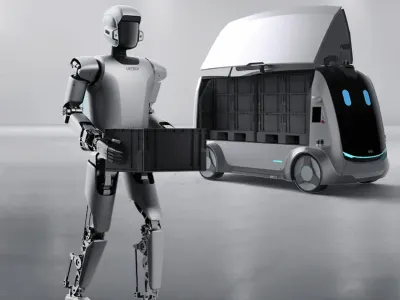
Walker S1 vs AgiBot G2
Walker S1 or AgiBot G2? Compare specs, sensors, navigation, speed, and real-world performance.
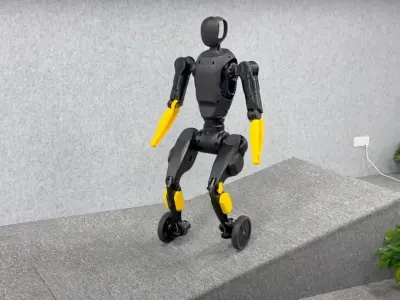
AgiBot G2 vs AgiBot X2-N
AgiBot G2 or AgiBot X2-N? Compare specs, navigation, battery, and sensors.
Disclaimer
All content, comparisons, and verdicts on this website are based on our research, testing, and opinion. While we strive for accuracy, we do not guarantee the completeness, reliability, or suitability of any information. Performance, specifications, and results may vary depending on usage and conditions. This website and its authors are not responsible for any decisions, actions, or outcomes based on the information provided. Always verify product details with the manufacturer before making purchase or operational decisions.