Pudu D7 vs AlphaBot 2 at a glance
AlphaBot 2 is the taller of the two at 240 cm, against 165 cm for Pudu D7. Pudu D7 lasts longer on a charge, about 8 hours against 6 hours for AlphaBot 2. AlphaBot 2 has more degrees of freedom (34 against 30 for Pudu D7), which allows finer movement.
Which one fits your use?
Based on the uses each robot is built and marketed for. Open a use to see the specs that matter for it.
| Comparing for… | Pudu D7 | AlphaBot 2 |
|---|---|---|
| Suited | Suited | |
| Suited | Suited | |
| Not listed | Suited | |
| Not listed | Suited | |
| Suited | Suited |
- Pick AlphaBot 2 for research labs and home help and elder care.
- Both suit warehouse and logistics work, factory and manufacturing work and hospitality, retail and public-facing roles, so compare the specs for that use.
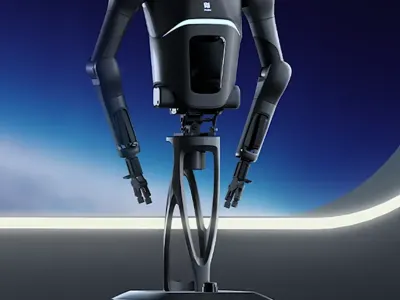
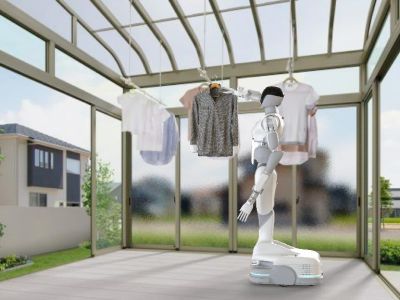
D7 is Pudu Robotics' first semi-humanoid: a human-like upper body with two arms on an omnidirectional wheeled base. It is 165 cm tall, weighs 45 kg, moves at up to 2 m/s and works for more than eight hours on a charge.
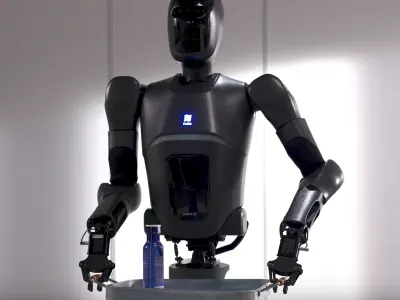
AI² Robotics of Shenzhen unveiled AlphaBot 2 in April 2025 as a general-purpose humanoid. Its AlphaBrain platform and GOVLA vision-language-action model drive a body that can reach from 0 to 240 cm, and it can work for more than six hours at a stretch.
Detailed Analysis

Pudu D7
Design & Build Quality
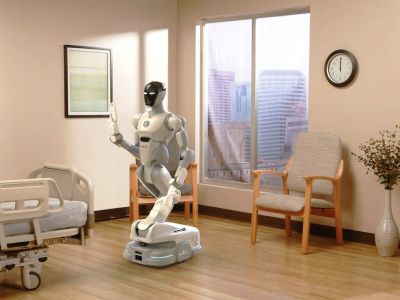
D7 and AlphaBot 2 both put a humanoid upper body on a wheeled base, but they are tuned for different reach. D7 is 165 cm and 45 kg, with 30 degrees of freedom, or 50 with dexterous hands, and arms that reach 65 cm and place their tips to within 0.1 mm. AlphaBot 2 has more than 34 degrees of freedom and a waist-and-leg lift that gives a vertical working range of 0 to 240 cm, with 700 mm of reach per arm; AI² Robotics has not published its height or weight. D7 is built for precise work at a fixed height, while AlphaBot 2 can work from floor level up to high shelves.
AlphaBot 2
Mobility & Navigation
Both robots roll on wheeled bases. D7's 360° omnidirectional chassis moves in any direction at up to 2 m/s and climbs slopes of up to 10°. AlphaBot 2 uses what AI² Robotics calls 360° × 360° full-space perception to get around, but its speed has not been published. D7 is the better-documented choice for moving goods quickly through a building.
Pudu D7
Sensors & Perception
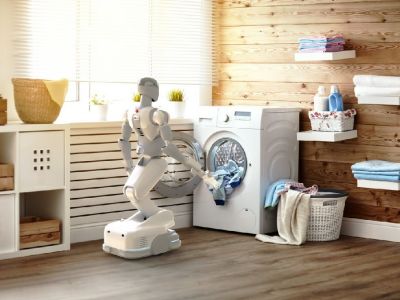
AlphaBot 2 sees through a 360° ring of cameras and stereo cameras, backed by force feedback sensors, a microphone array and proximity sensors. Pudu has not said which cameras or sensors D7 carries. AlphaBot 2 is therefore the easier robot to assess for perception and handling. Ask Pudu for D7's sensor details before comparing the two on vision or touch.
AlphaBot 2
AI Capabilities
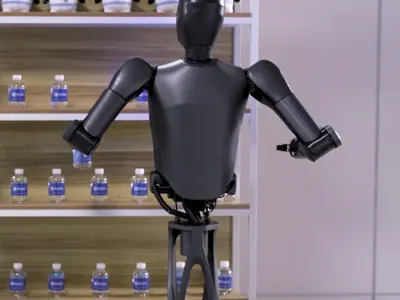
Both robots split thinking into fast and slow layers. D7's high-level planning sets the strategy while low-level control reacts to sensor input in real time, and Pudu says it keeps refining its skills from data. AlphaBot 2 thinks with AI² Robotics' GOVLA model, in which a slow System 2 reasons through tasks step by step and a fast System 1 drives whole-body movement, with DeepSeek technology built in. AlphaBot 2 has been shown chaining long, multi-step tasks such as cooking, while D7's published skills centre on transport, lifts and sorting.
Pudu D7
Battery & Power Efficiency
Both are built for long shifts. D7's battery of more than 1 kWh gives over eight hours of continuous work, and AlphaBot 2 works for more than six hours continuously, according to AI² Robotics. D7 has the longer published runtime by about two hours. Either can cover most of a working day.
AlphaBot 2
Use-Case Suitability
Pudu's target for D7 is service venues and industrial sites, with jobs such as operating lifts, carrying items and sorting goods. AlphaBot 2 targets automotive, semiconductor and biotech manufacturing, with airports and residential communities planned, and has been shown cooking, doing sterile filling, packing and inspecting. D7 moves things around buildings, while AlphaBot 2 performs detailed tasks at a workstation. Choose D7 for all-day service, lift operation and sorting on flat floors, or AlphaBot 2 for multi-step lab and factory tasks over long shifts.
Pudu D7
Software Ecosystem
D7's software is Pudu's in-house embodied-AI system, built on high-level and low-level planning. AlphaBot 2's software is AI² Robotics' AlphaBrain embodied-AI platform, updated over the air. Both are vendor-managed systems rather than open developer platforms. Ask each maker what integration and customisation they support before choosing.

AlphaBot 2
Safety Features
Neither maker has published safety features or certifications for these robots. Pudu notes only that D7's wheeled base keeps it low and stable on flat floors, and AI² Robotics has released no safety details for AlphaBot 2. Both avoid the fall risk of walking robots because they stand on wheels. Buyers should request full safety documentation from both companies.
Capabilities & Operational Tasks
Head-to-head comparison of what Pudu D7 and AlphaBot 2 can do, their applications, and capabilities.
What Can Pudu D7 & AlphaBot 2 Do?
149 tasks listed for both, 0 only for Pudu D7, 5 only for AlphaBot 2.
Technical Specifications
Pudu D7 and AlphaBot 2 differ on 32 of the 52 specifications listed for both.
Functional Utility & Use Cases
4 Comparative Metrics
Manipulation & Load Capacity
4 Comparative Metrics
Kinematic Architecture & Dexterity
4 Comparative Metrics
Related Comparisons

AgiBot G2 vs Pudu D7
AgiBot G2 vs D7: AgiBot's wheeled precision-assembly humanoid against Pudu's wheeled semi-humanoid, compared on size, mobility, sensors, AI and best uses.
AlphaBot 2 vs Walker Tienkung
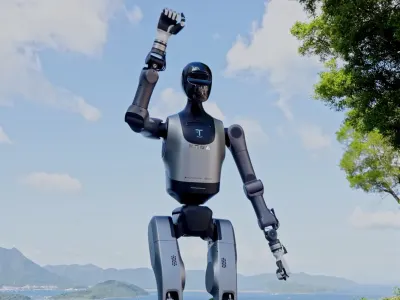
AlphaBot 2 vs Walker Tienkung: AI² Robotics' wheeled VLA humanoid against UBTECH's full-size research humanoid, compared on specs and uses.
Pudu D7 vs Walker Tienkung
D7 vs Walker Tienkung: Pudu's wheeled semi-humanoid against UBTECH's full-size research humanoid, compared on size, mobility, sensors, AI and best uses.

Pudu D7 vs AgiBot A2 Lite
D7 vs AgiBot A2 Lite: Pudu's wheeled semi-humanoid against AgiBot's performance humanoid, compared on size, mobility, sensors, AI and best uses.
Verdicts reflect our research and opinion. Confirm specifications with the manufacturer before buying.