Pudu D7 vs AgiBot A2 Lite at a glance
Pudu D7 lasts longer on a charge, about 8 hours against 1.5 hours for AgiBot A2 Lite. Pudu D7 is quicker, with a top speed of 2 m/s versus 0.8 m/s for AgiBot A2 Lite. Pudu D7 is lighter at 45 kg, compared with 63 kg for AgiBot A2 Lite. Pudu D7 has more degrees of freedom (30 against 23 for AgiBot A2 Lite), which allows finer movement.
Which one fits your use?
Based on the uses each robot is built and marketed for. Open a use to see the specs that matter for it.
| Comparing for… | Pudu D7 | AgiBot A2 Lite |
|---|---|---|
| Suited | Not listed | |
| Suited | Not listed | |
| Suited | Suited |
- Pick Pudu D7 for warehouse and logistics work and factory and manufacturing work.
- Both suit hospitality, retail and public-facing roles, so compare the specs for that use.
D7 is Pudu Robotics' first semi-humanoid: a human-like upper body with two arms on an omnidirectional wheeled base. It is 165 cm tall, weighs 45 kg, moves at up to 2 m/s and works for more than eight hours on a charge.
AgiBot's A2 Lite is a performance version of its A2 biped, priced at $44,560 on AgiBot's global store. The 169 cm, 63 kg robot has 23 degrees of freedom and walks at up to 0.8 m/s, and instead of perception or speech AI it comes with a library of routines from handshakes to tai chi and Peking opera.
Detailed Analysis
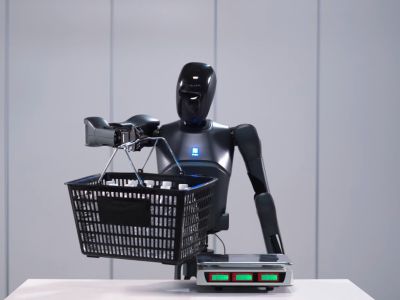
Pudu D7
Design & Build Quality
D7 and AgiBot A2 Lite are almost the same height but built in completely different ways. D7 is a 165 cm, 45 kg semi-humanoid on a wheeled base, with 30 degrees of freedom, or 50 with dexterous hands, all in its arms and upper body. AgiBot A2 Lite is a 169 cm, 63 kg biped with 23 degrees of freedom (five in each arm, six in each leg and one in the head) and soft prosthetic hands. D7 spends its joints on precise manipulation, while A2 Lite spends them on walking and expressive movement.
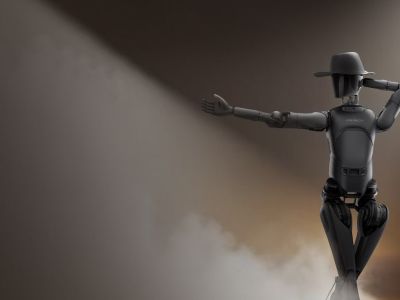
AgiBot A2 Lite
Mobility & Navigation
D7 rolls on a 360° omnidirectional chassis at up to 2 m/s and handles slopes of up to 10°. AgiBot A2 Lite walks at up to 0.8 m/s, or 0.6 m/s or less in daily use, and handles steps of up to 20 mm and slopes of up to 8%. D7 is more than twice as fast and copes with steeper ramps. A2 Lite's walking gait is part of its appeal as a performer, not a way of covering ground quickly.
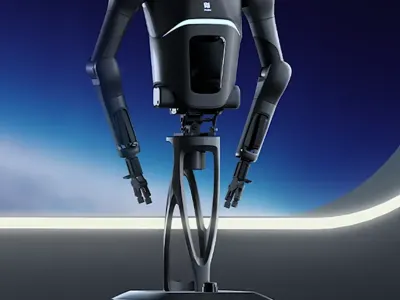
Pudu D7
Sensors & Perception
Pudu has not published a sensor list for D7, though its autonomous navigation and lift riding depend on onboard perception. AgiBot lists perception as not supported on the A2 Lite, so it has no camera-based vision package. A2 Lite cannot find or recognise objects on its own. D7 is the only one of the two built to work autonomously around a building.
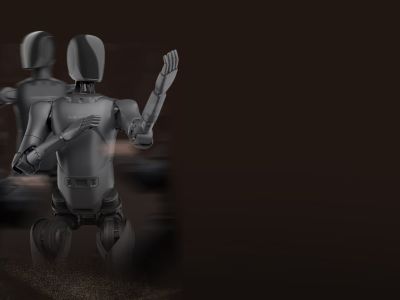
AgiBot A2 Lite
AI Capabilities
Pudu splits D7's intelligence into a planning layer that sets strategy and a control layer that reacts to sensors in real time, and says its skills improve with data. AgiBot A2 Lite has no perception or speech AI at all; it plays routines from an action library, and an optional VR teleoperation kit records new moves. D7 makes decisions as it works. A2 Lite replays choreographed movements.
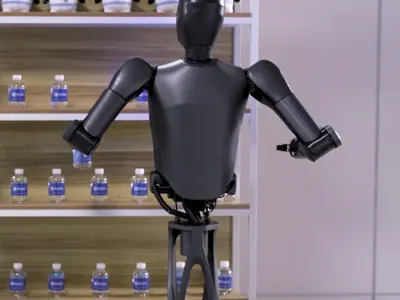
Pudu D7
Battery & Power Efficiency
D7's battery of more than 1 kWh gives over eight hours of continuous work. AgiBot A2 Lite's hot-swappable 14.4 Ah battery lasts about 1.5 hours of walking or 4 hours 35 minutes standing, and recharges in 2 hours. D7 can work a full day on one charge. A2 Lite relies on battery swaps to keep shows going.
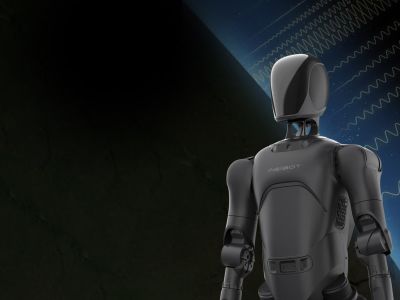
AgiBot A2 Lite
Use-Case Suitability
Pudu designed D7 for service spaces and industrial sites, where it can ride lifts, carry items and sort goods. AgiBot markets the A2 Lite for entertainment, cultural and commercial shows, with routines such as handshakes, tai chi, Peking opera and optional dances. These robots answer different needs entirely. Choose D7 for all-day service, lift operation and sorting on flat floors, or A2 Lite for scripted performances and entertainment.
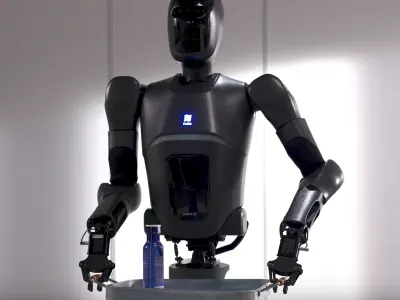
Pudu D7
Functional Tools & Payload
Each of D7's arms lifts 10 kg. Each A2 Lite arm is rated for 1.5 kg, and AgiBot says light-duty item handling is not supported. That is a difference of more than six times per arm. D7 is a working robot for moving goods, while A2 Lite's hands are for gestures and light props.
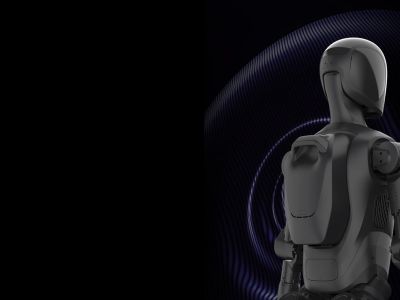
AgiBot A2 Lite
Software Ecosystem
Pudu runs D7 on its own embodied-AI system, which pairs high-level planning with low-level control. AgiBot A2 Lite is deployed through AgiBot's AIMMASTER client, with optional group-control software that times several robots together and a skill-pack shop for new routines. AgiBot's software is designed for staging shows. Pudu's is designed for autonomous service work.
Capabilities & Operational Tasks
Head-to-head comparison of what Pudu D7 and AgiBot A2 Lite can do, their applications, and capabilities.
What Can Pudu D7 & AgiBot A2 Lite Do?
111 tasks listed for both, 8 only for Pudu D7, 2 only for AgiBot A2 Lite.
Technical Specifications
Pudu D7 and AgiBot A2 Lite differ on 37 of the 52 specifications listed for both.
Functional Utility & Use Cases
4 Comparative Metrics
Manipulation & Load Capacity
4 Comparative Metrics
Kinematic Architecture & Dexterity
4 Comparative Metrics
Related Comparisons
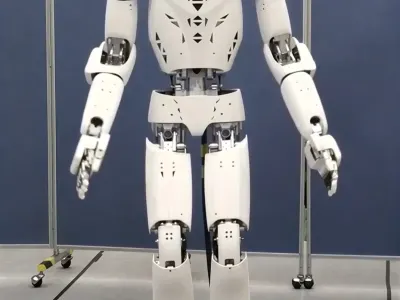
AgiBot A2 Lite vs Kaleido 8.0
AgiBot A2 Lite vs Kaleido 8.0: AgiBot's performance humanoid against Kawasaki's robust bipedal humanoid, compared on size, mobility, sensors, AI and best uses.

AgiBot G2 vs Pudu D7
AgiBot G2 vs D7: AgiBot's wheeled precision-assembly humanoid against Pudu's wheeled semi-humanoid, compared on size, mobility, sensors, AI and best uses.
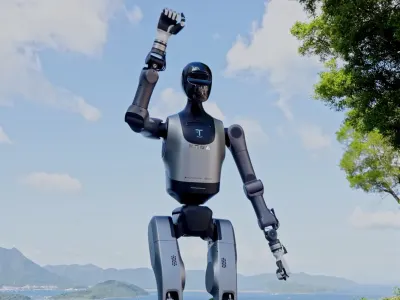
Pudu D7 vs Walker Tienkung
D7 vs Walker Tienkung: Pudu's wheeled semi-humanoid against UBTECH's full-size research humanoid, compared on size, mobility, sensors, AI and best uses.
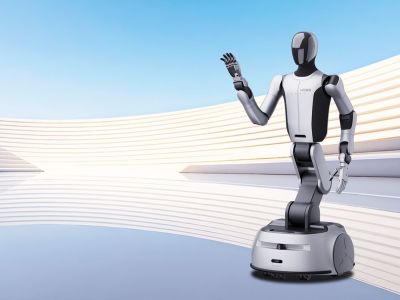
Cruzr S2 vs AgiBot A2 Lite
Cruzr S2 vs AgiBot A2 Lite: UBTECH's wheeled assembly and service humanoid against AgiBot's performance humanoid, compared on specs and uses.
Verdicts reflect our research and opinion. Confirm specifications with the manufacturer before buying.