Walker C vs Cruzr S2 at a glance
Both Walker C and Cruzr S2 are sold through a sales quote. Cruzr S2 has more degrees of freedom (44 against 20 for Walker C), which allows finer movement. Cruzr S2 is quicker, with a top speed of 2 m/s versus 1.7 m/s for Walker C.
| Key specs | Walker C | Cruzr S2 |
|---|---|---|
| Price | — | $80,000 |
| Height | — | 176 cm |
| Weight | 43 kg | — |
| Top speed | 1.7 m/s | 2 m/s (stronger) |
| Runtime | 2 hours | — |
| Degrees of freedom | 20 | 44 (stronger) |
| Payload | 5 kg | 15 kg (stronger) |
| Availability | Order via sales quote | Order via sales quote |
Last updated:
Which one fits your use?
Based on the uses each robot is built and marketed for. Open a use to see the specs that matter for it.
| Comparing for… | Walker C | Cruzr S2 |
|---|---|---|
| Not marketed | Suited | |
| Not marketed | Suited | |
| Suited | Not marketed | |
| Suited | Suited |
- Only Walker C is marketed for education and training.
- Only Cruzr S2 is marketed for warehouse and logistics work and factory and manufacturing work.
- Both suit hospitality, retail and public-facing roles, so compare the specs for that use.
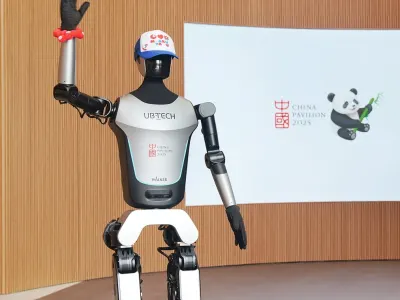
Walker C is UBTECH Robotics' walking service humanoid for guiding visitors, reception and exhibition work in malls, airports and museums. It has worked as a tour guide at the China Pavilion at Expo 2025 Osaka. An embodied interactive large model, an AI trained on conversation and body language, lets it hold multilingual chats with guests. U-SLAM, UBTECH's visual mapping system, helps it find its way.
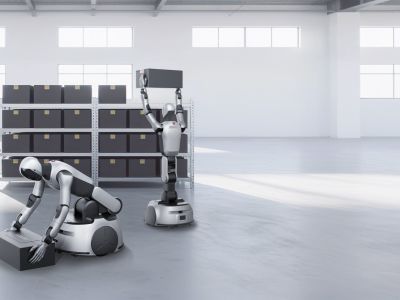
Cruzr S2 is UBTECH's full-size wheeled humanoid, introduced in August 2025 for commercial and industrial work. It rolls on a wheeled base instead of walking. Its Gen-4 industrial hands are made for sorting and assembling components, and a flexible waist lets it work from the floor upward. UBTECH's Co-Agent industrial agent plans its tasks, and spoken commands run through a large language model.
Detailed Analysis
How do Walker C and Cruzr S2 move and balance?
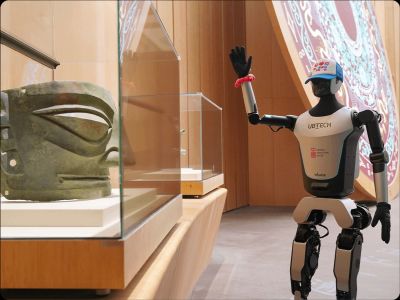
Walker C
Pick Walker C if the robot must walk among visitors on two legs. Pick Cruzr S2 if it works on flat floors and needs a faster, steadier base. Walker C walks and can jog, which lets it move through spaces built for people. Cruzr S2 rolls on wheels and can turn around within a narrow passage, a useful trait in aisles. It keeps its balance with learning-based motion control, while Walker C relies on whole-body motion control and AI obstacle detection. Walker C looks natural on busy public floors, and Cruzr S2 is quicker and steadier on commercial and factory floors.
Which robot handles dexterous manipulation better?
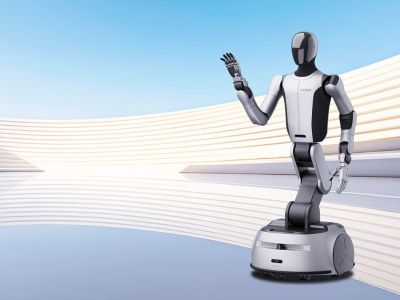
Cruzr S2
Cruzr S2 is the clear choice for manipulation. Its Gen-4 industrial hands have 11 degrees of freedom (separate ways to move) each, with tactile sensor arrays in every hand and six-axis force sensors in both wrists, which give it sub-millimetre control for assembly. A single finger grasp holds 1 kg. In total it has 44 degrees of freedom, against 20 for Walker C. Walker C's arms are built for gestures and light hand-overs, such as giving a visitor a leaflet or a small parcel. Its force limiting and collaborative mode keep those moves gentle near people.
Which humanoid robot is better for industrial manufacturing?
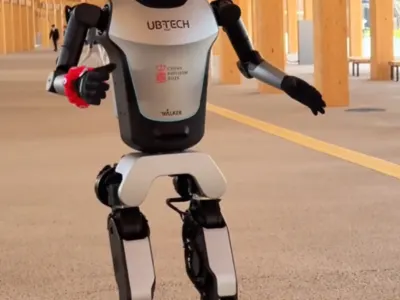
Walker C
Cruzr S2 is the better fit for manufacturing. UBTECH pitches it for sorting and component assembly, and its waist rotates ±170°, pitches from +90° to -35° and lifts 0.4 m, so its working reach runs from floor level to 1.8 m. That lets it pick parts from a low bin and place them on a high shelf without moving its wheels. Walker C is not built for production lines. Its strengths are reception, tour guiding and light delivery of tools and packages in commercial spaces. For industrial manufacturing, Cruzr S2 is the recommended option.
Which robot offers better autonomous learning capabilities?
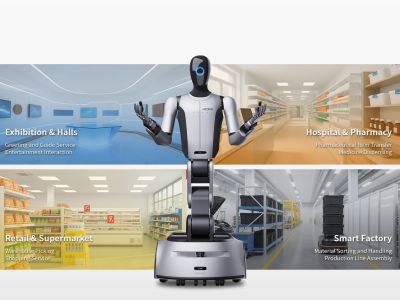
Cruzr S2
Walker C runs an embodied interactive large model that focuses on conversation and service behavior. It is semi-autonomous, with a remote operator as a fallback, and it learns through reinforcement learning for motion and task programming, plus adaptive narration for tours. Cruzr S2 plans its work through Co-Agent, which UBTECH calls the first industrial agent for humanoid robots, and it takes spoken commands through a large language model. It also uses learning-based motion control for its body. For learning aimed at guiding people, Walker C is the better fit. For learning aimed at tasks on a shop floor, Cruzr S2 leads.
How do their sensor suites affect deployment reliability?
Walker C
Walker C sees with dual RGB-D cameras (color plus depth) and dual structured-light 3D cameras, backed by ultrasonic sensors, an IMU that tracks tilt and a gyroscope. Its U-SLAM system builds a map from those cameras, which suits indoor navigation around people. Cruzr S2 uses two fisheye cameras and two RGB cameras for stereo vision, RGB-D cameras in its chest and base, front and rear radars, and a four-microphone array. Deep-learning depth estimation turns the stereo images into distance readings. Cruzr S2 has the richer set for handling objects, and Walker C has the more focused set for walking among visitors.
Which robot is more suitable for enterprise service tasks?
Cruzr S2
Walker C is the more focused choice for front-of-house work: reception, tour guiding, visitor assistance, multilingual customer interaction and light delivery. At 163 cm and 43 kg, it is built on a person's scale, and it already works as a guide at the China Pavilion at Expo 2025 Osaka, which shows it can handle crowds in a real venue. Cruzr S2 stands 176 cm, which is 13 cm taller. It can serve customers too through voice interaction, but its dexterous hands make it more valuable where the job also involves sorting or assembly. Choose Walker C to welcome people, and choose Cruzr S2 when the same robot must also handle parts.
How do pricing and deployment cost compare?
Walker C
Cruzr S2 costs $80,000 for a robot with industrial hands and a two-arm payload. Walker C is sold through UBTECH and regional partners on request, so its quote depends on the project. Running needs differ too. Walker C works 2 hours while walking, or 4 hours standing, on a 48 V, 15 Ah battery, and it recharges in 1.5 hours. Its draw averages 100 to 150 W while walking and peaks at 300 W. Cruzr S2 supports fast charging, so quick top-ups between shifts are possible. Request a quote for each robot and match the endurance to your shift.
Capabilities & Operational Tasks
Head-to-head comparison of what Walker C and Cruzr S2 can do, their applications, and capabilities.
What Can Walker C & Cruzr S2 Do?
93 tasks listed for both, 2 only for Walker C, 4 only for Cruzr S2.
Tap a circle area to filter the lists
Only Walker C
Not listed for the other robot
Shared by both
Listed for Walker C and Cruzr S2
2 differ in level (highlighted, A = Walker C, B = Cruzr S2)
Only Cruzr S2
Not listed for the other robot
Technical Specifications
Walker C and Cruzr S2 differ on 32 of the 33 specifications listed for both.
Manipulation & Load Capacity
4 Comparative Metrics
Kinematic Architecture & Dexterity
4 Comparative Metrics
Energy & Power Management
6 Comparative Metrics
Frequently Asked Questions
Which humanoid robot carries more for enterprise tasks?
Cruzr S2. Its two arms carry 15 kg together and each hand grasps 7.5 kg. Walker C's arms handle light tools and packages, rated at 5 kg per arm, with a deadlift of 5 to 7 kg.
Which robot moves faster indoors?
Cruzr S2 is the faster robot, because wheels roll quicker than legs jog. It rolls at 7.2 km/h, against 6 km/h for Walker C, and it turns around within a 0.8 m passage. Walker C moves through spaces built for people.
Is Walker C ready for reception and multilingual visitor assistance?
Yes. UBTECH designed Walker C for reception, tour guiding, visitor assistance and multilingual customer interaction in malls, airports and exhibitions.
How can visitors interact with each robot?
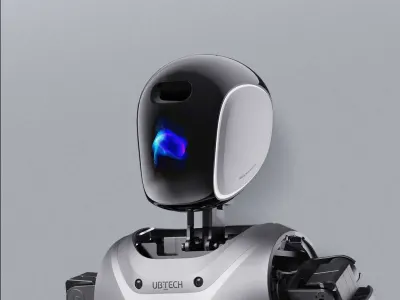
Walker C takes input through a touch panel, voice recognition, gestures and an app, and answers with matching body language. Cruzr S2 talks through a large language model and shows a face on a 4-inch circular display, with two speakers.
Can either robot work outdoors?
Walker C is built mainly for indoor use but can handle limited outdoor use on flat terrain. Cruzr S2 is designed for indoor commercial and industrial spaces, so it should stay inside.
How do the two robots connect to other equipment?
Walker C offers an open joint control interface plus Wi-Fi and Bluetooth. Cruzr S2 offers Gigabit Ethernet and USB 3.0 ports, a wired setup that suits fixed equipment on a shop floor.
Can I buy Walker C or Cruzr S2 today?
Both Walker C and Cruzr S2 are sold through a sales quote.
Which uses is each robot marketed for, Walker C or Cruzr S2?
Only Walker C is marketed for education and training. Only Cruzr S2 is marketed for warehouse and logistics work and factory and manufacturing work. Both suit hospitality, retail and public-facing roles, so compare the specs for that use.
How much does Cruzr S2 cost?
Cruzr S2 is listed at $80,000.
Where can I buy Walker C?
Walker C is sold through UBTECH Robotics's sales team; request a quote.
Where can I buy Cruzr S2?
Cruzr S2 is sold through UBTECH Robotics's sales team; request a quote.
Related Comparisons
Cruzr S2 vs Walker Tienkung
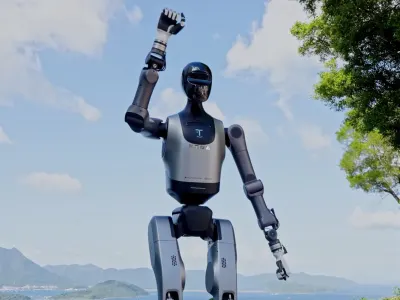
Cruzr S2 vs Walker Tienkung: UBTECH's wheeled assembly and service humanoid against UBTECH's full-size research humanoid, compared on specs and uses.
Cruzr S2 vs AgiBot A2 Lite
Cruzr S2 vs AgiBot A2 Lite: UBTECH's wheeled assembly and service humanoid against AgiBot's performance humanoid, compared on specs and uses.
Green vs Cruzr S2
Green vs Cruzr S2: Sber's 180 cm walking humanoid against UBTECH's wheeled Cruzr S2, compared on mobility, hands, AI and jobs.

Pudu D7 vs Cruzr S2
D7 vs Cruzr S2: Pudu's wheeled semi-humanoid against UBTECH's wheeled assembly and service humanoid, compared on size, mobility, sensors, AI and best uses.
Verdicts reflect our research and opinion. Confirm specifications with the manufacturer before buying.