Hanson Robotics’ Joey Chaos showed how expressive humanoids can hold a conversation, not just strike a pose
Robot Details
Joey Chaos • Hanson RoboticsPublished
May 25, 2026
Reading Time
3 min read
Author
Origin Of Bots Editorial Team

A robot with attitude
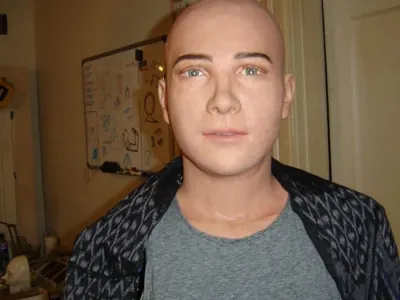
Joey Chaos, built by Hanson Robotics, was introduced as an expressive humanoid designed to answer questions, maintain eye contact, and study how people respond to a robot with a punk-rock personality. The 2007-era demo positioned the small biped as a testbed for human-robot interaction, showing how social cues, facial animation, and speech recognition can shape a more natural encounter between people and machines.
Why it mattered
What made Joey Chaos notable was not raw autonomy, but the combination of face tracking, conversational speech, and a deliberately edgy persona that let researchers probe how humans react to personality in a robot. Hanson’s approach emphasized expressive faces, interactive dialogue, and eye contact, which helped move humanoids beyond scripted motion displays and toward socially legible behavior. For a category still wrestling with balance and manipulation, Joey’s value was in the interaction layer, where trust and engagement are often won or lost. In that sense, the robot was less a product launch than an early argument for personality as a technical tool. Joey Chaos treated social response as a core engineering problem, not a decorative feature.

How it worked
The basic flow was human motion and speech input, then AI processing, then joint actuation and balance correction. In practice, that meant cameras and microphones fed the robot’s proprietary AI architecture, which handled face detection, speech recognition, and conversational response before the system drove facial motors and bipedal movement. The result was a humanoid that could turn toward a speaker, hold eye contact, and respond in a way that made the interaction feel more continuous than a simple voice assistant.
A service testbed
The most realistic deployment scenario for Joey Chaos was as a human-robot interaction research platform in public demonstrations or controlled service settings. In that role, the robot could be used to observe how people react when a humanoid not only answers questions but also projects a distinct personality through facial expression and tone. That matters in human-centric spaces, where teleoperation and assisted service increasingly depend on whether people are comfortable engaging with a machine that looks and behaves like a social actor.

What the build suggests
Reported specifications for Joey’s small humanoid form point to a machine around 60 x 25 x 20 cm, with a weight near 5 kg, which would make it easier to stage in demonstrations and closer to the scale of a tabletop research platform. The published feature set also points to RGB cameras, an IMU, a gyroscope, a microphone, visual SLAM, collision detection, an emergency stop, and a proprietary AI stack, all of which support interactive indoor use rather than autonomous outdoor work. Its bipedal mobility and low walking speed, reported at about 0.5 km/h / 0.3 mph, fit a robot built to show believable motion and social presence more than fast traversal.
Rivals Edge Check
| Robot | Key Advantage | Where Joey Chaos Wins | Target Use |
|---|---|---|---|
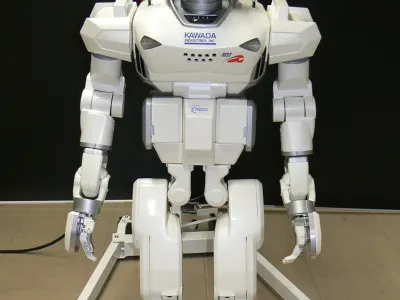
| HRP-3 | Advanced humanoid research platform with fuller body control | More personality-driven interaction and conversational staging | Research and motion studies |
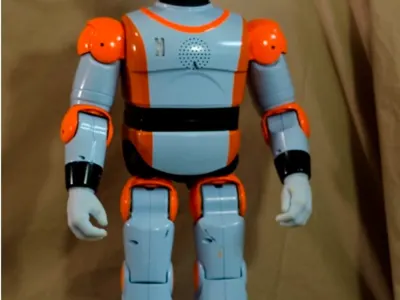
| Zeno | Small expressive humanoid focused on social engagement | More distinctive persona and stronger conversational performance | Human-robot interaction demos |
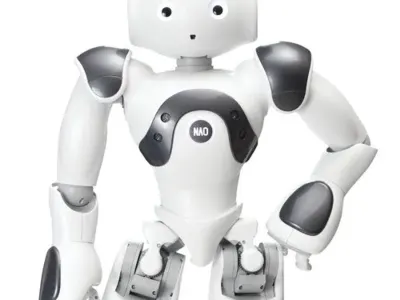
| NAO | Broad adoption in education and labs with reliable programmable behavior | More theatrical facial expression and character-driven presence | Teaching and lab work |
| Eva | Strong expressive robotics emphasis for public-facing interaction | Edgier personality and richer social cue testing | Public demonstrations |
Industry direction
Joey Chaos also hints at a broader shift now visible across humanoids: the move from pre-programmed motion libraries toward teleoperation-first systems that can be evaluated in real human spaces. That matters because the hardest problems in humanoids are not only balance and actuation, but also whether a person trusts the robot enough to keep interacting with it. Hanson’s early emphasis on expressive interaction looks less like a novelty in hindsight and more like a preview of where the category has been heading.
Explore Humanoids
Related Articles

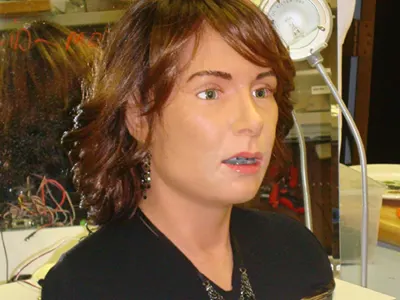
Hanson Robotics’ Bina48 remains the company’s most unusual face-to-face AI experiment
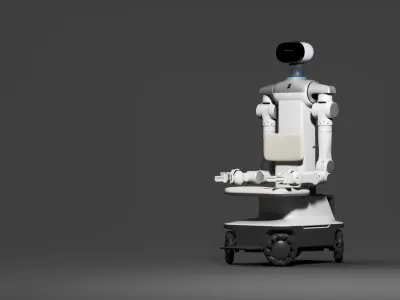
RobotGym’s Qijia Q1 pushes eldercare humanoids toward teleoperation-first service
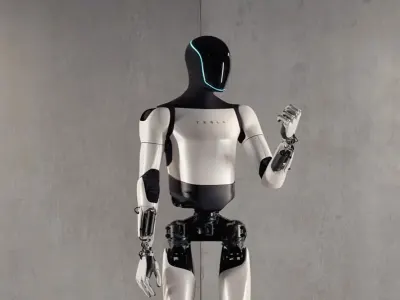
Tesla’s Optimus Gen 3 points to teleoperation-first humanoids as production nears
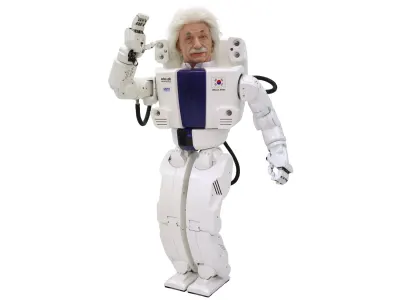
Albert HUBO showed how a humanoid can pair a lifelike head with bipedal motion in a research platform built for human interaction
Related Comparisons
Compare Joey Chaos with similar robots


Sophia vs Aria - Robot Girlfriend
Head-to-head: Sophia vs Aria - Robot Girlfriend compared on bipedal balance, AI learning, and real-world deployment.

Optimus vs Unitree G1
Compare Optimus vs Unitree G1 for humanoid mobility, dexterity, autonomy, and payload capacity.
Unitree G1 vs Unitree H1
Head-to-head: Unitree G1 vs Unitree H1 compared on bipedal balance, AI learning, and real-world deployment.
Optimus vs Atlas (Electric Atlas, 2025)
In-depth comparison of Optimus and Atlas (Electric Atlas, 2025), covering hardware capabilities, teleoperation, and enterprise readiness.
Learn More About This Robot
Discover detailed specifications, reviews, and comparisons for Joey Chaos.
View Robot Details →