AgiBot G2 vs Pudu D7 at a glance
Both AgiBot G2 and Pudu D7 are sold through a sales quote. Pudu D7 is lighter at 45 kg, compared with 185 kg for AgiBot G2. Pudu D7 lasts longer on a charge, about 8 hours against 4 hours for AgiBot G2. Pudu D7 is quicker, with a top speed of 2 m/s versus 1.5 m/s for AgiBot G2. Pudu D7 has more degrees of freedom (30 against 26 for AgiBot G2), which allows finer movement.
| Key specs | AgiBot G2 | Pudu D7 |
|---|---|---|
| Price | $100,000–$125,000 | — |
| Height | 180 cm | 165 cm |
| Weight | 185 kg | 45 kg |
| Top speed | 1.5 m/s | 2 m/s (stronger) |
| Runtime | 4 hours | 8 hours (stronger) |
| Degrees of freedom | 26 | 30 (stronger) |
| Payload | 5 kg | 10 kg (stronger) |
| Availability | Order via sales quote | Order via sales quote |
Last updated:
Which one fits your use?
Based on the uses each robot is built and marketed for. Open a use to see the specs that matter for it.
| Comparing for… | AgiBot G2 | Pudu D7 |
|---|---|---|
| Suited | Suited | |
| Suited | Suited | |
| Suited | Not marketed | |
| Not marketed | Suited | |
| Suited | Not marketed |
- Only AgiBot G2 is marketed for research labs and hazardous or high-risk work.
- Only Pudu D7 is marketed for hospitality, retail and public-facing roles.
- Both suit warehouse and logistics work and factory and manufacturing work, so compare the specs for that use.
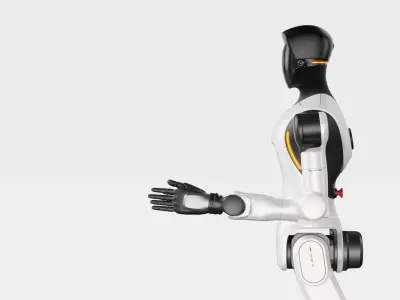
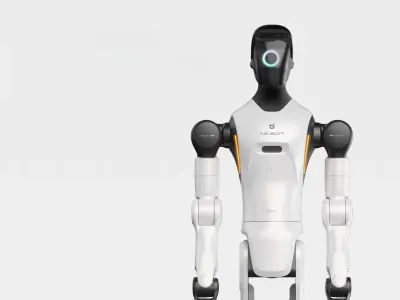
AgiBot G2 is a wheeled industrial humanoid made for precision work. Its 7-DoF force-controlled arms reach sub-millimetre accuracy, its omnidirectional base moves at 1.5 m/s, it has 26 active degrees of freedom (expandable to 50), and two swappable batteries give about four hours each. Safety features include emergency stop, real-time force sensing and obstacle avoidance. Its sensors include 3D LiDAR, stereo Camera and fisheye Camera.
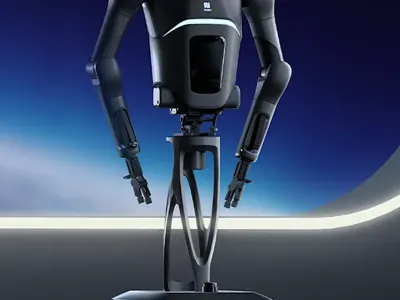
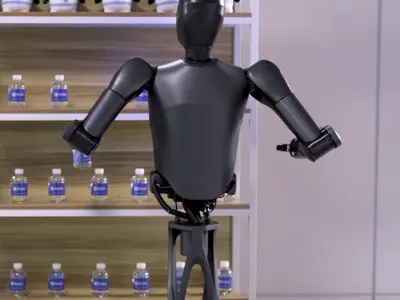
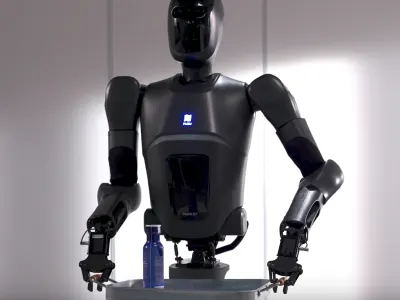
D7 is Pudu Robotics' first semi-humanoid: a human-like upper body with two arms on an omnidirectional wheeled base. It is 165 cm tall, weighs 45 kg, moves at up to 2 m/s and works for more than eight hours on a charge. Pudu D7 has 30 degrees of freedom and carries 10 kg.
Detailed Analysis
Design & Build Quality

AgiBot G2
AgiBot G2 and D7 are both humanoid upper bodies on wheeled bases, but G2 is about four times heavier. AgiBot G2 weighs 185 kg, adjusts its height from about 123 to 180 cm and has 26 active degrees of freedom, expandable to 50, including two 7-DoF force-controlled arms and a 3-DoF waist. D7 is 165 cm and 45 kg, with 30 degrees of freedom, or 50 with dexterous hands, and arms that reach 65 cm and place their tips to within 0.1 mm. Both can reach 50 degrees of freedom with hands; G2's weight makes it a stable station robot, while D7 is light and mobile.
Mobility & Navigation

Pudu D7
Both roll on omnidirectional bases. D7 moves at up to 2 m/s and handles slopes of up to 10°, while AgiBot G2 moves at up to 1.5 m/s and maps its surroundings with 3D LiDAR SLAM. D7 is the quicker of the two and is built to ride lifts between floors. G2 is designed to move between workstations and then stay put while it works. AgiBot G2's mobility type is wheeled. Pudu D7's mobility type is wheeled-based. AgiBot G2 stands 180 cm tall and weighs 185 kg. Pudu D7 stands 165 cm tall and weighs 45 kg.
Sensors & Perception

AgiBot G2
AgiBot G2 carries two 3D LiDARs, a stereo camera, three fisheye cameras, RGB-D cameras in its head and wrists, a microphone array and torque sensors. D7's sensor hardware has not been listed by Pudu. G2's wrist cameras let it watch its hands closely during precision work. Ask Pudu for D7's sensor details before comparing the two on perception. AgiBot G2 has 26 degrees of freedom and carries 5 kg per arm. Pudu D7 has 30 degrees of freedom, carries 10 kg and can deadlift 50 kg.
AI Capabilities
Pudu D7
AgiBot G2 runs AgiBot's GO-1 and GE-1 vision-language-action models on NVIDIA Jetson T5000 compute rated at 2,070 TFLOPS. D7's control is layered: high-level planning decides the approach, low-level control responds to its sensors in real time, and Pudu says the robot improves its skills from data. G2 has the more powerful published onboard computer, aimed at fine manipulation. D7's AI is focused on service tasks such as lift operation and sorting. AgiBot G2 is listed as semi-autonomous with vision-language-action models. Pudu D7 is listed as semi-autonomous to fully autonomous.
Battery & Power Efficiency
AgiBot G2
D7's battery of more than 1 kWh gives over eight hours of continuous work. AgiBot G2 runs for about four hours, hot-swaps between two batteries with 1,652 Wh in total, charges in 1.5 hours and can charge itself. D7 lasts twice as long on a charge. G2's hot-swapping and self-charging let it keep working almost continuously. Pudu D7 runs for more than 8 hours per charge. AgiBot G2's safety features include emergency stop, real-time force sensing, obstacle avoidance and impedance control. AgiBot G2's sensors include 3D LiDAR, stereo Camera, fisheye Camera and head RGBD Camera.
Use-Case Suitability
Pudu D7
AgiBot G2 targets sub-millimetre precision assembly, machine tending, industrial kitting and showroom tours. Pudu's target for D7 is service venues and industrial sites, with jobs such as operating lifts, carrying items and sorting goods. G2 is a precision workstation robot, while D7 moves goods around a building. Choose AgiBot G2 for precision assembly with near-continuous uptime, or D7 for all-day service, lift operation and sorting on flat floors. AgiBot G2's listed uses include sub-millimeter precision assembly, hole searching, machine tending and industrial kitting. AgiBot G2 runs for 4 hours per charge and recharges in 1.5 hours.
Software Ecosystem
AgiBot G2
AgiBot G2 runs AgiBot's own AI operating system with the GO-1 and GE-1 models and support for reinforcement learning and simulation, which helps teams train new skills before deploying them. D7's software is Pudu's in-house embodied-AI system, built on high-level task planning and low-level real-time control that refines operations from data. G2 suits teams that want to train and tune skills in simulation, while D7 suits service operators who want a managed system. G2 is controlled by autonomous AI, teleoperation and multimodal voice.
Safety Features
Pudu D7
AgiBot G2 uses real-time force sensing and impedance control in its arms, plus obstacle avoidance and an emergency stop, and it carries an IP42 rating and an operating range of -15 to 50 °C. D7 stands on a 360° omnidirectional wheeled base that handles slopes up to 10° and does not need to balance like a walking robot. Both are wheeled, so neither has the fall risk of a walker. G2's impedance control suits precise work near people, and D7's low, stable base suits service floors.
Capabilities & Operational Tasks
Head-to-head comparison of what AgiBot G2 and Pudu D7 can do, their applications, and capabilities.
What Can AgiBot G2 & Pudu D7 Do?
198 tasks listed for both, 10 only for AgiBot G2, 1 only for Pudu D7.
Both AgiBot G2 and Pudu D7
8Only AgiBot G2
10Only Pudu D7
1Technical Specifications
AgiBot G2 and Pudu D7 differ on 43 of the 43 specifications listed for both.
Manipulation & Load Capacity
4 Comparative Metrics
Kinematic Architecture & Dexterity
4 Comparative Metrics
Energy & Power Management
7 Comparative Metrics
Frequently Asked Questions
Can I buy AgiBot G2 or Pudu D7 today?
Both AgiBot G2 and Pudu D7 are sold through a sales quote.
Which is lighter, AgiBot G2 or Pudu D7?
Pudu D7 is lighter at 45 kg, compared with 185 kg for AgiBot G2. AgiBot G2 is also taller, at 180 cm against 165 cm for Pudu D7.
Which uses is each robot marketed for, AgiBot G2 or Pudu D7?
Only AgiBot G2 is marketed for research labs and hazardous or high-risk work. Only Pudu D7 is marketed for hospitality, retail and public-facing roles. Both suit warehouse and logistics work and factory and manufacturing work, so compare the specs for that use.
How much does AgiBot G2 cost?
AgiBot G2 is listed at $100,000–$125,000.
Where can I buy AgiBot G2?
AgiBot G2 is sold through AgiBot's sales team; request a quote.
Where can I buy Pudu D7?
Pudu D7 is sold through Pudu Robotics's sales team; request a quote.
Related Comparisons
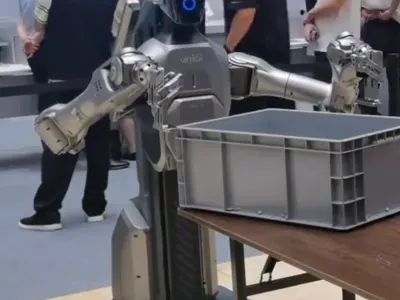
AgiBot G2 vs Cruzr Y1
Compare AgiBot G2 vs Cruzr Y1 for humanoid mobility, dexterity, autonomy, and payload capacity.
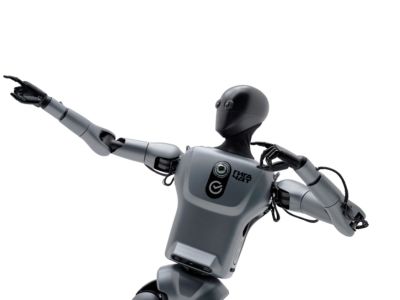
AgiBot G2 vs Green
AgiBot G2 vs Green: AgiBot's wheeled precision-assembly humanoid against Sber's walking GigaChat robot, compared on build, sensors, battery and price.
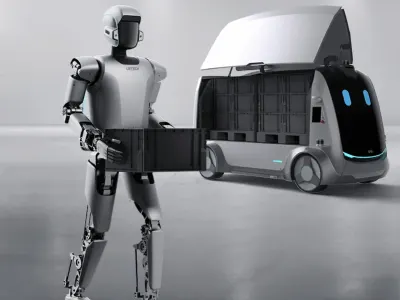
Walker S1 vs AgiBot G2
Walker S1 vs AgiBot G2: UBTECH's factory humanoid against AgiBot's wheeled precision-assembly humanoid, compared on size, mobility, sensors, AI and best uses.
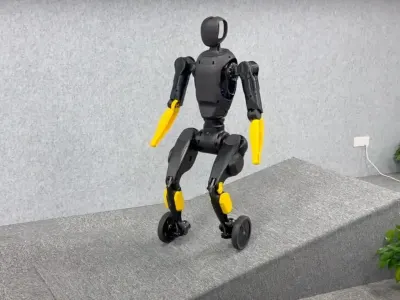
AgiBot G2 vs AgiBot X2-N
AgiBot G2 or AgiBot X2-N? Compare specs, navigation, battery, and sensors.
Verdicts reflect our research and opinion. Confirm specifications with the manufacturer before buying.