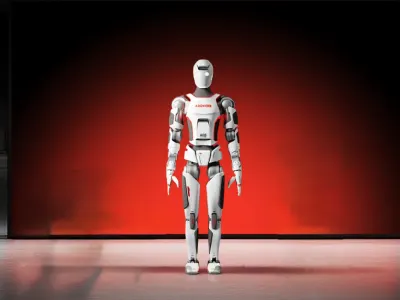
The NEO Home Robot by 1X Technologies is the first consumer-ready humanoid designed specifically for safe interactions within domestic environments, positioning itself as an affordable alternative to industrial units. Its market differentiation relies on a soft 3D-lattice exterior, tendon-driven actuation, and a noise profile quieter than a refrigerator, making it uniquely compliant around people. NEO excels in gentle manipulation tasks like opening doors and wiping surfaces but currently operates at 60-70% autonomy with teleoperation fallback for complex chores. This robot is ideal for households seeking elderly assistance and home cleaning without the bulk or risk of heavy industrial machinery.
ELIXIS by Addverb Technologies is a heavy-duty humanoid engineered for industrial logistics, warehouse inventory, and security patrols, prioritizing robustness and high payload capacity over domestic gentleness. Its key differentiators include a 41-degree-of-freedom (DoF) structure, advanced sensor suite with stereo depth cameras and 3D LiDAR, and a semi-autonomous to fully autonomous operational level. ELIXIS is significantly larger and heavier (75 kg) than NEO, offering superior stability for assembly and maintenance tasks in dynamic industrial settings. This robot is best suited for enterprises requiring reliable, high-speed automation for manufacturing and logistics rather than home companionship.
Detailed Analysis

How does bipedal mobility and balance compare?
NEO Home Robot achieves a walking speed of 5 km/h (1.4 m/s) and a top running speed of 6.2 m/s, utilizing low-inertia tendon drives for smooth, human-like motion. Its 30 kg weight and soft body enhance safety if a fall occurs, though it sacrifices raw stability compared to heavier units. ELIXIS operates at a slower 3.6 km/h (1 m/s) but benefits from a 75 kg mass and 41 DoF, providing superior stability for industrial floors with obstacles. While NEO prioritizes gentle, agile movement for home navigation, ELIXIS offers the robust balance required for heavy-duty assembly and maintenance tasks.

What are the dexterity and manipulation capabilities?
NEO Home Robot features 25 DoF total, with specialized hands containing 22 DoF for high-precision tasks like picking up wine glasses or folding laundry. Its tendon-driven system allows for delicate force control, enabling it to manipulate fragile objects without shattering them. ELIXIS offers 41 DoF total, providing a wider range of motion for complex industrial assembly but lacks the specific high-fidelity hand articulation of NEO. While NEO excels in fine motor skills and gentle interaction, ELIXIS is optimized for broader, forceful manipulation tasks in warehouse environments.

Which robot offers better autonomous learning capabilities?
NEO Home Robot utilizes Redwood AI, a Generalist AI model, and is semi-autonomous with teleoperation fallback, currently achieving 60-70% autonomy at launch. It learns from real-world tasks to improve safety and functionality, with autonomy expected to reach 95%+ by 2028. ELIXIS operates at a semi-autonomous to fully autonomous level, using ROS2 and a proprietary VLA for industrial decision-making without human intervention in standard workflows. ELIXIS is more capable for immediate, high-level autonomy in structured industrial settings, whereas NEO is transitioning toward full autonomy for unstructured home environments.

How does payload and lifting capacity compare?
NEO Home Robot can lift up to 70 kg (154 lbs) and carry 5 kg (18 lbs) per arm, leveraging its lightweight 30 kg design for efficient movement. Its lifting capacity is impressive relative to its mass, though it is limited in sustained heavy lifting compared to industrial units. ELIXIS has a carrying capacity of 5 kg per arm but lists no deadlift capacity, prioritizing speed and precision over raw lifting power. While NEO is engineered for lifting household items like groceries, ELIXIS is designed for handling lighter, repetitive logistics tasks in warehouses.
What is the battery runtime and power efficiency?
NEO Home Robot offers a 4-hour runtime with a quick-charge capability of 6 minutes per hour of use, powered by an 842 Wh pack. Its tendon-driven actuation is energy-efficient, mimicking human musculature to minimize power consumption during movement. ELIXIS provides a battery life of 3-5 years, likely referring to the battery pack's lifespan rather than a single charge duration, which is typical for industrial units with continuous charging cycles. NEO is optimized for intermittent home use with rapid recharge, while ELIXIS supports continuous industrial operations with long-term battery durability.
Which humanoid robot is better for industrial manufacturing?
ELIXIS is the superior choice for industrial manufacturing due to its 75 kg weight, 41 DoF, and robust sensor suite including 3D LiDAR and stereo depth cameras. It is designed for assembly, maintenance, and warehouse inventory, offering the stability and autonomy required for factory floors. NEO Home Robot, with its soft body and smaller size, is unsuitable for heavy industrial tasks but excels in home cleaning and elderly assistance. For manufacturing environments requiring durability and complex motion, ELIXIS is the clear recommendation.
How do sensor suites and vision systems differ?
NEO Home Robot employs four microphones, three speakers, RGB cameras, an IMU, and a gyroscope, with optional ultrasonic and tactile sensors for home interaction. Its vision system is optimized for recognizing household objects and human gestures in low-light domestic settings. ELIXIS features a more advanced industrial suite with four stereo depth cameras, one 3D LiDAR, dual 9-axis IMUs, and optional foot pressure sensors. ELIXIS provides superior depth perception and environmental mapping for navigating complex industrial obstacles, while NEO focuses on audio-visual interaction for social companionship.

Which robot is more capable for complex manipulation tasks?
NEO Home Robot is more capable for complex manipulation tasks involving delicate or fragile objects due to its 22 DoF hands and tendon-driven actuation system. It can perform fine motor skills like folding laundry, watering plants, and opening jars without damaging items. ELIXIS, with 41 DoF, offers greater range for industrial assembly but lacks the specific dexterity for fine household manipulation. For tasks requiring precision and gentle force control, NEO is the recommended choice, whereas ELIXIS is better for repetitive, forceful industrial movements.
Analysis Score Summary
Total Score
4
NEO Home Robot
VS
Based on Detailed Analysis
Total Score
12
ELIXIS
📊 Win: 2 points | Trade-off: 1 point each
Scores are summed across every insight: a clear winner earns 2 points, while balanced trade-offs give each robot 1 point. The total reflects how often each robot outperforms the other (or shares the spotlight) throughout the detailed analysis sections.
Capabilities & Operational Tasks
Head-to-head comparison of what NEO Home Robot and ELIXIS can do, their applications, and capabilities.
What Can NEO Home Robot & ELIXIS Do?
19Core operational tasks, activities, and physical manipulation duties evaluated side-by-side.
| Task & Description | Model ANEO Home Robot12 supported | Model BELIXIS14 supported |
|---|---|---|
| Assembly | — | High |
| Autonomous task execution | High | High |
| Carrying and transport | High | High |
| Cleaning | High | — |
| Collaborative work | High | High |
| Human interaction | High | — |
| Inspection | — | High |
| Loading and unloading | — | High |
| Machine tending | — | High |
| Maintenance | High | — |
| Material handling | — | High |
| Move objects | High | High |
| Navigation | High | High |
| Obstacle traversal | High | — |
| Pick and place | High | High |
| Quality control | — | High |
| Repetitive physical tasks | High | High |
| Sorting | High | — |
| Tool use | — | High |
Technical Specifications
Head-to-head performance data and metrics
| Specification | Model ANEO Home Robot | Model BELIXIS |
|---|---|---|
Functional Utility & Use Cases4 Comparative Metrics | ||
Control Method | Autonomous AI control with remote override via companion app | Autonomous, teleoperation, learned behaviors |
Use Cases | Household chores, object retrieval, delivery inside homes, elder assistance, telepresence, robotics research | Warehouse inventory, maintenance, assembly, security patrols |
Multi Robot Coord | Yes, fleet coordination and remote operator scheduling | (Inferred · Medium confidence · Common for service-robot platforms) | Yes |
Pet Friendly | Yes, low-force joints and safe motion profiles around pets | Yes, with safety protocols |
Manipulation & Load Capacity4 Comparative Metrics | ||
Carrying Capacity | 8 kg per arm | 5 kg per arm |
Deadlift Capacity | 68 kg | - |
Payload Type | Household items up to 5 kg | Tools, packages, precision instruments |
Modular Attachments | Magnetic wrist tool mounts for brushes, grippers, and vacuums | Tool changers, end-effector options |
Kinematic Architecture & Dexterity4 Comparative Metrics | ||
Degrees of Freedom | 75 | 41 |
Material | Aluminum, composite polymer, soft-touch covers | (Inferred · Medium confidence · Typical lightweight humanoid construction) | Aluminum, composite, soft skin elements |
Mobility Type | Bipedal legged | Legged (bipedal walking) |
Hardware Interface | USB-C service port, hidden GPIO header | USB, CAN bus, Ethernet |
Functional Utility & Use Cases
4 Comparative Metrics
Manipulation & Load Capacity
4 Comparative Metrics
Kinematic Architecture & Dexterity
4 Comparative Metrics
Frequently Asked Questions
What is the lifting and payload capacity of the NEO Home Robot compared to ELIXIS?
The NEO Home Robot lifts 70 kg (154 lbs) and carries 5 kg per arm, while ELIXIS carries 5 kg per arm with no listed deadlift capacity. NEO is optimized for household lifting, whereas ELIXIS focuses on logistics precision.
How does the autonomy level and teleoperation fallback differ between NEO Home Robot and ELIXIS?
NEO Home Robot is semi-autonomous with teleoperation fallback, currently at 60-70% autonomy. ELIXIS operates from semi-autonomous to fully autonomous, ideal for industrial workflows without human intervention.
What are the walking speed and stability differences between NEO Home Robot and ELIXIS?
NEO Home Robot walks at 5 km/h (1.4 m/s) and runs at 6.2 m/s, prioritizing agility. ELIXIS walks at 3.6 km/h (1 m/s), offering greater stability for industrial environments due to its 75 kg weight.
How do the dexterity and hand capabilities compare between NEO Home Robot and ELIXIS?
NEO Home Robot features 22 DoF in its hands for fine manipulation, while ELIXIS has 41 DoF total for broader industrial motion. NEO excels in delicate tasks, whereas ELIXIS is better for assembly.
What are the primary use cases and deployment readiness for NEO Home Robot?
NEO Home Robot is deployed for elderly assistance, home cleaning, and social companionship, with shipping starting in the U.S. in 2026. It is consumer-ready for domestic environments.
What are the primary use cases and deployment readiness for ELIXIS?
ELIXIS is designed for warehouse inventory, maintenance, assembly, and security patrols in industrial settings. It is ready for enterprise deployment in logistics and manufacturing facilities.
Related Comparisons
Discover similar robot matchups to expand your knowledge and find the perfect solution

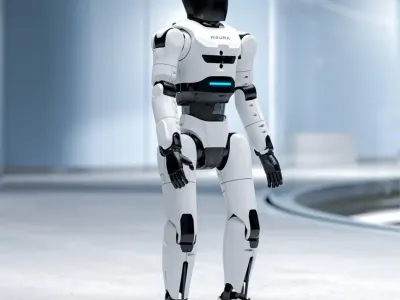
NEO Home Robot vs 4NE-1 Mini
Head-to-head: NEO Gamma vs 4NE-1 Mini compared on bipedal balance, AI learning, payload capacity, and real-world deployment for research and home use.

NEO Home Robot vs T800
In-depth comparison of NEO Gamma by 1X Technologies and T800 by EngineAI. Analyze navigation, sensors, and battery performance.

SE01 vs NEO Home Robot
In-depth comparison of SE01 by EngineAI Robotics and NEO Gamma by 1X Technologies. Analyze sensors, navigation, and battery performance.

Optimus vs NEO Home Robot
Compare Tesla's Optimus and 1X's NEO Gamma on design, AI, battery life, and use cases for industrial and home robotics.
Disclaimer
All content, comparisons, and verdicts on this website are based on our research, testing, and opinion. While we strive for accuracy, we do not guarantee the completeness, reliability, or suitability of any information. Performance, specifications, and results may vary depending on usage and conditions. This website and its authors are not responsible for any decisions, actions, or outcomes based on the information provided. Always verify product details with the manufacturer before making purchase or operational decisions.