Which one fits your use?
Based on the uses each robot is built and marketed for. Open a use to see the specs that matter for it.
| Comparing for… | Pepper | AIREC |
|---|---|---|
| Suited | Suited | |
| Suited | Not listed | |
| Suited | Suited | |
| Suited | Not listed | |
| Suited | Suited |
- Pick Pepper for education and training and hospitality, retail and public-facing roles.
- Both suit research labs, home help and elder care and healthcare settings, so compare the specs for that use.
Pepper by SoftBank Robotics is a 28 kg wheeled humanoid launched in 2014 that was designed to talk with people rather than lift or carry. It stands 121 cm tall, moves on a tri-wheel omnidirectional base, and offers a touch tablet, voice and emotion recognition, which made it a common sight in reception areas, retail, education and events. It is a long-running commercial platform with a large developer community around the NAOqi software environment.
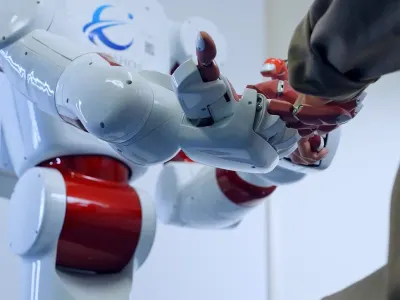
AIREC by Waseda University, launched in 2021, is a 150 kg research humanoid built to physically assist people in care settings. It combines RGB, fisheye and depth cameras with tactile and force sensors, and it is being developed for tasks such as repositioning, dressing, rehabilitation, ultrasound exams and cooking assistance. Compared with Pepper, AIREC targets hands-on caregiving and medical research rather than conversation and customer engagement.
Detailed Analysis
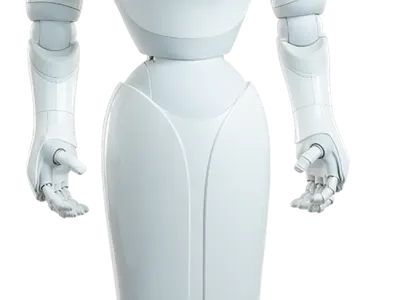
Pepper
What is each humanoid robot designed to do?
Pepper is a social robot made for customer service, reception, education, elder care companionship and events, where its job is to greet, inform and engage people. AIREC is a research platform whose use cases include elderly care such as repositioning, dressing and rehabilitation, as well as medical exams like ultrasound, biometrics and cooking assistance. Pepper works through conversation, gestures and its tablet, while AIREC works through physical contact and precise manipulation. The two robots therefore solve different problems and are rarely direct substitutes.
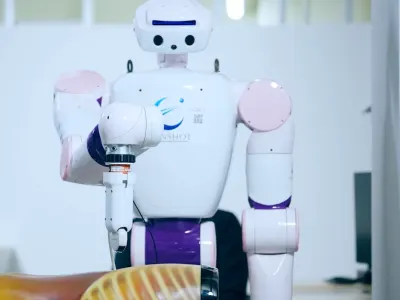
AIREC
How do Pepper and AIREC differ in size, weight and build?
Pepper weighs 28 kg, measures 121 x 48 x 42.5 cm and is built from plastic and soft composites, with a mobile base that moves at up to 3 km/h. AIREC weighs 150 kg and uses an aluminum frame with soft skin composites, which suits a robot that has to support or move a person safely. The much heavier frame gives AIREC the strength needed for care tasks but makes it a far larger machine to install and operate. Pepper's lighter body makes it much easier to move and install in shops, lobbies and classrooms.

Pepper
Which robot has more advanced arms, hands and touch sensing?
Pepper has 20 degrees of freedom and can carry about 1 kg per arm with a maximum lift of 2 kg, enough for gestures and light handling. AIREC is equipped with tactile sensors, force sensors and a body built for contact with people. Pepper uses touch sensors and bumpers mainly for interaction and safety, whereas AIREC uses force sensing to control how it handles a person's body. For physical assistance, AIREC is the far more capable manipulator.
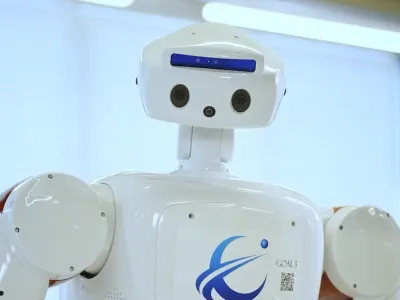
AIREC
How do their sensors and perception systems compare?
Pepper carries two 5 MP HD RGB cameras, a 3D depth sensor, six laser sensors, two sonars, an IMU, four microphones and touch and bumper sensors, and navigates indoors with laser, sonar and visual SLAM. AIREC uses RGB, fisheye and depth cameras with tactile sensors, force sensors, an IMU and a gyroscope, and relies on visual SLAM for navigation. Pepper's mix of lasers and sonar is tuned to moving safely among people in public spaces, while AIREC's vision and touch sensors are tuned to close physical work. Both are designed for indoor environments.

Pepper
How do their AI, software and learning capabilities compare?
Pepper runs NAOqi OS and can be programmed in Python, C++, Java and JavaScript, with Choregraphe and Android Studio for building behaviors and a ROS interface for researchers. Its learning features focus on emotion recognition and task programming. AIREC runs on ROS2 with proprietary deep neural networks and Python APIs, and learns through reinforcement learning, motion learning from human demonstration and predictive deep learning. Its computing is handled by an NVIDIA RTX GPU together with a CPU and NPU, while Pepper uses an Intel Atom E3845 processor, so AIREC has far more on-board capacity for AI.
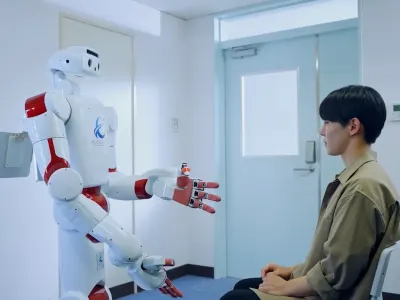
AIREC
How do Pepper and AIREC compare on power and charging?
Pepper uses a 30 Ah, 795 Wh lithium-ion pack that provides about 12 hours of operation and takes around 4 hours to charge, averaging roughly 50 W with peaks near 100 W. AIREC uses a lithium-ion polymer battery that charges fully in about 3 hours. Neither robot has a swappable battery, so both are recharged on a dock or at a charging point. Pepper's long working day suits a full shift of customer interaction, while AIREC's sessions are shaped by the length of each care or research task.

Pepper
Which humanoid robot is better for customer service and reception?
Pepper is the better choice for customer service, reception and events. It is built to talk, read emotions and interact through a touch tablet, voice and gestures, and it can run around 12 hours between charges. Its lighter 28 kg body, omnidirectional base and mature developer tools make it far easier to deploy in shops, lobbies and classrooms. AIREC is not designed for front-of-house work, so for public engagement Pepper is the clear recommendation.
AIREC
Which humanoid robot is better for elderly care and medical research?
AIREC is the better choice for elderly care and medical research. Its tactile and force sensors, learning-from-demonstration capability and focus on repositioning, dressing, rehabilitation and ultrasound exams match the physical needs of caregiving, and its on-board GPU supports advanced AI experiments. Pepper can keep older adults company and lead activities, but with 20 degrees of freedom and a 1 kg per-arm carrying limit it cannot physically assist a person. Research labs and care-technology developers should look at AIREC, while Pepper fits companionship and engagement roles.
Capabilities & Operational Tasks
Head-to-head comparison of what Pepper and AIREC can do, their applications, and capabilities.
What Can Pepper & AIREC Do?
115 tasks listed for both, 1 only for Pepper, 5 only for AIREC.
Technical Specifications
Pepper and AIREC differ on 31 of the 53 specifications listed for both.
Functional Utility & Use Cases
4 Comparative Metrics
Manipulation & Load Capacity
4 Comparative Metrics
Kinematic Architecture & Dexterity
4 Comparative Metrics
Frequently Asked Questions
Which humanoid robot is better at talking to customers and visitors, Pepper or AIREC?
Pepper by SoftBank Robotics is better, since it is built for conversation with a touch tablet, voice interaction, gesture control and emotion recognition. AIREC by Waseda University is focused on physical care tasks.
Can Pepper or AIREC physically help lift or reposition a person?
AIREC can, as it is developed for repositioning, dressing and rehabilitation using tactile and force sensors. Pepper carries only about 1 kg per arm and is not designed to support a person.
How much do Pepper and AIREC weigh?
Pepper weighs 28 kg and stands 121 cm tall. AIREC weighs 150 kg, reflecting its aluminum frame and the strength needed for care and medical assistance tasks.
How long does Pepper run on a charge compared with AIREC?
Pepper runs about 12 hours on its 795 Wh battery and charges in around 4 hours. AIREC charges fully in about 3 hours and works in task-length sessions.
Which robot is easier for developers to program, Pepper or AIREC?
Pepper is easier to start with, using NAOqi with Python, C++, Java and JavaScript plus Choregraphe. AIREC uses ROS2, deep neural networks and Python APIs aimed at research teams.
Which robot is better for medical exams and care research, Pepper or AIREC?
AIREC is better, because it is being developed for ultrasound exams, biometrics, rehabilitation and elderly care, with tactile and force sensing. Pepper is suited to companionship and engagement, not clinical contact.
Related Comparisons

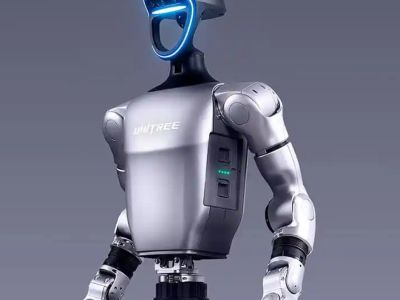
Optimus vs Unitree G1
Compare Optimus vs Unitree G1 for humanoid mobility, dexterity, autonomy, and payload capacity.
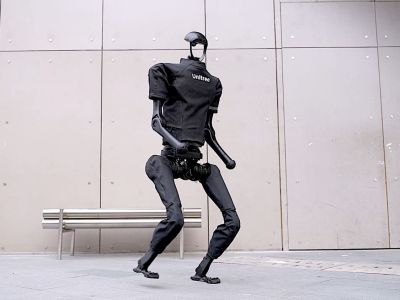
Unitree G1 vs Unitree H1
Head-to-head: Unitree G1 vs Unitree H1 compared on bipedal balance, AI learning, and real-world deployment.
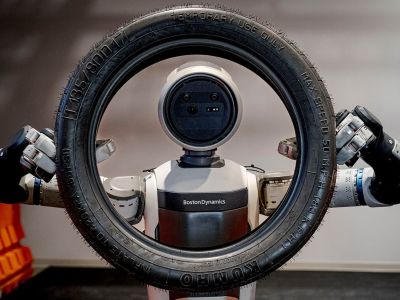
Optimus vs Atlas (Electric 2025)
In-depth comparison of Optimus and Atlas (Electric Atlas, 2025), covering hardware capabilities, teleoperation, and enterprise readiness.


Ameca vs Moya
Which humanoid robot is better? Ameca vs Moya compared for dexterity, AI capabilities, and price.
Verdicts reflect our research and opinion. Confirm specifications with the manufacturer before buying.