PhoneBot
Last updated:
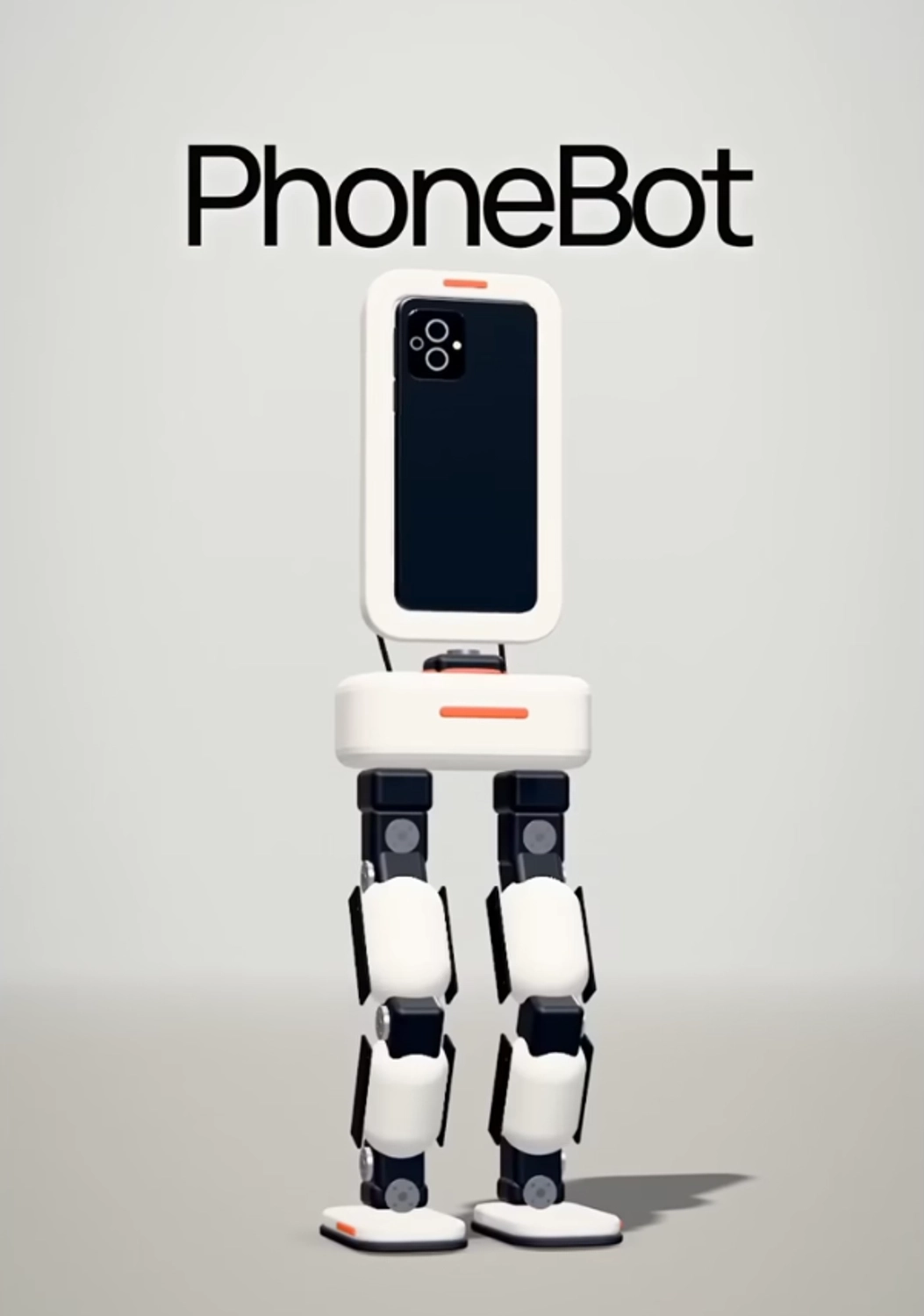
PhoneBot is a small, low-cost, open humanoid-style walking robot from researchers at UCLA that uses an ordinary Android smartphone as its brain. The robot is about 48 cm tall, weighs roughly 1.8 kg, and has two legs and a torso with 13 DYNAMIXEL servo motors (12 in the lower body plus one that rotates the torso) but no arms yet. The phone sits above the hips, runs the control software and neural networks, and supplies the camera, motion sensors and Wi-Fi, sending commands to a small onboard computer that drives the servos, so a phone can be swapped without changing the robot's electronics. Early demonstrations show walking, tracking a person with the camera and recovering from a face-down position. The hardware costs about $400 without the phone, and the team presents the platform as open for students, researchers and enthusiasts. The preprint, by Ruochen Hou, Quanyou Wang, Daniel Koh and Dennis W. Hong, appeared on arXiv on October 6, 2026.
Quick Overview & Key Facts
PhoneBot is a robot made by UCLA in United States, launched in 2026 and built for teaching and research on humanoid and legged locomotion; low-cost embodied-AI experiments; reusing old smartphones as robot brains. Its estimated price is About $400 in hardware, not including the smartphone (research prototype; not sold as a product).
- Dimensions
- About 48 cm (19 in) tall
- Weight
- About 1.8 kg (4 lb)
- Mobility
- Bipedal (legged) robot with a phone-mounted torso
- Handles
- Not published; motor torque limits payload
- Charging time
- 1.5–3 hours
- Sensors
- The smartphone's camera, IMU/motion sensors and microphone; joint feedback from the DYNAMIXEL servos
- Operating environment
- Flat indoor floors (the walking controller was trained only on flat terrain)
What Can PhoneBot Do?
Core operational tasks and activities demonstrated or performed by PhoneBot.
Real-World Applications of PhoneBot
Industries, working environments, and deployment suitability for PhoneBot.
PhoneBot Capabilities
Inherent physical, perceptual, and cognitive abilities built into PhoneBot.
Robot Specifications
More Robots
Discover more robots in the same category


Robots From Other Categories
Discover complementary robots from different categories that work well together

Frequently Asked Questions
Get answers to common questions about this robot
Q1. What is PhoneBot, and what problem is it designed to solve?
PhoneBot is a small, low-cost walking robot from UCLA researchers that uses an ordinary Android smartphone as its brain and sensor suite, so old phones can get a second life as robots.
Q2. What are the main capabilities and key features of PhoneBot?
It is about 48 cm tall with 13 servo motors, walks, tracks people with the phone camera and gets back up after a face-down fall; it has no arms yet.
Q3. Who is PhoneBot built for, and which industries can benefit from it?
It is aimed at students, researchers and enthusiasts who want an inexpensive platform for legged locomotion and embodied-AI experiments.
Q4. Is PhoneBot a commercial product or still a research prototype?
PhoneBot is a research prototype presented in an arXiv preprint, not a commercial product.
Q5. Is PhoneBot currently available for purchase, and when is it expected to ship?
No. It is not sold, but the team describes it as an open platform that people can build for about $400 in hardware plus a phone.
Q6. How does PhoneBot actually work in real-world environments?
The phone runs the control software and neural networks, using its camera and motion sensors, and sends commands over Wi-Fi to a small onboard computer that drives the servo motors.
Q7. When was PhoneBot announced or officially launched?
The preprint appeared on arXiv on October 6, 2026.
Q8. How is PhoneBot different from other robots in the same category?
Unlike most research humanoids that cost thousands, PhoneBot reuses a phone as its computer and sensors and costs about $400 in hardware, and it works with different Android phones.
Q9. Does PhoneBot require additional development or customization after purchase?
You need an Android phone, the hardware build and the team's app; the walking controller was trained for flat terrain only.
Q10. What is the future roadmap or planned upgrades for PhoneBot?
The team plans to add arms and to move speech and language processing onto the phone; terrain handling is also listed as future work.
Rating and Reviews
Share your experience and help others decide!
Loading...
User Reviews
No user reviews. Be the first one to review!
User Comments (No Login needed)
Share your thoughts, experiences, or questions about this robot.
Comments are reviewed before posting.