Robots from Germany
Discover 15 robots and autonomous systems developed by pioneering robotics manufacturers headquartered in Germany.
Select any country to view its robotics innovations.
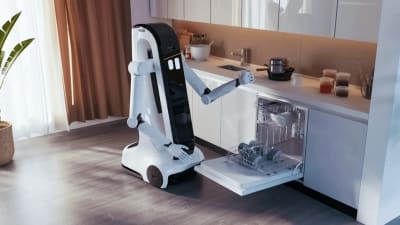
MiPA
MiPA by NEURA Robotics is an AI-powered personal assistant robot designed for home, care, and workplace environments. It features advanced sensors including force-torque, LiDAR, cameras, and ultrasonic sensors, enabling safe, touchless human detection and real-time obstacle avoidance. MiPA supports multi-language voice commands, gesture control, and customizable touch interfaces. Its modular design allows for flexible expansion with add-ons tailored to specific tasks such as light logistics, item transport, and care assistance. Optimized primarily for indoor use, MiPA adapts to dynamic environments and learns new tasks autonomously, making it suitable for both personal and commercial applications.
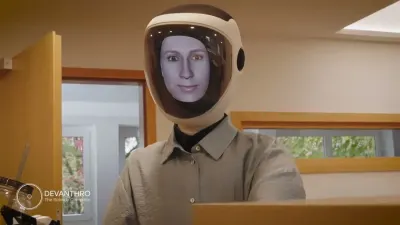
Robody
Robody is Devanthro's humanoid robotic body, remotely operated by a person through VR with AI assistance to bring 24/7 help, companionship and peace of mind to older adults living at home. The latest generation has a redesigned torso and arms, a soft enclosed skin, haptic feedback and a customizable appearance, and it has been tested in unmodified private homes. Operators see through the robot's eyes, speak with their own voice and use both hands to fetch items, prepare meals and hand over medication.
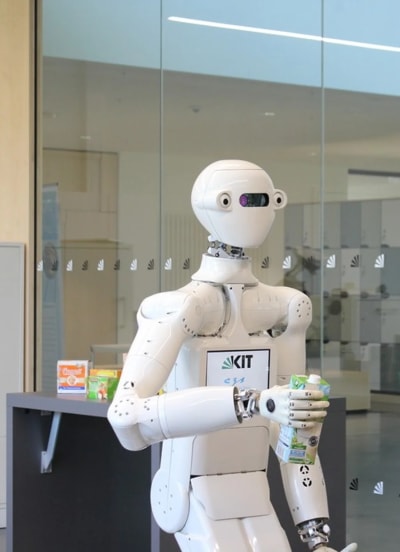
ARMAR-7
ARMAR-7 is the latest humanoid robot from KIT's ARMAR family, engineered for assistance in human environments like households and care facilities. Featuring dual torque-controlled 8-DoF arms, underactuated five-finger humanoid hands, a head with stereo vision, a torso, and a holonomic mobile platform, it stands at anthropomorphic dimensions for seamless interaction. With 32 controllable degrees of freedom driven by EtherCAT, it integrates torque sensors in joints, force-torque sensors in wrists, and absolute encoders for precise manipulation. ARMAR-7 excels in tasks such as opening doors, loading dishwashers, handing over objects, and recognizing speech commands like "Bring me the milk." It learns from human demonstrations via imitation learning, processes visual data for object recognition, interprets gestures and intentions, and employs cognitive architecture for contextual understanding, error recovery, and autonomous adaptation in daily activities.
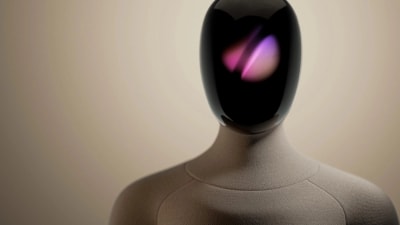
Vesoma 1
Vesoma 1 is the first humanoid from Vesoma, a Munich-based physical-AI company founded in December 2025. Its design is complete and the first units are being built, with a product unveiling planned for early 2027. The robot is a human-form worker (fabric-clad body and a glossy faceless head) meant to be trained by a self-improving reinforcement-learning agent that learns physical work from its own experience rather than from human demonstrations, targeting manufacturing, logistics and warehousing first. Vesoma has not published its specifications, and all imagery so far is labeled as design visualization.
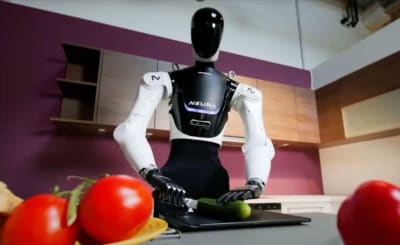
4NE‑1
4NE‑1 is a next-generation humanoid robot built by Neura Robotics to seamlessly collaborate with humans in industrial and assistive roles. It features full-body sensor coverage, human-like bipedal mobility, AI-based perception, and modular limbs for flexible tasks. The robot uses Neura’s fusion of visual, auditory, and tactile inputs, allowing it to learn, adapt, and safely operate in dynamic environments. It’s engineered for long-term autonomous use and is intended to support workflows in manufacturing, logistics, caregiving, and research.
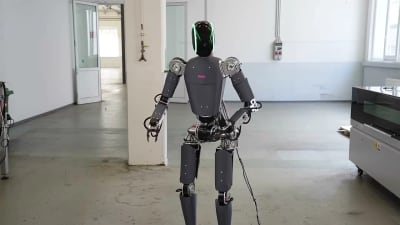
P0
P0 is the first humanoid prototype from Pink Robotics, a Darmstadt, Germany, startup (legal entity Anyscrew GmbH) founded by engineer Christopher Helmke. Designed and made in Germany, it stands 1.75 m tall, weighs 82 kg, has 32 degrees of freedom and can handle an 8 kg payload. It is aimed at package handling and sorting in distribution centers, where its human proportions let it work in existing facilities. Its demonstrations are currently teleoperated while vision-language-action models are trained for manipulation, and Pink Robotics is preparing a logistics pilot with a major supermarket chain. Pink Robotics introduced the robot in a video on August 24, 2026.
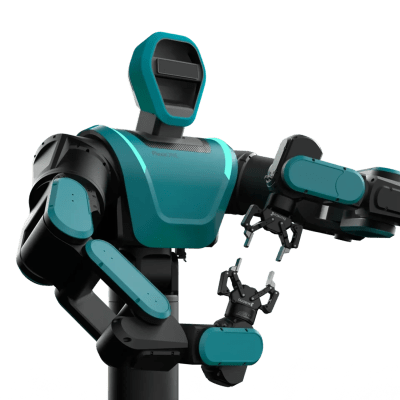
PLEXA One
PLEXA One is an industrial humanoid from Konstanz-based fruitcore robotics, introduced on May 5, 2026 as the top configuration of its Industrial Humanoid Platform. Built on the company's proven HORST600 G2 and HORST800 G2 industrial arms, it offers dual-arm setups with 14 to 16 axes, up to 7 kg per arm, ±0.05 mm repeatability and IP54 or IP65 protection, either stationary (PLEXA ONE S) or on an autonomous mobile robot (AMR) platform. The PLEXA Core 2.0 intelligence layer, in which AI agents built on vision-language-action models run on the horstOS operating system, plans and controls its work. First configurations are due for industrial customers later in 2026.
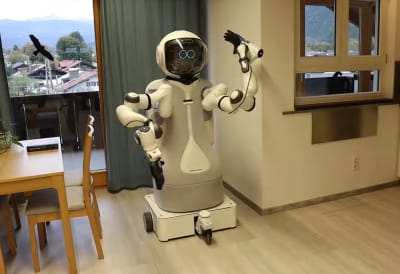
GARMI
GARMI is a humanoid assistance robot engineered for elderly care, featuring a wheeled mobile base for efficient indoor navigation and upper-body humanoid design for natural human interaction. It supports activities of daily living such as fetching objects, serving meals, clearing dishes, and physical rehabilitation exercises with safe torque-controlled arms. Equipped with a multimodal head including screens and sensors, GARMI enables intuitive voice commands via ChatGPT integration for multilingual communication, internet searches, and telemedical support like ECG monitoring, blood pressure checks, and ultrasound assistance. Full-body torque control ensures collision-free operation, slowing or stopping upon detecting humans or obstacles. A digital twin simulates safe movements beforehand, while AI enhances precise grasping without spills. Deployed in test apartments, it manages full-day assistance from morning routines to emergency doctor bookings, bridging physical, audiovisual, and haptic interactions to su
4NE-1 Mini
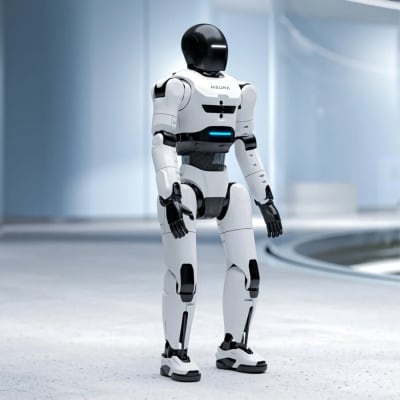
The 4NE-1 Mini by NEURA Robotics is a compact, child-sized cognitive humanoid robot standing at 132 cm tall and weighing 36 kg, optimized for education, research, and interactive environments. Featuring 25 degrees of freedom for natural human-like movements, it supports bipedal locomotion, precise manipulation with 3 kg payload capacity per arm, and advanced multi-sensor fusion including computer vision cameras and human detection safety sensors. Powered by Neuraverse OS, it enables shared learning across robot networks, natural language interaction with multi-language voice recognition, and reinforcement learning for task adaptation. Its Studio F.A. Porsche design emphasizes aesthetic appeal and safety, with capabilities for skills marketplace integration allowing developers to download, publish, and monetize behaviors. Ideal for classrooms and labs, the Mini excels in demonstrations, collaborative experiments, and human-robot interaction while maintaining agility in confined spaces.