Robots from France
Discover 12 robots and autonomous systems developed by pioneering robotics manufacturers headquartered in France.
Select any country to view its robotics innovations.
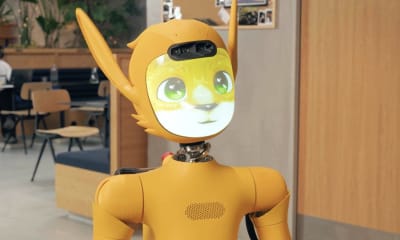
Mirokaï
Mirokaï is a compact social humanoid robot designed for human interaction, reception, guidance, light handling, and assisted service tasks. It combines a human-like upper body with a self-balancing rolling omnidirectional base, giving it smooth indoor mobility and strong presence in shared spaces. Publicly reported specs indicate a height around 123 cm, mass near 26–30 kg, roughly 26–28 degrees of freedom, and a battery runtime of about 4 hours. Its sensor suite is reported to include RGB-D vision, infrared, time-of-flight, ultrasonic, microphones, torque sensing, and multiple IMUs, enabling responsive navigation and interaction. The robot’s animated face and expressive design emphasize engagement, while light payload capability and safe human proximity make it suitable for hospitality, retail, research, and demonstration environments. (Inferred from public data)
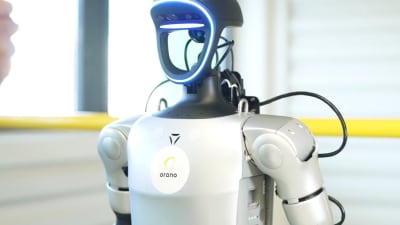
Hoxo Robot
Hoxo is an intelligent humanoid robot designed specifically for the nuclear industry, combining advanced AI, real-time perception, and autonomous navigation to operate safely alongside human teams in hazardous environments. It replicates human movements and performs technical gestures with precision, enhancing safety by reducing human exposure to risky zones. Hoxo integrates robotics, computer vision, digital twins, and AI to deliver scalable robotic assistance, redefining human-machine collaboration in sensitive industrial settings. Its deployment at Orano’s Melox site marks a pioneering step in using humanoid robots as “Non-Human Workers” in high-stakes sectors.
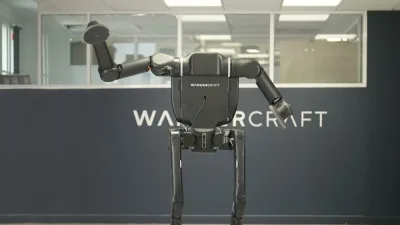
Calvin-40
Calvin-40 is Wandercraft's first humanoid: a headless, voice-controlled, self-balancing industrial robot developed in 40 days on top of the company's exoskeleton technology. It is designed to carry heavy loads and to handle boxes, parcels, tires, panels and carts on factory floors, with a certifiable safety system for working next to people. Renault Group is its lead partner and plans to deploy hundreds of units, and Wandercraft says first series deliveries are expected in the first half of 2027.
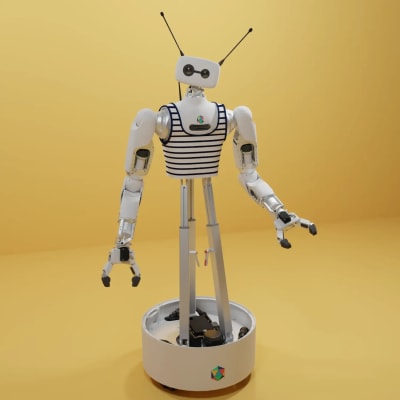
Reachy 2
Reachy 2 is an advanced open-source humanoid robot designed for research, education, and AI development. It features dual 7-DoF bio-inspired arms with human-like proportions, enabling precise manipulation and lifting up to 3 kg per arm. Equipped with multiple RGB-D cameras and a Time-of-Flight sensor, it provides stereo vision and depth perception. Reachy 2 supports immersive teleoperation with spatialized audio. Its modular architecture allows alternative grippers and mobile bases, making it adaptable for human-robot interaction, telepresence, and embodied AI research. The robot runs on ROS 2 with Python APIs, supports OTA updates, and enables flexible programming.
Northstar
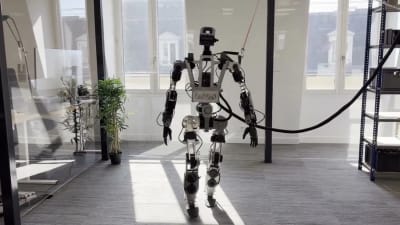
Northstar is UMA's first flagship general-purpose humanoid, unveiled in July 2026 about nine months after the Paris startup emerged from stealth. UMA describes it as a lightweight, repairable bipedal robot with a soft outer shell, visible mechanical joints and a neutral visor, designed to learn skills in real time from human demonstration. It targets European factories, warehouses and healthcare pilots first, and homes later, under a robots-as-a-service model.