Humanoid Robots That Teach Kids, Compared (2026)



The Short Answer: Start With the FF Nova Mini
For a child at home, the best humanoid robot in 2026 is the FF Nova Mini from Faraday Future. It is 35 cm tall, weighs 0.94 kg, is made for ages 8 and up, and comes with a block-coding app and a 16-class online course. Five other humanoids can teach children too, but they are built for schools, labs or older students: Eagle 8.0, Bumi, FF Nova, StarBot Spark and the K1 EDUCATIONAL.
These six are very different machines. The FF Nova Mini fits in a backpack, while the Booster K1 EDUCATIONAL stands 95 cm tall and weighs 19.5 kg. Eagle 8.0 is the only one that already teaches lessons in real classrooms. The table below puts the numbers side by side, and each robot gets its own short profile after it.
Quick Overview
Six humanoids, ranked by how directly each one is built to teach children. The last column shows where each robot is meant to be used.
| Rank | Robot | Manufacturer | Key Strength | Best For | Where It Teaches |
|---|---|---|---|---|---|
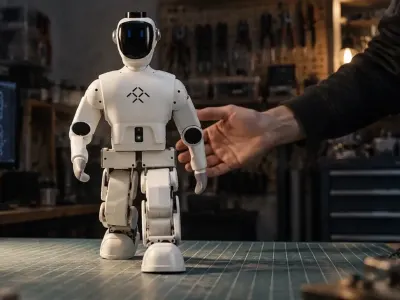
| #1 |  FF Nova Mini | Faraday Future | 35 cm, 0.94 kg, block coding and a 16-class course | Children aged 8 and up | Home and classroom |
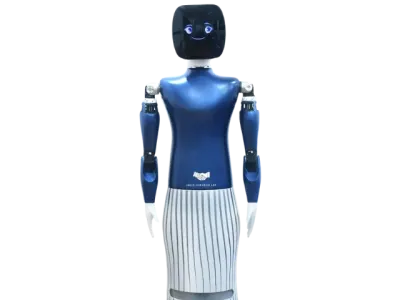
| #2 |  Eagle 8.0 | Indus Humanoid Lab | Teaches lessons beside a human teacher in schools | Schools and districts | Classroom |
| #3 | 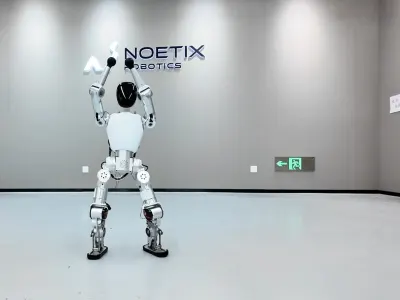 Bumi | Noetix Robotics | 94 cm tall, drag-and-drop programming for children | Families and school labs | Home and programming labs |
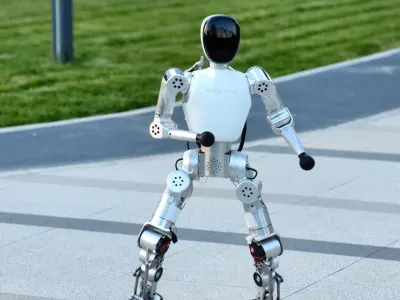
| #4 |  FF Nova | Faraday Future | 20 joints, 2D LiDAR, Python and simulation tools | Clubs and teenage coders | School labs |
| #5 |  StarBot Spark | StarBot | Three feet tall, 22 joints, up to 3 hours of runtime | Robotics programs | School robotics programs |
| #6 |  K1 EDUCATIONAL | Booster Robotics | 117 TOPS of AI compute, RoboCup KidSize champion | Older students and soccer teams | University and student labs |
Only the FF Nova Mini is made for a child to use at home, and only Eagle 8.0 already teaches classes. The other four are platforms that a teacher, club or student team programs.
Explore the Robots

FF Nova Mini
The FF Nova Mini ranks first because it is the only humanoid here built for a child to use at home. Faraday Future launched it on October 15, 2026. It is 34.9 cm tall, weighs 0.94 kg and has 17 servo joints, so a child can carry it in a backpack. Children start with voice commands, then teach it poses by hand, then move to block coding in an app. A built-in library of actions and dance routines works on day one, and an online course of 16 live classes is sold separately. The maker lists about 50 minutes of runtime and a recharge of about the same length. Its limits are the short battery and the small size, which rules out carrying anything. It suits children aged 8 and up and families who want a first robot with a clear learning path.

Eagle 8.0
Eagle 8.0 ranks second because it is the only robot here whose job is to teach a class. Indus Humanoid Lab in India built it for classroom teaching beside a human teacher. It delivers lessons in several languages, holds a spoken conversation with generative AI, listens continuously and reads facial expressions to judge how engaged students are. A dashboard gives teachers the data, and a battery and a dongle let it work in places with weak infrastructure. Indus reports more than 4,000 lessons taught to over 2,500 students. Its movement is limited, so it is a teacher at the front of the room, not a walking robot. It is sold to schools through a sales form. It suits schools that want a robot to share lessons.
Bumi
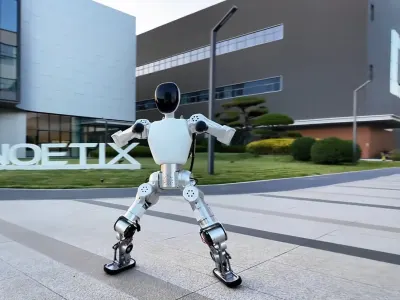
Bumi ranks third because it is a child-sized robot with programming made for children. Noetix Robotics in Beijing announced it in October 2025. It stands about 94 cm tall and weighs about 12 kg, and it walks, runs and dances. A 48 V battery gives 1 to 2 hours of runtime. Noetix says it supports drag-and-drop graphical programming for children and voice interaction for companion and learning use. Early demos showed it walking and dancing, so its teaching tools matter more than its tricks. Sales run through an inquiry form on the maker's site, which makes delivery less clear than for the Faraday Future robots. It suits families and school labs that want a full-height humanoid to program.

FF Nova
The FF Nova ranks fourth because it is a teaching platform for schools and developers, not a toy. Faraday Future builds it as a 497 mm, 2.8 kg walking robot with 20 degrees of freedom and a detachable wheeled cart. It carries a 2D LiDAR, a depth sensor, a wide-angle camera and a ring of microphones, and it holds voice conversations on the device. A Python SDK and a simulation-to-real workflow let students train skills on a computer first. The maker lists 2 to 3 hours of runtime. Its walking speed tops out at 0.1 m/s, so the cart does the travelling. The first 100 units went to invited developers and schools. It suits school clubs and teenage coders.

StarBot Spark
StarBot Spark ranks fifth because it is a classroom-sized robot with a plan for schools but fewer proven details. StarBot, a Santa Barbara company that builds in the USA, lists it for robotics education, programming practice, AI projects and supervised research. It is about three feet tall, weighs 35 pounds and moves on 22 degrees of freedom. The maker lists up to 3 hours of runtime and a recharge of about 40 minutes, which is the fastest charge in this list. It supports Isaac simulation. Reservations are open, but outside reports note that StarBot has not promised a delivery date. It suits school robotics programs and clubs that can wait for delivery.

K1 EDUCATIONAL
The K1 EDUCATIONAL ranks last because it is aimed at older students and labs, not children. Booster Robotics builds it at 95 cm and 19.5 kg with 22 degrees of freedom. The education version carries an NVIDIA Jetson Orin NX with 117 TOPS of AI compute and a 5 Ah battery that runs up to 80 minutes and charges in up to an hour. It runs Python and ROS 2. The K1 won the KidSize category at RoboCup Soccer in 2025, and the education version comes with a 12-month warranty and a year of support from the reseller page we read. Its weight makes it a lab robot. It suits university courses, student projects and robot soccer teams.
How to Choose Between Them
Start with who will use the robot. If it is for one child at home, look at the FF Nova Mini first. Its learning path starts with voice commands, moves to teaching poses by hand, then moves to block coding. A child can get a first result in minutes, and the maker's course gives a parent a plan to follow. Bumi is the other option aimed at children, with drag-and-drop programming, but its sales route is an inquiry form, so ask about delivery before you plan around it.
If you are buying for a classroom, think about who runs the lesson. Eagle 8.0 is designed so a robot teaches a class beside a human teacher, with lesson content and a dashboard supplied by the maker. FF Nova and StarBot Spark are different: they are platforms a teacher or a club leader programs, so someone in the room needs to be comfortable with code. The FF Nova uses Python and a simulation tool, and StarBot lists robotics education, programming practice and AI projects as its aims.
Match battery time to your lesson length, because a class of 30 children shares one robot. Runtimes in this list run from under an hour to three hours, and recharge time matters as much as runtime. The Faraday Future robots and Bumi suit short sessions, and Spark and the FF Nova suit a full lesson.
Look at size and what you want the robot to do. The two Faraday Future robots and Spark are desk-sized to three feet tall, so they are easy to carry into a room. The K1 EDUCATIONAL is a 19.5 kg machine that suits a university lab or a robot soccer club more than a living room. It is the only one here with a RoboCup KidSize title, won in 2025, which makes it the natural pick for students who want to build a soccer team.
Check availability before you commit. Some of these robots are on sale today, some take reservations and some are sold only through a sales form. Ask for a delivery date in writing, and ask what is included, such as the course, the software or the warranty. The K1 EDUCATIONAL comes with a 12-month warranty and a year of technical support according to the reseller page we read.
A quick way to pick: choose the FF Nova Mini for a child at home, Eagle 8.0 for a school that wants a robot teacher, FF Nova or StarBot Spark for a club that wants to teach coding on a walking robot, and the K1 EDUCATIONAL for older students working on AI or soccer. Supervise young children around any walking robot, and ask the maker for safety information before you buy.
How We Ranked These Robots
We started with the live humanoid robots in our database and kept those whose maker names children, students or classrooms as the main users. We then checked each one against the maker's own page and at least one outside report. A robot only appears here when the maker has given a height, a weight and a runtime, so a claim like a short battery life or a heavy body is based on a published number.
The ranking has three steps. First, how directly the robot is built to teach children. Second, whether it has real classroom use or a learning plan behind it, such as a course or lesson content. Third, how easily a family or school can get one today. So the FF Nova Mini comes first and the K1 EDUCATIONAL comes last: the K1 is a capable teaching platform, but it is aimed at older students and labs.
We left out robots with too little published detail. AgiBot's Q1 is a small humanoid for education and research, but the maker has not given a price, a ship date or a battery time. AiMOGA's MoBo is a home companion that helps children with language, but it has only reached the pre-order stage. We also left out older toy-style robots from 2017 and 2019, and developer robots such as the Unitree R1 that are not built for children.
Where a maker lists more than one version, we used the newest one on the site for the same product line. Eagle 8.0 is the latest Eagle, and the K1 EDUCATIONAL is the education version of the K1. All specs on the page come from the maker's pages or from outside reports that match them. If you see a different number on a reseller page, check the maker, because versions and regions vary.
Frequently Asked Questions
What is the best humanoid robot for kids to learn with?
Pick the FF Nova Mini from Faraday Future if the robot is for a child at home. It teaches through voice commands, pose teaching and block coding, and the maker sells a course alongside it. Pick Eagle 8.0 from Indus Humanoid Lab if you run a school, because it is the one built to deliver lessons beside a human teacher.
What age is a humanoid robot suitable for?
The FF Nova Mini is made for children aged 8 and up, and its block-coding app and online classes follow that age. Bumi offers drag-and-drop programming for children, but Noetix does not state an age. The larger robots, such as the FF Nova, StarBot Spark and K1 EDUCATIONAL, are aimed at teenagers, clubs and university students, so younger children should use them with an adult.
Can a humanoid robot teach my child to code?
Yes, three of the six do it directly. The FF Nova Mini uses a block-coding app with a tutor built in. Bumi supports drag-and-drop graphical programming for children. The FF Nova uses Python and a simulation tool for older students. Block coding suits younger children because they drag pieces together instead of typing code, and then they watch the robot act out the result.
How long does the battery last on a robot for kids?
It ranges from about 50 minutes to 3 hours. The FF Nova Mini runs about 50 minutes, the K1 EDUCATIONAL up to 80 minutes, Bumi 1 to 2 hours, the FF Nova 2 to 3 hours and StarBot Spark up to 3 hours. For a class, charging time matters too: StarBot lists about 40 minutes for the Spark, and Booster lists up to one hour for the K1 EDUCATIONAL.
How much does a humanoid robot for a child cost?
The range is wide. The FF Nova Mini lists at $299, and its online course is $499 on top. The FF Nova lists at $2,490, StarBot Spark starts at $7,999 with a $5,999 offer for the first 100 confirmed orders, and Bumi was announced at about $1,400. Eagle 8.0 and the K1 EDUCATIONAL are sold through sales forms, and resellers list the K1 well above $10,000 in several markets.
Is a humanoid robot better than a coding robot like mBot or Ozobot?
It depends on the child. Most buying guides recommend non-humanoid robots such as mBot, Botley and Ozobot for young children, because they are cheaper and sturdier. A humanoid suits a child who wants to learn about walking, balance and AI, as a walking robot makes those ideas visible. The FF Nova Mini is the one humanoid here that is priced and sized like a toy.
Can a robot replace a teacher?
Not in these designs. Indus Humanoid Lab built Eagle 8.0 for classroom teaching beside a human teacher, in what it calls a collaborative learning model. The robot delivers lessons in several languages and reads how engaged students are, and the teacher uses that data. The other five robots are tools that a teacher, parent or club leader runs and programs.
Sources
- FF Nova Mini Profile
- Eagle 8.0 Profile
- Bumi Profile
- FF Nova Profile
- StarBot Spark Profile
- K1 EDUCATIONAL Profile
- FF Nova Mini
- FF Nova
- Faraday Future unveils a $2,490 humanoid robot for developers and schools
- Embrace the Power of AI and Humanoid in Education!
- Beijing startup Noetix Robotics launches ‘consumer-grade humanoid robot’ at $1,400
- StarBot Spark is a three-foot humanoid robot built in the US for $7,999
- StarBot | Robots for Education, Research & Service
- Booster K1 humanoid robot
Related Articles
Humanoid Robots With a Sense of Touch in 2026: Tactile Hands Compared
11/14/2026
Teleoperated Humanoid Robots in 2026: Which Ones a Person Can Drive Remotely
11/13/2026

Humanoid Robots Running NVIDIA Jetson Thor in 2026: Which Ones Ship?
11/12/2026
Best Humanoid Robots in 2026: Our Top 7 Picks, Ranked by Real Use
11/16/2026
Humanoid Robots With ROS 2 Support in 2026: Which Ones Really Work With It
11/16/2026
Which Humanoid Robots Are Built in Germany? 8 Models Compared for 2026
11/15/2026