Humanoid Robots Running NVIDIA Jetson Thor in 2026: Which Ones Ship?




The Short Answer: Vega 1 Pro Is the Easiest to Get
Eight humanoid robots on this list run NVIDIA Jetson Thor, the onboard computer NVIDIA began selling in August 2025, and only a few can be bought today. The Vega 1 Pro from Dexmate is the clearest case: its maker lists Jetson AGX Thor in the specs, has it in production and quotes a four-week lead time. The Booster T2 is also in production but is sold through a purchase inquiry. The Lumi from Lightberry takes preorders for units that ship in 2026.
Jetson Thor matters because it lets a robot run large AI models on its own body instead of sending video to a cloud server. NVIDIA rates it at up to 2,070 teraflops of FP4 math with 128 GB of memory, which is a peak figure for low-precision AI work. The robots below range from a lab robot you can order now to prototypes that arrive in 2027. We ranked them by how soon and how directly you can get one.
Quick Overview
Eight current humanoids that name NVIDIA Jetson Thor as onboard compute, ranked by how soon and how directly a buyer can get one.
| Rank | Robot | Manufacturer | Key Strength | Best For | Availability |
|---|---|---|---|---|---|
| #1 |  Vega 1 Pro | Dexmate | Jetson AGX Thor, 20 hour runtime, reaches 2.2 m | Labs that need a robot now | Order page, 4-week lead time |
| #2 |  Booster T2 | Booster Robotics | 31 DoF walker with 140 Nm joints and Thor T5000 | University and developer labs | In production, sold by inquiry |
| #3 |  Lumi | Lightberry | Jetson Thor with 64 GiB, 34 DoF, 1.3 m tall | Events and public-facing demos | Preorder, first 100 units ship in 2026 |
| #4 | 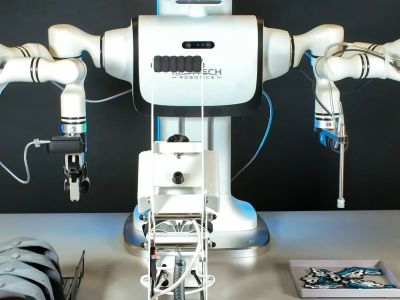 Dex | Richtech Robotics | Wheeled dual-arm robot with four cameras and Thor | Factory and logistics trials | Sold through the maker's sales team |
| #5 |  Gino 1 | Geek+ | Thor with 7-DoF arms and tactile three-finger hands | Warehouse box handling | Launched in 2026, no public order path |
| #6 |  D01 | Sharpa | Whole-body tactile skin and Thor main processor | Fine hand work and data capture | Price on request |
| #7 |  Agile ONE SN | Agile Robots | Thor plus preloaded NVIDIA GR00T software | Humanoid AI research | Scheduled for early 2027 |
| #8 |  ugo Nova | ugo | 22 DoF wheeled upper body with Thor | Pick and place in Japan | Mass production planned for 2027 |
Only the Vega 1 Pro lists a lead time you can plan around today. For everything else, confirm the date and the exact Thor module with the maker before you budget.
Explore the Robots

Vega 1 Pro
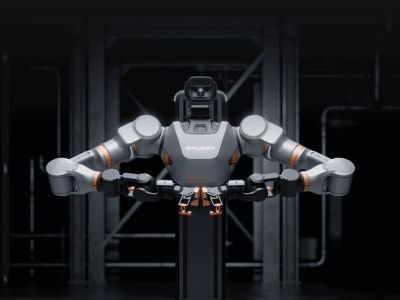
The Vega 1 Pro ranks first because Dexmate lists Jetson AGX Thor in its specs and sells the robot with a stated four-week lead time, the most direct route on this list. It is a wheeled humanoid from Santa Clara with two 7-DoF arms that each carry 5 kg in any pose, a 3-DoF torso that lifts the arms to 2.2 m and folds so the robot passes through a standard door. It has 24 degrees of freedom in total, weighs 135 kg and runs for 20 hours. Developers get Python, C++ and Rust interfaces and simulation-ready models. Its limit is that it rolls on wheels, so it cannot climb stairs. It suits research labs and AI teams that need to start collecting data quickly.

Booster T2
The Booster T2 ranks second because it is in production and built around NVIDIA's Thor T5000, though buyers must go through a purchase inquiry. It is a walking robot that stands 140 cm tall and weighs 42 to 43 kg, with 31 degrees of freedom, an optional 12-DoF hand set and joints that deliver 140 Nm of peak torque. Booster lists 2,070 teraflops of Thor compute, walking at 3 m/s, recovery from a fall without help and full-body teleoperation that mirrors a human. The limit is a runtime of about 2 hours of active walking, so test sessions need spare batteries. It suits university labs and developers who want a capable walking platform.

Lumi
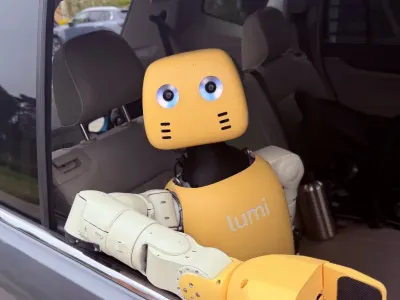
The Lumi ranks third because Lightberry lists Jetson Thor with 64 GiB of memory on its own page and takes preorders for 100 Founder Edition units that ship in 2026, secured by a $200 refundable deposit. It is a yellow, rounded humanoid from San Francisco that stands 1.3 m tall, weighs about 40 kg and has 34 degrees of freedom. It sits on a Unitree G1 base, with Lightberry cameras, microphones, speakers and compute added. It holds long conversations, tells stories, takes photos and guides visitors. The limit is a battery that lasts 2.5 to 3.5 hours. It suits events, shops and venues that want a talking robot with a face.

Dex
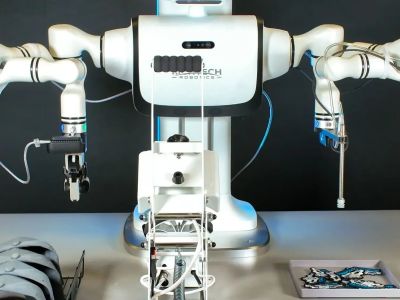
The Dex ranks fourth because Richtech Robotics named Jetson Thor as its accelerator when it unveiled the robot in October 2025, and the company sells it through its sales team. It is a wheeled industrial humanoid that stands 137 cm tall, weighs 55 kg and combines a mobile base with two arms that take interchangeable hands, clamps or tools. Four cameras handle navigation and tasks, and it was shown at CES 2026. It travels up to 1 m/s, runs for 4 hours while driving and works continuously when parked on mains power. The limit is that the maker still describes industrial trials rather than mass deployment. It suits factory and logistics teams running a pilot.

Gino 1
The Gino 1 ranks fifth because Geek+ launched it in February 2026 with Jetson Thor and called it ready for mass production, but we found no public way to order one. It is a warehouse humanoid that stands 168 cm tall and weighs 63 kg. It has dual 7-DoF force-controlled arms and three-finger hands with 7 active degrees of freedom each, plus 3D LiDAR, multi-eye vision and tactile sensing. Geek+ ties it to its own Brain platform and its warehouse robot fleet. It runs 8 hours and moves at 1.5 m/s. The limit is that buyers must approach Geek+ directly. It suits large logistics operators already using Geek+ systems for box handling and inspection.

D01
The D01 ranks sixth because Sharpa lists an NVIDIA Jetson Thor main processor but sells only on request, after unveiling the robot at IROS 2026 in Pittsburgh. It pairs two Sharpa Wave dexterous hands with 7-DoF arms and a four-layer tactile skin across the body, with 0.2 N force resolution sampled at 100 Hz. It sits on a pedestal with a height-adjustable torso from 1,109 to 1,624 mm and weighs about 40 kg without its optional chassis. Its end effectors move above 10.5 m/s with ±0.2 mm repeatability. The limit is that it is mostly stationary. It suits labs working on delicate, contact-heavy tasks and teleoperated data capture.

Agile ONE SN
The Agile ONE SN ranks seventh because Agile Robots confirms Jetson Thor on its product page but schedules availability for the beginning of 2027. The Munich company launched it with NVIDIA at GTC Berlin on October 21, 2026 as a compact reference platform. It stands 1.4 m tall, weighs 43 kg and has 31 degrees of freedom in the body, plus two Wuji tactile five-finger hands with 20 degrees of freedom each. Thor runs alongside an Intel i3 N305 base module, and NVIDIA's GR00T 1.7 software comes preloaded. Joints reach 140 Nm and each arm carries 3 kg. The limit is the wait. It suits research groups that want NVIDIA's full training workflow from day one.

ugo Nova
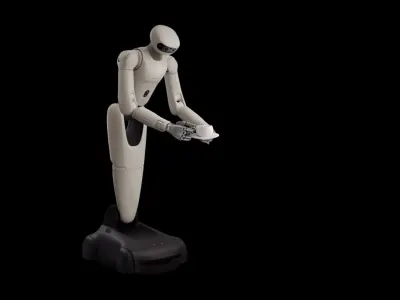
The ugo Nova ranks eighth because ugo's announcement names Jetson Thor but mass production is planned for 2027. It is a Japanese-made semi-humanoid from Tokyo, announced in September 2026, with a white head, a face display and two 7-axis arms ending in two-finger hands. The body has 22 degrees of freedom and a 4-axis waist. It rides on a four-wheel mecanum base that moves in any direction and weighs about 100 kg. A 350 mm lifter and 843 mm arm reach let it pick and place across a wide area, and both arms together lift up to 10 kg. It runs about 6 hours. The limit is its prototype stage. It suits Japanese warehouses and shops planning ahead.
How to Choose Between Them
Start with what you need the robot to do. Thor is a computer, not a skill. It gives a robot room to run big vision and language models locally, but the arms, hands, battery and software decide whether it can do your task. A wheeled robot such as the Vega 1 Pro or the Dex is steadier and runs longer, while a walking robot such as the Booster T2 or the Agile ONE SN can cross floors that have steps and gaps.
Next, check the real compute. Every robot here names Jetson Thor, but module sizes differ. Lightberry lists the Lumi with 64 GiB of memory, while NVIDIA's top Thor module carries 128 GB. Ask the maker which module is inside, whether a Thor upgrade is standard or optional, and whether you get direct access to the GPU for your own models. A robot you cannot program freely is a much weaker buy for a research team.
Then look at availability honestly. Only the Vega 1 Pro has a published order page and lead time. The Lumi is a deposit-backed preorder for the first 100 units. The Booster T2, the Dex and the Sharpa D01 are sold through the maker's sales team. The Gino 1 has been launched but has no public order path, and the Agile ONE SN and ugo Nova are scheduled for 2027. Treat any date as a plan until a unit is in your lab.
Check the power and runtime too. The Vega 1 Pro lists 20 hours of operation, the Gino 1 lists 8 hours, the ugo Nova about 6 hours, the Dex 4 hours when driving, the Lumi 2.5 to 3.5 hours and the Booster T2 about 2 hours of active walking. A powerful computer drains a battery quickly, so match the runtime to your shift or test session before you commit.
Finally, think about support. A research robot with a lab-friendly team can be more useful than a bigger machine with no local help. Ask who services the robot in your country, how software updates are delivered and what happens to your data. For a short pick: choose the Vega 1 Pro to start work in weeks, the Booster T2 for a walking research platform, the Lumi for public-facing demos, the Gino 1 for warehouse trials and the Agile ONE SN if you can wait for NVIDIA's GR00T tools.
How We Ranked These Robots
We started from every live humanoid on Origin of Bots and kept the ones where the maker's own page, or launch coverage of the maker's announcement, names NVIDIA Jetson Thor as the onboard computer. For each company we used its newest humanoid on the site. We left out robots where Thor appears only as an optional upgrade from a third party or only inside a partner reference design.
The order follows how directly a buyer can get the robot. First come robots with an order page and a lead time, then robots in production that are sold through a sales team, then robots on preorder or shown with no public order path, and last robots scheduled for 2027. Within each step we put the robots whose Thor listing is on the maker's own page ahead of those confirmed only by launch coverage.
We did not rank by speed, price or height, since none of them tells you how well a robot uses Thor. We also left out Galbot G1, whose maker page lists an older Jetson module, and the Humanoid HMND 01, Atlas and Digit, where Thor is described as a plan or a prototype stage rather than a shipping product. Thor figures are NVIDIA's own peak numbers, so real performance on a robot depends on the model it runs.
Frequently Asked Questions
What is NVIDIA Jetson Thor?
Jetson Thor is a robot computer from NVIDIA that went on sale in August 2025. It uses a Blackwell GPU and, in its top module, 128 GB of memory, and NVIDIA rates it at up to 2,070 FP4 teraflops. That peak figure is for low-precision AI math. It lets a robot run large vision and language models on its own body.
Which humanoid robots use Jetson Thor today?
Eight models name it: Dexmate's Vega 1 Pro, Booster's T2, Lightberry's Lumi, Richtech's Dex, Geek+'s Gino 1, Sharpa's D01, Agile Robots' ONE SN and ugo's Nova. Ordering differs a lot between them, from a store page to a 2027 schedule, so check each maker's status before you plan around one.
Can I buy a Jetson Thor humanoid robot right now?
Yes, in a few cases. Dexmate sells the Vega 1 Pro with a four-week lead time. Lightberry takes preorders for the Lumi with a refundable deposit, and Booster and Richtech sell through their sales teams. The Agile ONE SN and ugo Nova are scheduled for 2027, so you cannot get them yet.
Is a Thor humanoid better than one with an older Jetson?
Not automatically. Thor gives more room to run big AI models on the robot itself, which helps with vision, language and learning from demonstrations. But the arms, hands, balance and software decide what a robot can do. Some robots, such as Galbot's G1, still use an older Jetson module and work well for their tasks.
Do all Thor robots use the same 128 GB module?
No. NVIDIA's top Thor module has 128 GB of memory, but makers can choose other versions. Lightberry lists the Lumi with 64 GiB. Always ask a maker which Thor module is inside, since memory limits the size of the AI models the robot can run.
Does Thor make a humanoid robot walk better?
Not on its own. Walking is handled by motors, sensors and balance software that run in real time. Thor mainly adds computing room for vision and AI models. A wheeled robot with Thor, such as the Vega 1 Pro, can be steadier than a walking robot that has a weaker body.
Why are some Thor humanoids not for sale yet?
Many are announced as prototypes or reference platforms first. The Agile ONE SN is scheduled for early 2027 and the ugo Nova for mass production in 2027. Makers often show a robot at a trade event, then spend months on testing and parts supply before they ship.
Sources
- Vega 1 Pro Profile
- Booster T2 Profile
- Lumi Profile
- Dex Profile
- Gino 1 Profile
- D01 Profile
- Agile ONE SN Profile
- ugo Nova Profile
- NVIDIA Blackwell-Powered Jetson Thor Now Available, Accelerating the Age of General Robotics
- Meet Vega 1 Pro
- Booster T2 Brings Nvidia Thor Compute to Humanoid Robotics
- The world’s most interactive robot
- Richtech Robotics Offers First Look at Dex: A Mobile Humanoid Robot for Real-World Work
- Geek+ Unveils Gino 1 Warehouse Humanoid Robot
- The humanoid reference platform: Agile ONE SN
Related Articles

Indian Humanoid Robots in 2026: Every Made in India Model Ranked
11/8/2026
Humanoid Robots You Can Actually Buy Right Now in 2026, and How to Order
11/7/2026
Which Humanoid Robots Can Do a Backflip? Every Flipping Robot Compared (2026)
11/5/2026

Humanoid Robots That Can Climb Stairs in 2026: Step Heights and Loads Compared
11/11/2026
Best Dancing Humanoid Robots in 2026, Ranked by Real Performances
11/10/2026
Humanoid Robots With Swappable Batteries in 2026: Which Can Work Around the Clock?
11/9/2026