Teleoperated Humanoid Robots in 2026: Which Ones a Person Can Drive Remotely



The Short Answer: Reachy 2 and Vega 1 Pro
Seven humanoid robots on this list can be driven by a person who is somewhere else. The clearest buying choices are the Reachy 2 from Pollen Robotics and the Vega 1 Pro from Dexmate. Reachy 2 comes with a documented VR kit: you put on a headset, hold hand controllers and the robot copies your arm and head movements. Vega 1 Pro is in production and can be driven with VR or an exoskeleton, a wearable frame that reads your arm motion.
Teleoperation means a human sits at a control station and the robot acts as their hands and eyes. It is used for two jobs: doing work in places a person should not go, and recording demonstrations that teach a robot to do the task alone later. The robots below range from lab machines you can order today to hazard robots that are still in paid pilots. We ranked them by how clearly the maker publishes the control setup and how directly you can get the robot.
Quick Overview
Here is how the seven robots compare on the control method, in rank order.
| Rank | Robot | Manufacturer | Key Strength | Best For | How the Operator Controls It |
|---|---|---|---|---|---|
| #1 | 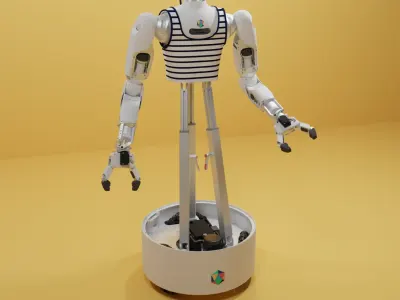 Reachy 2 | Pollen Robotics | Open-source, documented VR kit | AI and robotics labs | VR headset with hand controllers |
| #2 |  Vega 1 Pro | Dexmate | 24 degrees of freedom, 2.2 m reach | Mobile manipulation research | VR or exoskeleton |
| #3 |  AgiBot G1 | AgiBot | Height adjusts from 130 to 180 cm | Large-scale data collection | VR or motion capture |
| #4 |  Robody | Devanthro | In private homes since early 2024 | Remote presence at home | VR headset |
| #5 |  Roger | Minerva Humanoids | Haptic feedback to the operator | Hazardous sites | Headset, body trackers, haptics |
| #6 |  Avatar | Avatar Robotics | Trained operators step in | Warehouse picking and packing | Remote operators on staff |
| #7 |  Mirsee Robotics MH3 | Mirsee Robotics | 10-hour runtime, 31 degrees of freedom | Factory skilled labour | Remote teleop plus AI control |
The first four are the clearest to evaluate today, because their makers publish what the operator wears and how the robot is supplied.
Explore the Robots

Reachy 2
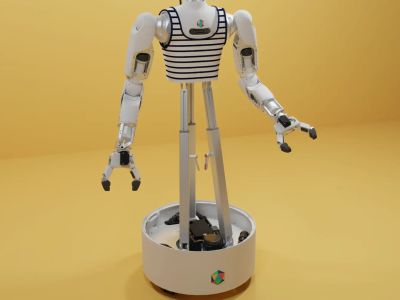
Reachy 2 ranks first because Pollen Robotics documents the whole operator setup. You need a VR headset with hand controllers, a network link and the Reachy 2 teleoperation app. Your arm and head movements become the robot's arm and head movements, and its stereo cameras show you the room. The arms have 7 degrees of freedom each and carry about 3 kg per arm. The robot is 136 to 166 cm tall, weighs up to 50 kg and runs ROS 2 with a Python SDK. Sessions can also record demonstration data for training machine learning models. Pollen presents it as a bimanual mobile manipulator for AI and robotics labs. It suits research teams that want a robot they can drive today and then teach to act alone.

Vega 1 Pro
Vega 1 Pro ranks second because its maker says it is in production and can be driven by VR or an exoskeleton, with both used to record demonstrations. The body is wheeled with two 7-DoF arms, a 3-DoF torso, a 3-DoF head and a 4-DoF base, 24 degrees of freedom in total. It reaches from the floor to 2.2 m, carries up to 5 kg per arm, weighs about 135 kg and lists about 20 hours of runtime. NVIDIA Jetson AGX Thor handles onboard compute. Dexmate sells it to developers and researchers through its shop. It has no legs, so it cannot climb stairs. It suits teams that want to collect arm and reach data for mobile manipulation.

AgiBot G1
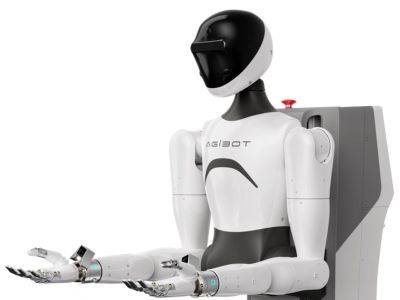
AgiBot G1 ranks third because AgiBot states that it offers millisecond-latency VR and motion-capture remote operation, and records full-body joint data while you drive it. The page names no headset or capture suit, so ask which are included. The robot adjusts from 130 to 180 cm, weighs 150 kg and lists more than 4 hours of runtime. It carries a six-axis force sensor on each arm, three RGB-D cameras and five fisheye cameras. Onboard compute is a Jetson AGX Orin 64GB. AgiBot lists large-scale production with immediate delivery and routes requests through a contact form. It suits companies that need many operators to record training data on the same robot design.

Robody
Robody ranks fourth because Devanthro has put it in real homes since early 2024 and says a remote person drives it by VR. The operator sees through the robot's eyes, hears what it hears and speaks with their own voice, over 5G and Wi-Fi 6. Onboard AI handles routine tasks while the human adds judgment. Robody is 1.65 m tall, weighs 60 kg and lists 6 hours of runtime. It is aimed at fetching items, helping with meals and keeping a family member or carer present. Devanthro does not describe the hand tracking or the operator pool, so a buyer should ask about both. It suits families and care providers who want a person, not a machine, in charge of the robot.

Roger
Roger ranks fifth because Minerva Humanoids has published a clear control concept but is still in paid pilots. The robot's cameras send the worksite view to the operator's headset, trackers on the operator's body send motion to Roger and haptic feedback returns the feeling of contact. Onboard software handles balance, walking and recovery from falls. Minerva built it light enough to ride in a passenger seat and aims it at gas leaks, fire watches, gauge reading and ordnance disposal. Modular payloads are listed as coming soon and harsh-environment features are still being built. The company raised 10 million dollars at launch. It suits energy, defence and emergency teams that want a person out of the danger zone.

Avatar
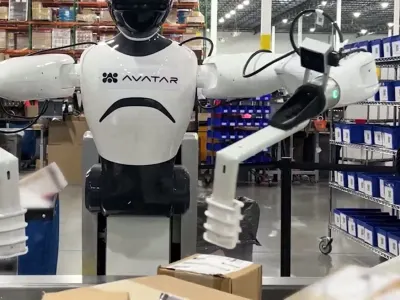
Avatar ranks sixth because the maker describes the operators but not the gear they use. Avatar Robotics says trained remote operators step in when its AI is not ready, and the same work records training data so the robots need less help over time. The robots run in warehouses doing sorting, packing, kitting, picking and carting for third-party logistics, e-commerce, pharma and beauty, food and beverage and apparel. Customers do not buy a robot. They pay by the hour for output and Avatar supplies the hardware and operators. The page gives no latency figure and no named customers. It suits warehouse managers who want a task done without running a robot team.

Mirsee Robotics MH3
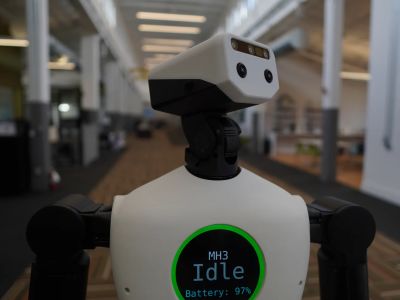
Mirsee Robotics MH3 ranks seventh because the maker says it combines AI autonomy with remote teleoperation but gives little detail on the operator station. The page lists remote teleop and AI control as features, 31 degrees of freedom, a 10-hour runtime, wireless charging, power-off brakes and strong hands and arms. Mirsee says it is progressing through phased deployment with strategic manufacturing partners and considers new partners selectively. Its client list includes Eclipse Automation, Stanford and the National Research Council of Canada, though the page does not say which clients use MH3. The page does not describe VR or haptic gear. It suits manufacturers who want a robot that can work alone and accept a remote person to help when needed.
How to Choose Between Them
Start with the reason you want remote control. If you want to collect training data for robot learning, pick a research robot with a documented operator kit, such as Reachy 2, Vega 1 Pro or AgiBot G1. If you want a person to be present in a home, pick a robot built for that, such as Robody. If the job is dangerous, look at Roger. If you only want work done and do not want to run operators yourself, look at a service such as Avatar.
Check what the operator actually uses. VR headsets give the operator a first-person view, but they can cause motion sickness when the network is slow. An exoskeleton or body trackers give finer control of the arms. Haptic feedback sends a sense of touch back to the operator, which matters when the robot has to handle fragile or unknown objects. Ask the maker which of these are included in the box and which are extra.
Look at reach and weight next. A wheeled body such as the one on Vega 1 Pro is steadier and runs for hours, while a walking body can cross steps and gaps but drains the battery sooner. Payload also differs a lot: Reachy 2 lists about 3 kg per arm and Vega 1 Pro lists up to 5 kg per arm. Match these numbers to the heaviest object your task needs to lift.
Then check how the robot is sold. Vega 1 Pro is in production and orderable through the maker. AgiBot G1 lists immediate delivery on request. Reachy 2, Roger and Mirsee MH3 are sold through contact with the maker. Robody is placed in home pilots, and Avatar offers its robots as an hourly service. Treat any delivery date as a plan until the robot is in your building.
Finally, ask about autonomy. Many of these robots mix remote control with onboard skills, so the operator takes over only when the robot cannot cope. That lowers the operator workload and lets one person supervise more work. A short pick: choose Reachy 2 for an open research kit, Vega 1 Pro for mobile manipulation, Robody for home presence, Roger for hazardous sites and Avatar if you want a warehouse task handled for you.
How We Ranked These Robots
We started from every live humanoid on Origin of Bots and kept the ones where the maker names remote operation as a way to control the robot. We then read each maker page, and the robot documentation where it exists, to see how the operator controls the robot: VR headset, exoskeleton, motion capture, body trackers or trained remote staff. Robots that only mention a handheld remote controller were left out, because that is driving, not teleoperation.
The ranking weighs two things. First, how clearly the maker publishes the control setup, so a documented VR kit ranks above a general mention of teleoperation. Second, how directly someone can get the robot or the service: in production and orderable ranks above a pilot, and a pilot ranks above a robot with no public order path. Ties were broken by the newest generation from the same maker.
We used only values that makers publish. None of these makers publishes a latency number in a way we could compare, so we do not rank on latency. Booster T2, Sharpa D01 and KEENON XMAN-L1 are not listed because their maker pages did not describe the operator setup in enough detail. A robot can move up this list as makers publish more.
Frequently Asked Questions
What is a teleoperated humanoid robot?
It is a humanoid robot that a person controls from another location. The operator wears a headset, a body-tracking suit or an exoskeleton, and the robot copies their arm and head movements while sending camera views back. Some robots add onboard AI so the operator only steps in when needed.
Which humanoid robot can I buy and teleoperate today?
Vega 1 Pro from Dexmate is the clearest case: its maker says it is in production and can be driven by VR or an exoskeleton, and sells it through its shop. AgiBot G1 lists immediate delivery on request, and Reachy 2 is sold through Pollen Robotics with a documented VR kit.
Do I need a VR headset to control these robots?
For most of them, yes. Reachy 2 uses a VR headset with hand controllers, Robody uses VR and Roger uses a headset with body trackers. Vega 1 Pro also offers an exoskeleton as an alternative, and AgiBot G1 lists VR or motion capture.
Is teleoperation the same as an autonomous robot?
No. A teleoperated robot follows a person in real time, while an autonomous robot decides what to do on its own. Several robots here mix both: onboard software handles balance or navigation and the human takes over for hard tasks, which is often called shared autonomy.
Why record teleoperation data at all?
Recorded sessions show a robot how a person does a task, and that data can train an AI model to repeat the task alone. Reachy 2, Vega 1 Pro and AgiBot G1 all list demonstration or joint data recording as part of operation.
Can a teleoperated robot be used in a home?
Yes, Robody is the example. Devanthro says its robots have been in private homes since early 2024, and a remote person sees, hears and speaks through the robot. Ask the maker how operators are scheduled and what happens to the video and audio data.
Sources
Related Articles
Humanoid Robots With Swappable Batteries in 2026: Which Can Work Around the Clock?
11/9/2026

Indian Humanoid Robots in 2026: Every Made in India Model Ranked
11/8/2026

Humanoid Robots You Can Actually Buy Right Now in 2026, and How to Order
11/7/2026

Humanoid Robots Running NVIDIA Jetson Thor in 2026: Which Ones Ship?
11/12/2026

Humanoid Robots That Can Climb Stairs in 2026: Step Heights and Loads Compared
11/11/2026
Best Dancing Humanoid Robots in 2026, Ranked by Real Performances
11/10/2026