Mirokaï vs TIAGo Pro at a glance
Both Mirokaï and TIAGo Pro are sold through a sales quote. Mirokaï is lighter at 26 kg, compared with 95 kg for TIAGo Pro. TIAGo Pro lasts longer on a charge, about 8–10 hours against 4 hours for Mirokaï. TIAGo Pro is quicker, with a top speed of 1.5 m/s versus 0.9 m/s for Mirokaï. Mirokaï has more degrees of freedom (26 against 23 for TIAGo Pro), which allows finer movement.
| Key specs | Mirokaï | TIAGo Pro |
|---|---|---|
| Price | $30,000 | €29,000–€59,000 |
| Height | 123 cm | — |
| Weight | 26 kg | 95 kg |
| Top speed | 0.9 m/s | 1.5 m/s (stronger) |
| Runtime | 4 hours | 8–10 hours (stronger) |
| Degrees of freedom | 26 (stronger) | 23 |
| Payload | 1.5 kg | 3 kg (stronger) |
| Availability | Order via sales quote | Order via sales quote |
Last updated:
Which one fits your use?
Based on the uses each robot is built and marketed for. Open a use to see the specs that matter for it.
| Comparing for… | Mirokaï | TIAGo Pro |
|---|---|---|
| Not marketed | Suited | |
| Not marketed | Suited | |
| Not marketed | Suited | |
| Suited | Not marketed | |
| Suited | Suited | |
| Suited | Not marketed |
- Only Mirokaï is marketed for home help and elder care and healthcare settings.
- Only TIAGo Pro is marketed for factory and manufacturing work, research labs and education and training.
- Both suit hospitality, retail and public-facing roles, so compare the specs for that use.
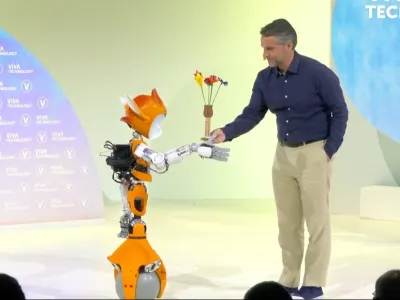
Mirokaï is presented by Enchanted Tools as a lightweight, interactive humanoid aimed at social logistics and HRI-focused service tasks; it is compared here to assess how its compact, ball‑based mobility, multichannel perception suite, and interaction‑first design position it against established mobile manipulators. The comparison highlights Mirokaï’s emphasis on social awareness, visual SLAM navigation, a large array of time‑of‑flight and RGB‑D cameras, and a design optimized for guiding, carrying light loads, and repetitive manipulation in public spaces.
TIAGo Pro from PAL Robotics is an established humanoid mobile manipulator targeted at research, industrial prototyping, healthcare assistance and HRI, and it is compared here to measure differences in robustness, payload, and industrial sensor suites. The comparison highlights TIAGo Pro’s heavier build, larger payload and battery footprint, laser‑based SLAM with LiDAR, and ROS 2–centric software ecosystem designed for manipulation, navigation and integration into labs and facilities.
Detailed Analysis
Design & Build Quality
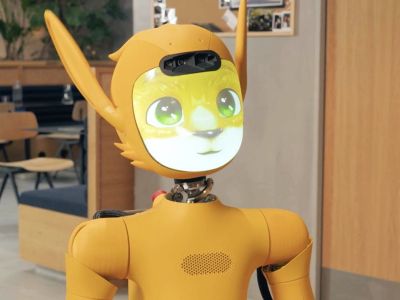
Mirokaï
Mirokaï is a compact humanoid with dimensions 123 cm x 52.5 cm x 50 cm and a mass of 26 kg, using a ball‑based mobile platform and animation‑style exterior focused on social presence and lightweight operation. TIAGo Pro is physically larger and heavier with variable height 120–155 x 50 x 72 cm and mass ~95 kg, built as a robust mobile manipulator with conventional wheeled base and industrial‑grade structural components. The two platforms reflect different tradeoffs: Mirokaï emphasizes low mass and expressive form for public interaction, while TIAGo Pro emphasizes structural heft and payload capacity for manipulation and prototyping. Materials and joint architectures differ accordingly, with Mirokaï optimized for safe social contact and TIAGo Pro for sustained manipulation workloads.
Mobility & Navigation
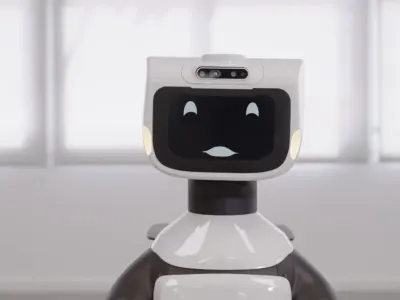
TIAGo Pro
Mirokaï navigates indoors using Visual SLAM (VSLAM) with social awareness and reports speeds around 3.2 km/h (0.8–0.9 m/s) on a spherical/omnidirectional base enabling agile, human‑paced movement. TIAGo Pro uses laser‑based SLAM (LiDAR) with longer‑range self‑localization and obstacle avoidance and a top speed of 1.5 m/s (5.4 km/h), reflecting a design for faster transit and long‑range mapping in mapped facilities. Mirokaï’s VSLAM and social navigation optimize proxemic behavior and interaction in crowded public spaces, whereas TIAGo Pro’s LiDAR SLAM favors accurate mapping, loop closure and navigation to arbitrary map points. Both support autonomous navigation and teleoperation, but sensor modalities and base designs produce different operational envelopes.
Sensors & Perception
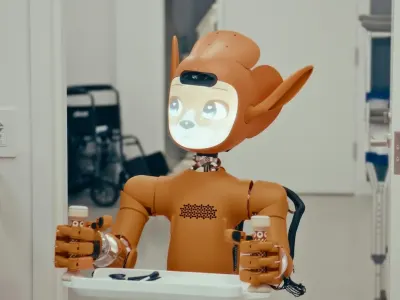
Mirokaï
Mirokaï carries a dense multi‑camera and proximity array (2 RGB‑D cameras, 2 infrared cameras, 9 time‑of‑flight cameras, 6 ultrasound sensors, 4 microphones, 3 IMUs, torque sensors and hand contact/Hall sensors) to enable 360° perception and rich HRI capabilities. TIAGo Pro bundles 2x LiDAR units (10–25 m, 360° FoV), an RGB‑D camera (Intel RealSense D435), IMU, encoders, force/torque sensors at the wrist and joint torque sensing, plus a 4‑mic array and motor current feedback for situational awareness. Mirokaï’s sensor set targets multimodal social perception and close‑range object handling, while TIAGo Pro’s LiDAR and wrist F/T sensors prioritize mapping accuracy and manipulation feedback. Both platforms provide microphones and IMUs, but their complementary sensor choices reflect different perception tradeoffs.
AI Capabilities
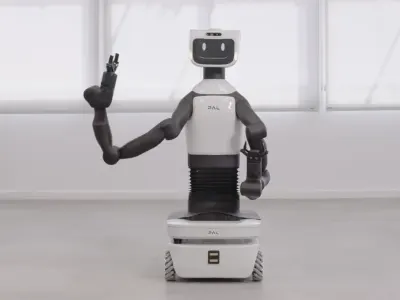
TIAGo Pro
Mirokaï uses onboard learned behaviors, VLMs and multi‑LLM integrations for real‑time speech recognition, multilingual dialogue and social awareness tied to its VSLAM navigation and grasping routines. TIAGo Pro relies on ROS 2–based frameworks supporting learned behaviors, teleoperation and autonomous navigation/manipulation workflows via standard ROS tooling and user‑supplied models. Mirokaï’s stack is oriented toward integrated HRI, expressive animation and out‑of‑the‑box interaction primitives, while TIAGo Pro emphasizes modularity for research and deployment with ros_control and ros2_controllers for custom AI stacks. Both support programming in Python and C++ and can execute learned behaviors, but Mirokaï foregrounds VLM/LLM interaction features versus TIAGo Pro’s developer‑centric ROS 2 ecosystem.
Battery & Power Efficiency
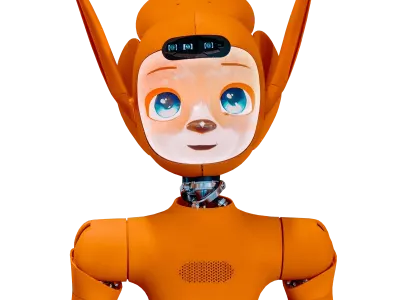
Mirokaï
Mirokaï is optimized for repeated short public‑space missions, while TIAGo Pro is sized for longer operational demands and heavier loads. Specific runtime per charge is not provided in the source data, so direct per‑charge endurance comparisons cannot be made from the supplied specs. Both indicate typical battery service life rather than single‑use runtime metrics. Mirokaï runs for 4 hours per charge and recharges in 60 minutes. TIAGo Pro runs for 8–10 hours per charge and recharges in 4–5 hours. Mirokaï carries 1.5 kg per arm and can deadlift 15 kg. TIAGo Pro has 23 degrees of freedom, carries 3 kg per arm and can deadlift 3 kg.
Use-Case Suitability
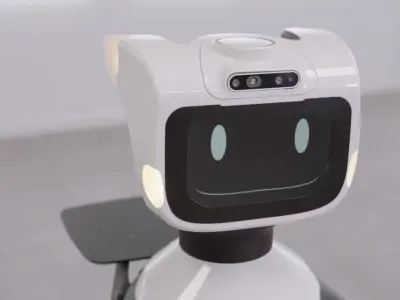
TIAGo Pro
Mirokaï is specified for guiding and informing visitors, carrying trays and light packages, repetitive manipulation tasks and social engagement in public spaces such as hotels, hospitals and airports. TIAGo Pro is specified for human‑robot interaction, pick‑and‑place, telepresence, healthcare assistance and lab prototyping, supporting heavier manipulation and research integrations. For pure social logistics and lightweight HRI, Mirokaï’s compact form and perception set align closely with those applications, while TIAGo Pro better fits scenarios requiring higher payloads, manipulation robustness and ROS‑driven integration. Both support collaborative modes and emergency stop features for deployment in human environments.
Software Ecosystem
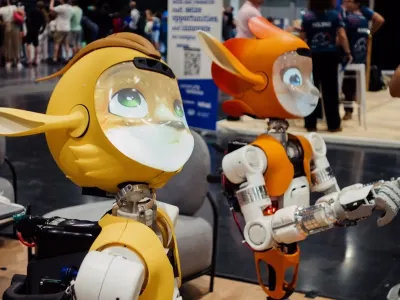
Mirokaï
Mirokaï runs a custom Linux OS with ROS 2 compatibility and provides APIs for Python and C++, with integrated VLM/LLM features and HRI primitives exposed for developers. TIAGo Pro is natively ROS 2 based, supports ros_control and ros2_controllers, and exposes navigation, manipulation and HRI APIs in Python and C++ tailored for research and industrial prototyping. The two ecosystems enable developer extension, but TIAGo Pro’s out‑of‑the‑box ROS 2 tooling and RViZ plugin support are optimized for labs and integrators, whereas Mirokaï packages additional integrated speech/VLM stacks aimed at turnkey interaction deployments.
Safety Features
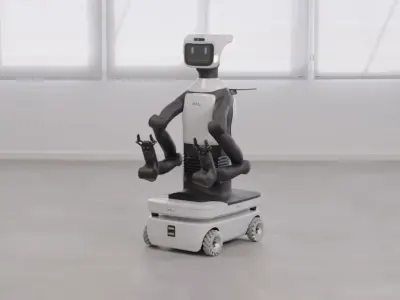
TIAGo Pro
Mirokaï includes force limiting, collision detection, emergency stop and collaborative mode features designed for safe operation around people and compliant interactions in public spaces. TIAGo Pro provides joint safety brakes, torque‑based force limiting, collision detection, emergency stop and collaborative‑mode compliance aligned with industrial safety standards. Both platforms implement multiple safety measures and force sensing for human environments, with TIAGo Pro adding mechanical joint brakes and commonly used industrial safety primitives and Mirokaï emphasizing soft compliance and proxemic behavior for social contexts.
Pricing & Value
Mirokaï
Mirokaï’s purchase price is listed at US $30,000 plus monthly maintenance fees, reflecting a service‑oriented commercial offering with ongoing support costs. TIAGo Pro’s price range is €29,000 to €59,000, reflecting configurable hardware and payload options for research and enterprise customers. The two pricing models differ in currency, range and recurring maintenance emphasis: Mirokaï cites a base price with ongoing fees while TIAGo Pro lists a broader purchase price range depending on configuration. Comparisons of value depend on required payload, sensors, software openness and intended deployment scale.
Capabilities & Operational Tasks
Head-to-head comparison of what Mirokaï and TIAGo Pro can do, their applications, and capabilities.
What Can Mirokaï & TIAGo Pro Do?
156 tasks listed for both, 2 only for Mirokaï, 7 only for TIAGo Pro.
Tap a circle area to filter the lists
Only Mirokaï
Not listed for the other robot
Shared by both
Listed for Mirokaï and TIAGo Pro
Only TIAGo Pro
Not listed for the other robot
Technical Specifications
Mirokaï and TIAGo Pro differ on 32 of the 38 specifications listed for both.
Manipulation & Load Capacity
4 Comparative Metrics
Kinematic Architecture & Dexterity
4 Comparative Metrics
Energy & Power Management
7 Comparative Metrics
Frequently Asked Questions
Can I buy Mirokaï or TIAGo Pro today?
Both Mirokaï and TIAGo Pro are sold through a sales quote.
Which is lighter, Mirokaï or TIAGo Pro?
Mirokaï is lighter at 26 kg, compared with 95 kg for TIAGo Pro.
Which uses is each robot marketed for, Mirokaï or TIAGo Pro?
Only Mirokaï is marketed for home help and elder care and healthcare settings. Only TIAGo Pro is marketed for factory and manufacturing work, research labs and education and training. Both suit hospitality, retail and public-facing roles, so compare the specs for that use.
How much does Mirokaï cost?
Mirokaï is listed at $30,000.
How much does TIAGo Pro cost?
TIAGo Pro is listed at €29,000–€59,000.
Where can I buy Mirokaï?
Mirokaï is sold through Enchanted Tools's sales team; request a quote.
Where can I buy TIAGo Pro?
TIAGo Pro is sold through PAL Robotics's sales team; request a quote.
Related Comparisons
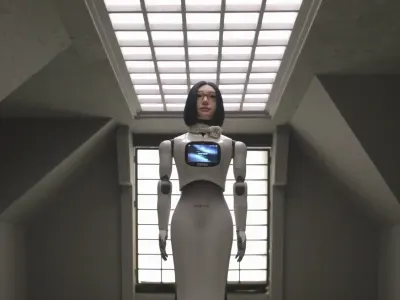
Mirokaï vs Hobbs W1(Guidance Expert)
Head-to-head: Mirokaï vs Hobbs W1(Guidance Expert) compared on bipedal balance, AI learning, dexterity, payload, and real-world service deployment.

Hiva Haiwa vs Mirokaï
In-depth comparison of Hiva Haiwa by Haier and Mirokaï by Enchanted Tools. Analyze sensors, navigation, battery, and mobility differences.
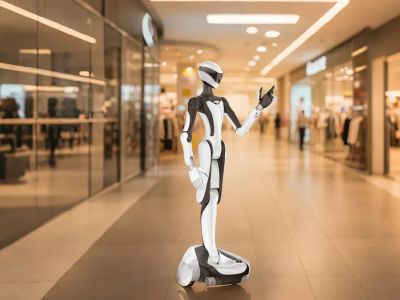
Mirokaï vs RobotEra Q5
Which robot wins? Mirokaï vs Q5 compared across sensors, navigation, speed, battery, and price for service robotics applications.
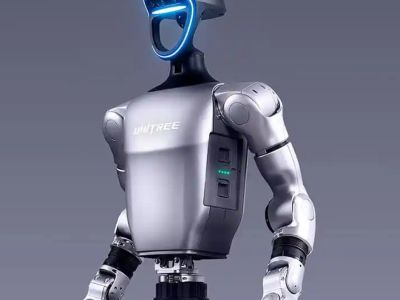
Unitree G1 vs Unitree H1-2
Unitree G1 vs Unitree H1-2: the G1 is the 35 kg lab humanoid with optional hands; the H1-2 is a taller 70 kg robot with stronger arms.
Verdicts reflect our research and opinion. Confirm specifications with the manufacturer before buying.