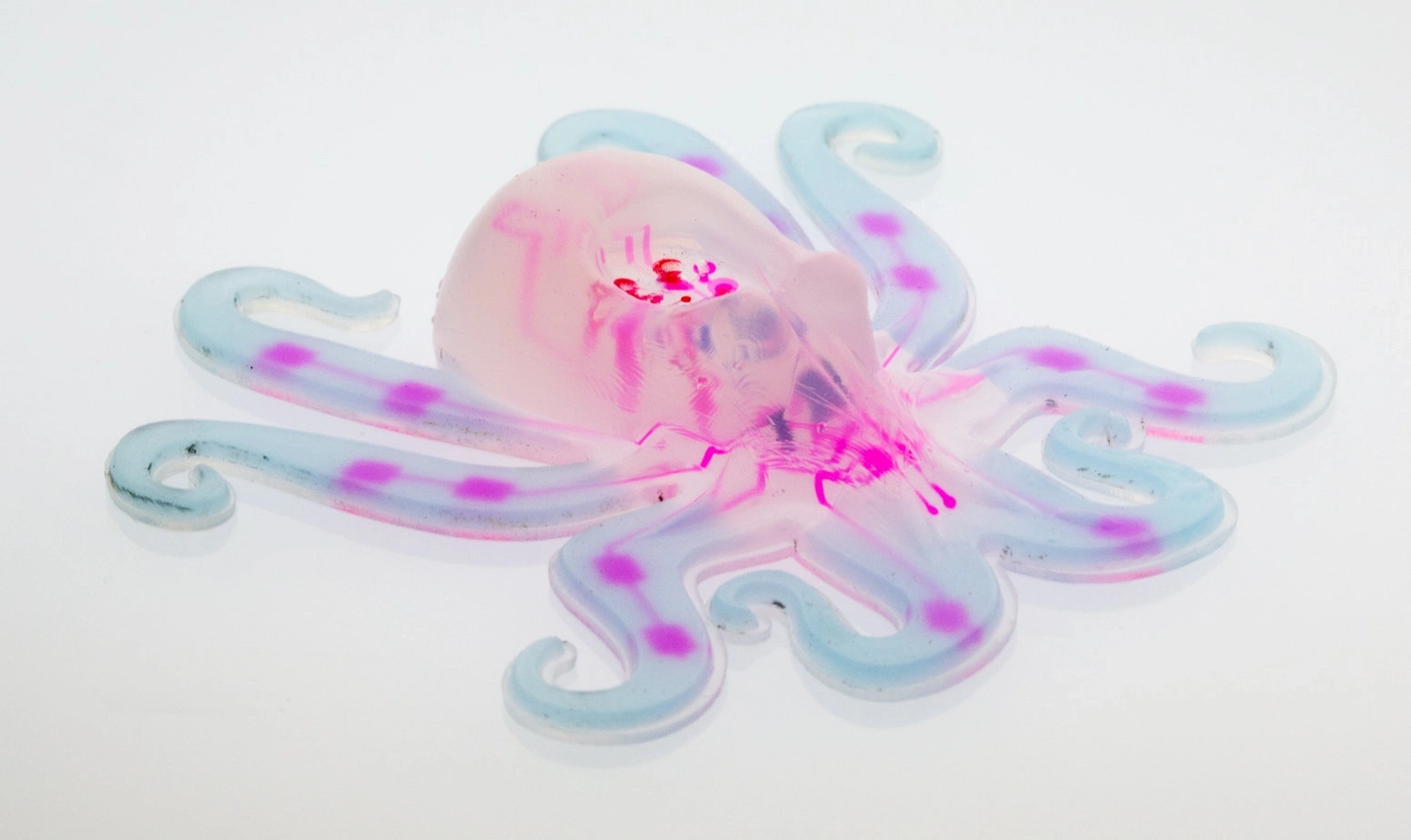
Octobot
AI ChatLast updated:
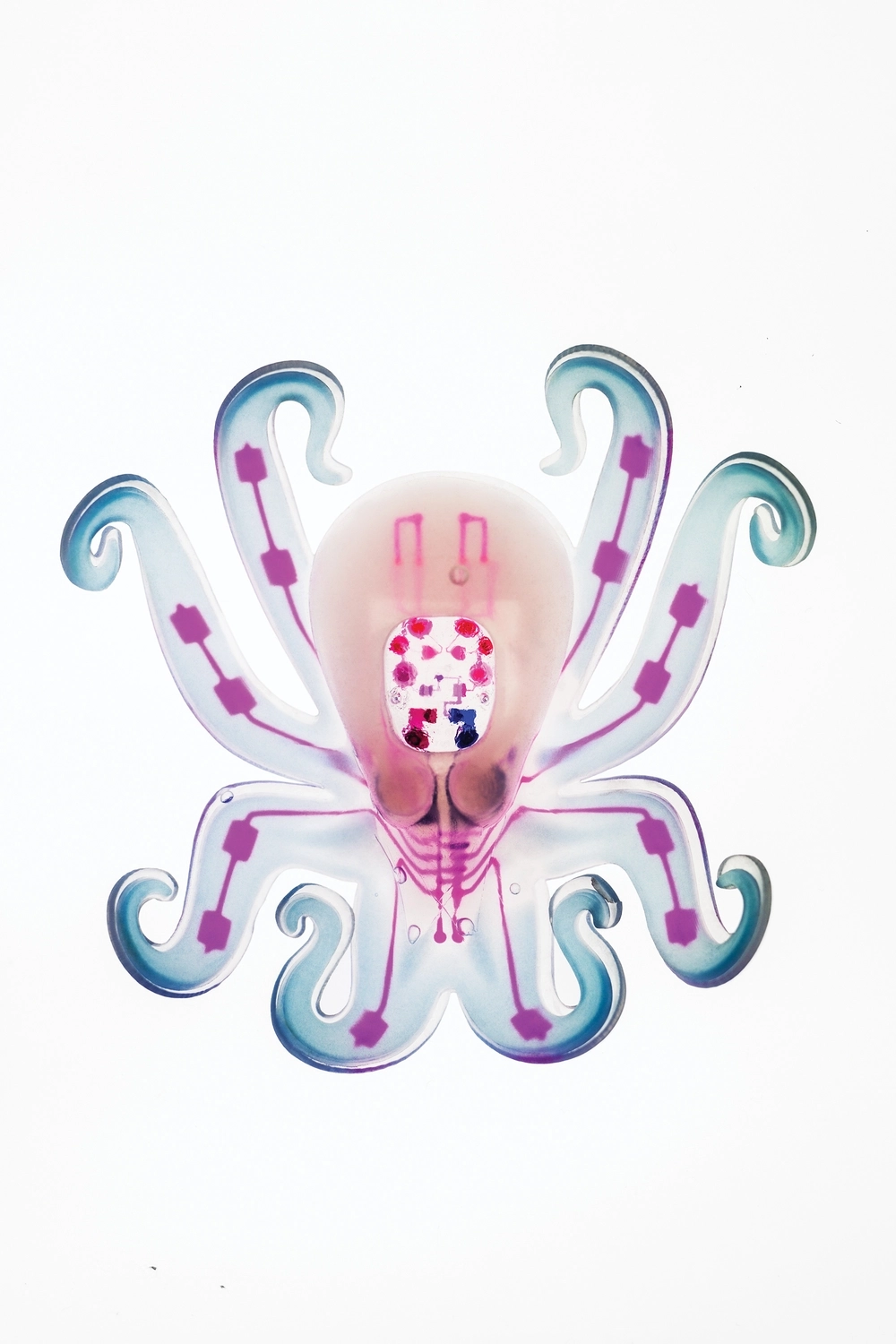
The Octobot is the world's first entirely soft, autonomous robot, inspired by octopuses and developed as a proof-of-concept for soft robotics at Harvard's Wyss Institute. It features no rigid components or electronics, powered by a chemical reaction where hydrogen peroxide decomposes into gas via a microfluidic logic circuit that acts as a soft oscillator to control gas flow for pneumatic actuation. Fabricated using 3D printing, soft lithography, and molding, it demonstrates integrated design for fuel storage, power, and actuation in a compact octopus-like body with inflatable arms. Primarily for research in soft robotics, it showcases potential for future crawling, swimming, and environmental interaction in delicate manipulation tasks like lab handling or biomedical applications, advancing untethered soft machines
Quick Overview & Key Facts
Octobot is a robot made by Harvard University (Wyss Institute) in United States, launched in 2016 and built for soft robotics research; proof-of-concept for pneumatic actuation; potential delicate object manipulation in labs or biomedical settings. Featured in “Octobot Powers Soft Robotics with 4-8 Minute Chemical Autonomy”.
- Dimensions
- Approximately 5.0 x 5.0 x 3.0 cm
- Weight
- Approx. 10–20 grams
- Mobility
- pneumatic soft limbs (inflatable arms)
- Battery runtime
- 4 to 8 minutes per 1 mL fuel charge
- Operating environment
- Lab/research environment
Image Gallery
Below images are from Harvard University (Wyss Institute)'s official sources


Review Videos
Watch expert reviews and demonstrations of this robot
Robot Specifications
Values without a Confirmed badge are compiled from public sources and may not be manufacturer-verified.
Not yet published by Harvard University (Wyss Institute): firmware version, update method and pet safety.
Latest News About Octobot
Stay updated with the latest articles and developments
More Robots from Harvard University (Wyss Institute)
Explore other robots from this manufacturer

RoboBee
Manufactured by Harvard University (Wyss Institute)
RoboBee is an autonomous flying microrobot inspired by insect biology, designed for applications requiring access to confined or hazardous spaces. Measuring half the size of a paperclip, it represents a breakthrough in micro-aerial vehicle technology. The robot features bio-inspired wing actuation, advanced sensor integration, and swarm coordination capabilities. Primary applications include search-and-rescue operations in disaster zones, environmental monitoring in inaccessible areas, artificial crop pollination, and surveillance in spaces too small or dangerous for human access. The platform demonstrates capabilities in autonomous flight, underwater-to-aerial transitions, and perching on surfaces using electrostatic adhesion.
More Robots
Discover more robots in the same category


Robots From Other Categories
Discover complementary robots from different categories that work well together

Frequently Asked Questions
Get answers to common questions about this robot
Q1. What is Octobot, and what problem is it designed to solve?
Octobot is an entirely soft, autonomous robot developed at Harvard University's Wyss Institute. It addresses limitations of rigid robots by demonstrating fully soft actuation and control for tasks requiring flexibility, such as handling delicate objects.
Q2. What are the main capabilities and key features of Octobot?
Octobot features pneumatic actuation powered by a chemical reaction converting hydrogen peroxide to gas, controlled by a microfluidic logic circuit. It has no rigid components or electronics, enabling soft, octopus-inspired movements.
Q3. Who is Octobot built for, and which industries can benefit from it?
Octobot serves as a research platform for soft robotics developers at institutions like the Wyss Institute. Potential applications include laboratory handling of fragile items and medical tasks requiring compliant manipulation.
Q4. Is Octobot a commercial product or still a research prototype?
Octobot remains a research prototype developed by Wyss Institute researchers. It demonstrates integrated soft fabrication techniques rather than serving as a market-ready device.
Q5. Is Octobot currently available for purchase, and when is it expected to ship?
Octobot is not available for purchase as it is a non-commercial research prototype. No shipping timeline has been announced by the Wyss Institute.
Q6. How does Octobot actually work in real-world environments?
Octobot operates via an onboard chemical reaction producing gas to inflate soft actuators in sequence, directed by microfluidic circuits. It functions untethered for short periods in controlled lab settings, without environmental sensing.
Q7. When was Octobot announced or officially launched?
Octobot was announced in 2016 through a publication in the journal Nature by Wyss Institute researchers. It has not undergone a commercial launch.
Q8. How is Octobot different from other robots in the same category?
Unlike rigid or hybrid robots, Octobot is fully soft with no electronics, using chemical fuel and microfluidics for autonomy. This design enables rapid fabrication via 3D printing, molding, and soft lithography.
Q9. Does Octobot require additional development or customization after purchase?
As a research prototype, Octobot is not for purchase and requires further lab development for specific applications. Researchers have iterated designs extensively during its creation.
Q10. What is the future roadmap or planned upgrades for Octobot?
Wyss Institute researchers aim to develop versions capable of crawling, swimming, and environmental interaction. Plans include integrating soft sensors to enable responsiveness beyond pre-programmed actuation.
Rating and Reviews
Share your experience and help others decide!
Loading...
User Reviews
No user reviews. Be the first one to review!
User Comments (No Login needed)
Share your thoughts, experiences, or questions about this robot.
Comments appear after moderator review.